
EPIC CONSTRUCTION MANAGEMENT LLC
Building today for tomorrow.
- SUPPORTING DETAIL
Designed for Scalable Tenant Operations
A proposed technical basis, not installed infrastructure
The Rev B design brief starts with separately maintainable blocks, overhead distribution and equipment-specific cooling. The final interior, reliability topology, operating responsibilities and recovery services must be agreed with the tenant and licensed designers.
Source basis: September 9, 2026 planning package · Not independently re-underwritten.
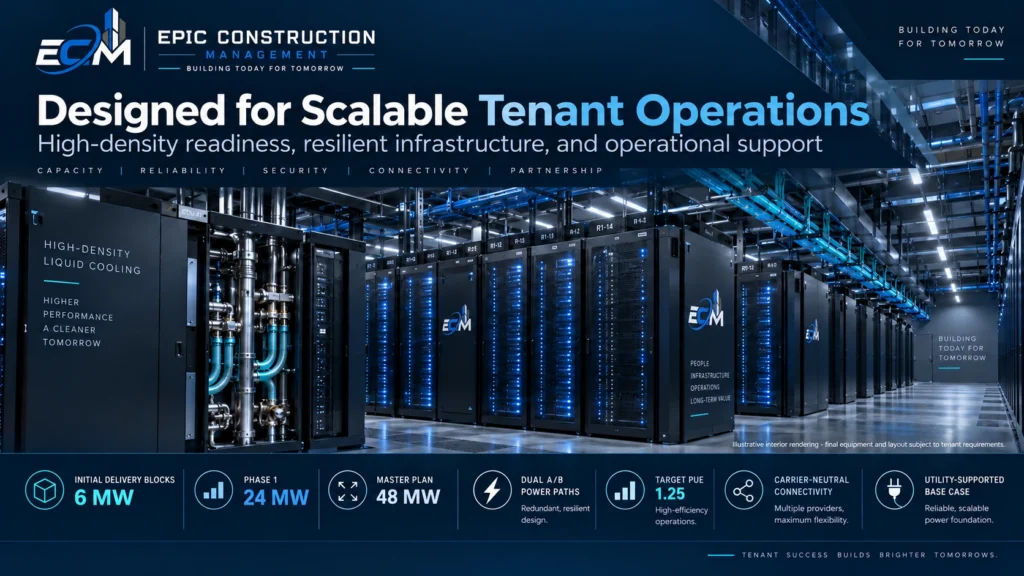
- CONCEPT INTERIOR: Equipment and service claims are proposed, not installed, certified or guaranteed. PUE is a target; off-site recovery is a separate scope.
A / B
Proposed critical-path approach
1.25
Planning annual PUE target
Separate
Off-site recovery scope
Planning data & boundaries
| System | Working design direction | Validation needed |
|---|---|---|
Cooling |
Direct-to-chip capability for AI; residual air cooling |
Heat maps, coolant, CDU ownership, redundancy and leak tests |
Heat rejection |
Compare dry systems with hybrid / chiller trim |
Weather, peak duty, water and energy performance |
Electrical |
Engineered A/B paths, UPS and standby |
Coordination, fault domains, load steps and failure tests |
Floor / overhead |
Slab / hard-floor starting alternative; overhead services |
Point/rolling loads, structural supports and access |
Security / controls |
Controlled access, monitoring and segregated facility controls |
Actual scope, staff, escalation and tenant IT demarcation |
Recovery |
Separate data copies, links and replacement compute |
Workload RPO / RTO, contracted capacity and tested restore |
Interior construction
Rev B does not assume raised flooring is mandatory. It proposes a hard-floor alternative with overhead distribution, subject to engineered loads and tenant needs. Technical ceilings/support systems and tested fire/smoke/security partitions need their own designs. No final drywall, ceiling, acoustic or fire-system specification is issued here.
Reliability is an acceptance task
Test loss of utility, loss of power/cooling modules, UPS ride-through, cooling recovery and safe live-phase isolation. Separate A/B paths do not prove independent upstream utilities. PUE 1.25 is a planning target, not a measured guarantee, and low-water or closed-loop cooling is not a zero-water promise.
Remote recovery is not another full campus by default
Define acceptable data loss (RPO) and restore time (RTO) per workload. Off-site recovery needs retained data, usable network links, credentials, restore procedures and replacement compute. The source example shows why transfer time alone does not establish total application recovery time. No recovery provider or site is selected.
Energy independence remains a separate study
The working case is grid-backed with standby support. On-site solar, extended storage and continuous diesel operation are separate studies and costs. Annual solar energy matching does not demonstrate round-the-clock adequacy, and diesel islanding still depends on imported fuel, maintenance and permitted operation.
Source trail
- Rev B model: Interior_BOD; Recovery; Energy_Screen; Budget_Boundaries.
- Original prospectus: slides 12-18, 40.
- Original document names and publication boundaries are listed in the source register.