
Picking between a design-build firm and a general contractor is one of the first real decisions an owner makes on a commercial project. The choice shapes the contract, the schedule, the budget, and who is on the hook when something goes wrong. Both routes can deliver a quality building. They get there in very different ways.
Design-build vs general contractor is a question about how the work is packaged. With design-build, the owner hires one team to draw the building and construct it. With a general contractor, the owner hires an architect first, finishes the drawings, and then hires a builder to put them in place.
This guide walks through both models the way an owner actually experiences them: who signs what, how money moves, where the schedule risk sits, and which projects fit which method.
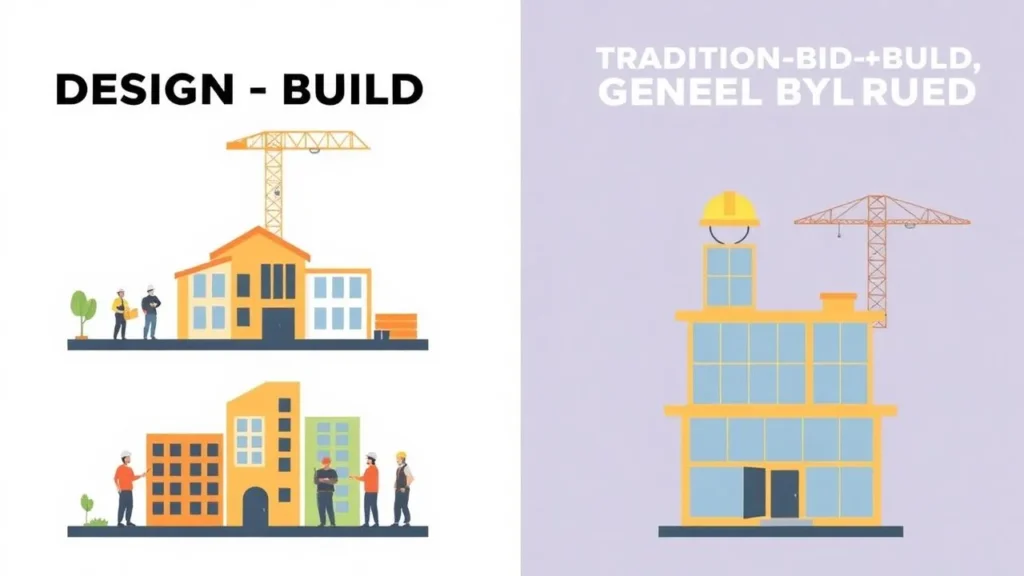
What Is a Design-Build Contractor?
A design-build contractor is a single firm that takes responsibility for both design and construction under one contract. The owner does not hire a separate architect and a separate builder. The owner hires one company, and that company brings the architect, engineers, and trades together under its own roof.
Some design-build construction companies employ in-house architects. Others are builder-led firms with long-term design partners. From the owner’s seat, the experience is the same: one phone number, one invoice stream, one party accountable for the final building.
The legal structure is simple. The owner signs one design-build agreement covering scope, schedule, fee, and warranty. The architect and trades sit beneath the design-build contractor on subcontracts. If the foundation drawings conflict with the structural steel, the owner does not arbitrate. The design-build contractor solves it internally and absorbs the cost.

What Does a General Contractor Do?
A general contractor is hired after the design is complete. The owner has already worked with an architect to produce drawings and specifications. Those documents go out for bid. General contractors price the work and submit a bid. The owner picks one and signs a construction contract.
From that point, the general contractor runs the build:
- Buying out the project. Soliciting bids and awarding trade contracts within budget.
- Scheduling. Sequencing concrete, steel, framing, MEP, and finishes without idle days.
- Site management. Supervision, safety, deliveries, daily reports, and quality control.
- Permits and inspections. Coordinating with the local jurisdiction throughout construction.
- Payments. Pay applications, sub distributions, lien waivers, and closeout.
The general contractor does not own the design. If the drawings call for a beam that cannot land where the architect drew it, the contractor flags the conflict, the architect issues a revision, and the change usually shows up as a change order. The owner pays for it.

Design-build vs General Contractor
The clearest way to see the difference is side by side. Same building, two delivery paths.
| Factor | Design-build | General Contractor (DBB) |
| Contracts owner signs | One | Two or more |
| Accountable party | Design-build firm | Split between architect and builder |
| Design and build phases | Run in parallel | Run in sequence |
| Cost certainty | Early, often at 30% design | Late, after full drawings and bidding |
| Change orders | Fewer; conflicts absorbed in-house | More; conflicts billed to owner |
| Owner design control | Lower | Higher |
| Typical schedule | Compressed | Longer end to end |
| Best fit | Schedule-driven commercial work | Public bid, architect-led, finished plans |
The Design and Build Process, Step by Step
For an owner choosing a design-build construction company, the project tends to move through six phases. Each phase has a clear deliverable and a clear decision point.
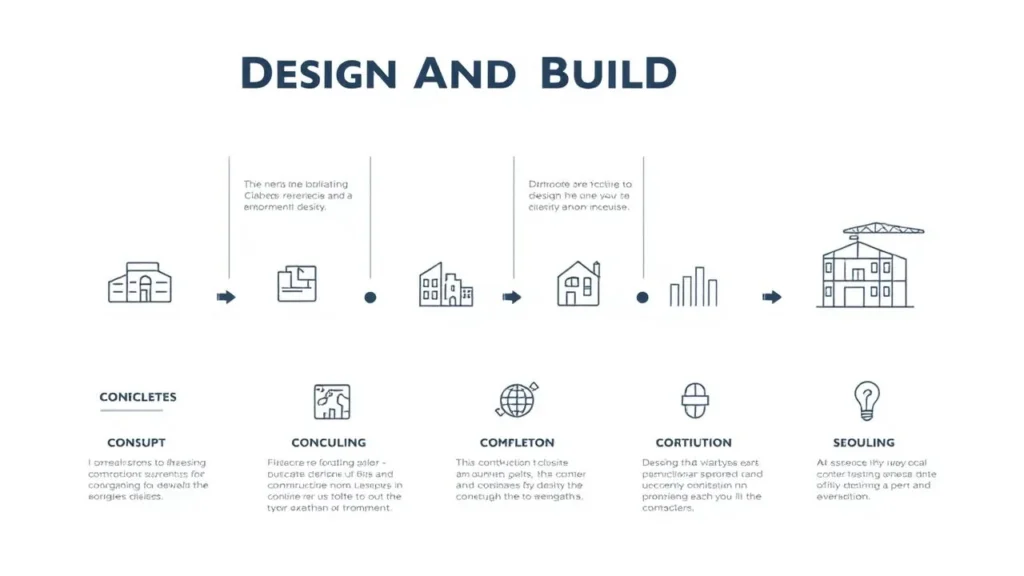
- Pre-design and programming. Functional needs, square footage, site constraints, and budget. Output: program and feasibility study.
- Concept design. Architect develops massing and exterior character. Builder prices are structured in parallel. Output: concept package and early cost model.
- Guaranteed maximum price (GMP). At roughly 60% design, the firm commits to a not-to-exceed price. Owner approves before drawings finalize.
- Construction documents. Drawings and specifications finished under the GMP ceiling.
- Construction. Permits pull, site work begins, and trades execute. Long-lead items are often ordered during design.
- Closeout and warranty. Inspections, commissioning, punch list, and turnover. Single warranty covers design and construction.
Advantages of Design-Build Construction
The advantages of design-build construction show up in schedule, cost certainty, and accountability. Owners feel them in the day-to-day rhythm of the project.
Single point of accountability
One contract, one firm responsible for design and construction. No finger-pointing when an issue surfaces.
Faster delivery
Design and construction run in parallel. Long-lead procurement starts during design, cutting six to twelve months.
Earlier cost certainty
A guaranteed maximum price is set well before drawings are complete. Financing and budgets lock with confidence.
Fewer change orders
Design conflicts are caught inside the integrated team and corrected without billing the owner.
Constructability built in
The builder shapes drawings as they develop. Decisions reflect what can actually be built within budget.
Cleaner warranty path
One warranty covers both design defects and construction defects. No chasing two parties post-occupancy.
Design-build is not the right answer for every owner. The trade-off is some loss of design control. For owners who want a building delivered with budget and schedule confidence, that trade is usually worth it. For owners with a strong design vision and a long-standing architect, the traditional path may serve them better.
Where General Contractors Still Win

The general contractor model remains the right fit for several common situations. It is not an outdated approach. It is a different one.
- Public projects. Many agencies require open competitive bidding against complete drawings.
- Architect-led work. When a renowned architect is central to the project’s identity.
- Small or simple scopes. A tenant fit-out or straightforward renovation handles well with a single hard bid.
- Finished design in hand. If drawings are complete and permitted, design-build offers little added value.
- Sophisticated owners. Developers with in-house project managers often prefer the control of running parallel contracts.
Construction Manager at Risk vs design-build
Both models bring the builder in early, and both can include a guaranteed maximum price. The difference lies in the contracts.
Under CMAR, the owner signs two contracts: one with an architect, one with the construction manager. Under design-build, the owner signs one contract that covers everything.
| Factor | CM at Risk | design-build |
| Owner contracts | Two (architect + CM) | One (design-build firm) |
| Design risk | Stays with the owner | Transferred to the firm |
| Cost commitment | GMP before construction | GMP, often earlier in design |
| Best fit | Owners who want their own architect | Owners who want a single accountable team |
Cost: How the Two Models Compare
On paper, a hard bid to a general contractor can look cheaper than a design-build proposal. In practice, the gap usually closes once change orders, design fees, and schedule overruns are counted. A working example on a 50,000 sq ft commercial office:
| Line | design-build | Architect + GC |
| Design fee | Included in GMP | 6% of construction |
| Construction | $12.0M GMP | $11.6M bid |
| Change orders | 2% to 3% | 6% to 10% |
| Schedule | 14 months | 19 months |
| Total likely owner cost | ~$12.3M | ~$13.0M |
The hard bid wins the headline construction number. design-build wins the bottom line once design fees, change orders, and time-to-occupancy are added in. Owners with revenue tied to the opening date often see the schedule advantage outweigh every other line.
Risk: Where It Sits in Each Model
Risk allocation is the quiet driver behind the choice. Both models include the same physical risks: weather, site conditions, material prices, and subcontractor performance. The difference is who pays when those risks land.
Design-build
- Design errors are absorbed by the design-build firm.
- Coordination between the architect and builder is handled internally.
- Cost overruns above GMP are paid by the contractor.
- Single warranty covering design and construction.
- Schedule risk is reduced through overlapping phases.
Architect + General Contractor
- Design errors are usually billed to the owner via change orders.
- Coordination gaps are arbitrated by the owner.
- Cost overruns are paid by the owner unless capped.
- Two warranties to chase, one architect, one builder.
- Sequential phases extend the total schedule risk.
Owners who want a single phone call when something goes wrong tend to choose design-build. Owners who want full visibility into every line of design and construction tend to choose the traditional path.
A Simple Decision Framework
Five questions usually settle the choice:
- How firm is your schedule? If the building must open on a fixed date, design-build is the lower-risk path.
- How developed is your design? Finished drawings: go to bid with GCs. Still a concept: a design-build firm earns its fee.
- How comfortable are you managing two contracts? Splitting the architect and builder adds to the owner’s workload. Single-contract design-build reduces it.
- How tight is your budget? Tight budgets favor design-build, where value engineering happens in real time.
- Public or private? Public agencies often require traditional bidding. Private owners have full flexibility.
Disadvantages of Each Model
Design-build
- No competitive build pricing. Trust open-book pricing or independent estimates to confirm value.
- Less independent design check. A third-party design reviewer at GMP is a sensible counterweight on larger projects.
- Customization can feel constrained. Integrated teams push back when a choice damages constructability or budget.
Traditional General Contractor
- Change-order disorder. On older buildings, change orders routinely add 8 to 15 percent to the construction line.
- Extended timelines. A serial workflow adds six to twelve months over an equivalent design-build schedule.
- Project management load. The owner sits at the intersection of architect and contractor.
- Late cost certainty. The full project price is not known until bids come back.
Best-Fit Profiles
Best fit for design-build:
- Fixed opening date tied to revenue or operations
- Program defined, design still developing
- Limited in-house construction expertise
- A firm budget where price certainty matters more than design control
Best fit for a general contractor:
- Drawings are already complete and permitted
- Public project requiring a competitive bid
- Long-standing architect relationship to preserve
- Design vision central to the project’s identity
Frequently Asked Questions
What is a design-build contractor?
A design-build contractor is a single firm that holds one contract covering both architectural design and construction. The owner signs with one entity, and that entity is accountable for drawings, permits, costs, and the finished building.
What does a general contractor do?
A general contractor manages the construction phase: hiring subcontractors, ordering materials, scheduling trades, running the site, and delivering the building per drawings prepared by a separately hired architect.
Is design-build cheaper than a general contractor?
Often yes on total project cost. Design and construction teams make price decisions together, which reduces change orders. Hard-bid jobs may show a lower headline number, but late changes and coordination gaps usually erase that gap.
What is design-build vs traditional construction?
Traditional construction (design-bid-build) uses three sequential phases with separate contracts for design and construction. design-build collapses those into one team and one contract, so design and construction happen in parallel.
What is the construction manager at risk vs design-build?
CMAR brings a builder on board early to advise the owner’s separate architect, and commits to a guaranteed maximum price before construction. design-build places the architect and builder under a single contract held by one firm.
Can I get a guaranteed maximum price with design-build?
Yes. The firm commits to a not-to-exceed figure once design reaches roughly 30% to 60%, well before construction documents are finished. Costs above the GMP are absorbed by the design-build firm rather than the owner.
What if I want to change the design after construction starts?
Under design-build, changes are scoped, priced, and authorized in days. Under a traditional GC contract, the same change runs through the architect for revised drawings, back to the contractor for repricing, then to the owner as a formal change order, often in two to four weeks.
Who handles permits in each model?
In design-build, the firm files and follows every permit as part of its scope. In the traditional model, the architect typically files for the building permit, and the general contractor pulls trade permits during construction.
Are change orders more common with a general contractor?
Yes. Industry data places change-order rates at roughly 6% to 10% on traditional projects, against 2% to 3% on design-build projects, since coordination errors are caught inside the team rather than billed to the owner.
Final Thoughts
The choice between a design-build contractor and a general contractor is not about which model is better in the abstract. It is about which model fits the project in front of you. Owners with a fixed opening date, a developing program, and limited internal capacity are best served by a design-build construction company. Owners with a finished design, a strong architect, or a public bidding requirement are best served by hiring a general contractor.
Whichever path is selected, the work that matters most happens in the first six weeks: setting the program, validating the budget, and confirming that the team has delivered comparable buildings. Get that right, and either delivery model can produce a successful project. For another perspective, read our guide on construction manager vs. general contractor.