EPIC CONSTRUCTION MANAGEMENT LLC
Building today for tomorrow.
- SUPPORTING DETAIL
Proposed Tenant Prospectus
Capacity, commercial terms and responsibility boundaries
The tenant presentation describes a proposed facility product to develop with an anchor customer and experienced operator. It is not an offer of installed space or a guarantee that the illustrated infrastructure, carriers or support services are already available.
Source basis: September 9, 2026 planning package · Not independently re-underwritten.
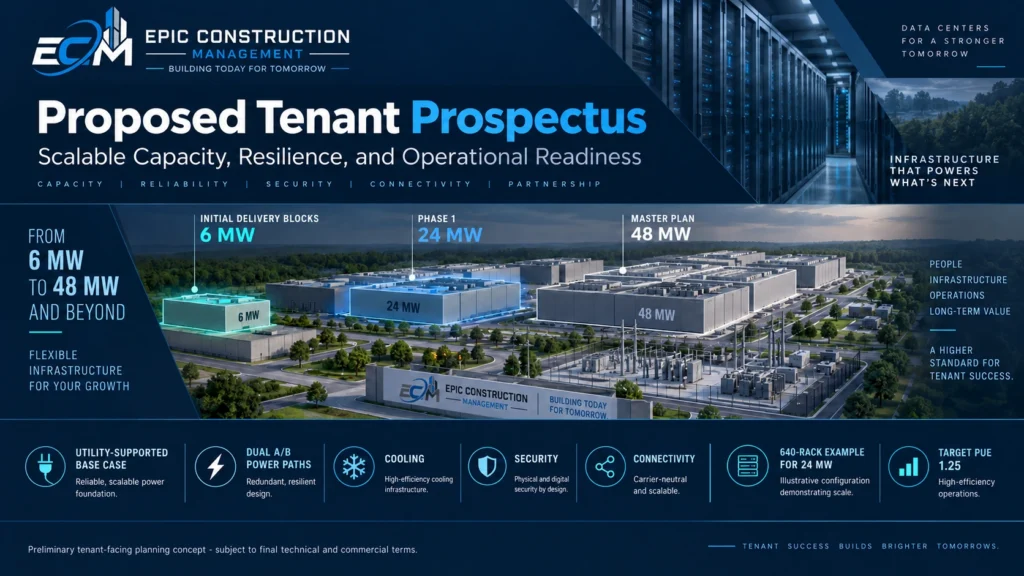
- PROPOSED SERVICE ONLY: No tenant, lease, utility allocation, operator appointment, carrier order or guaranteed availability is established.
6 MW
Proposed repeatable block
24 MW
First-phase IT concept
48 MW
Ultimate IT master plan
Planning data & boundaries
| Commercial topic | Proposed discussion position | Evidence required |
|---|---|---|
Anchor requirement |
Explore 12-24 MW with expansion in 6 MW blocks |
Customer credit, workload, location and timing |
Release criterion |
At least 80% of first-phase capacity; first block fully committed |
Binding credit-supported commitments; owner policy, not a financing rule |
Capacity rent |
$200 / kW / month; power separate |
Scope-matched negotiation, not a signed rate |
Initial lease term |
10-15 years |
Actual escalation, commencement, ramp and remedies |
IT and recovery |
Tenant-owned unless separately contracted |
Clear landlord / operator / tenant responsibilities |
Reserved capacity is different from energy use
The proposed model charges for contracted available capacity, subject to acceptance and service terms. Paid leased capacity is not the same thing as real-time server utilization. The model uses 90% paid capacity and a separate 85% average energized IT utilization assumption.
Technical brief before design freeze
The tenant needs to define rack and hall power, equipment/rolling mass, clearances, coolant, temperatures, network interfaces, load steps and growth. Changing workload type after equipment orders can change building, electrical and cooling scope.
Service and acceptance
Define readiness tests, facility availability, maintenance windows, credits, exclusions and remedies in the contracts. Facility availability is not application uptime. Dual A/B paths, a target PUE and an illustrated support team do not establish certified or contracted service.
Credit and pass-through obligations
Align customer security and termination provisions with utility upgrades, minimum charges, collateral and cancellation exposures. Energy pass-through at zero margin still requires billing-lag and default analysis. No named tenant, binding reservation, letter of intent or executed lease is asserted.
Source trail
- Original prospectus: slides 4, 10-18, 40.
- Rev B model: Tenant_Terms; Inputs; IT_Plan.
- Original document names and publication boundaries are listed in the source register.