
The drawings are done. Someone on your board asks whether you are hiring a general contractor or a construction manager. The words sound interchangeable. They are not.
So, what is a general contractor? A firm that signs one contract with you, hires every subcontractor, runs the site, and owes you a finished building at the agreed price.
Timing is where the two roles diverge. A general contractor prices the work after the architect finishes drawing it. By then the structural system is set. That single fact shapes everything else on this page.
What Is a General Contractor?
What is a general contractor in contract terms? The party holding the prime contract, sometimes called the prime contractor. Everyone else on site works beneath them by subcontract, which gives the owner one point of accountability instead of fifteen.
The question gets typed a dozen ways, “what is general contractor” and “whats a general contractor” among them. The answer does not change. What’s a general contractor selling to an owner is not labor. On most commercial and institutional projects, the general contractor self-performs little or none of the physical work.
What Is General Contracting?
What is general contracting as a business? Coordination, purchasing power, scheduling, and financial responsibility for the result. It is the service most owners mean when they say they need a builder, and the one most often bundled under general contracting. Concrete, steel, mechanical, electrical, and finishes all go to specialty subcontractors, so the contractor’s product is the sequence those trades work in, not the work itself.
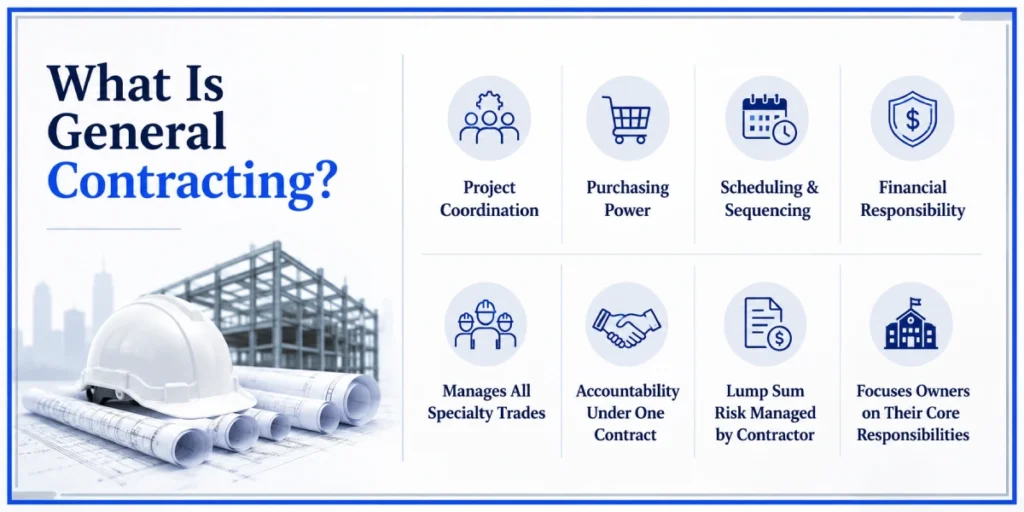
That financial piece is the one owners underestimate. Under a lump sum contract, if the drywall subcontractor underbids the job and walks, the shortfall belongs to the general contractor, not to you.
What are general contractors worth, then, on a project an owner could theoretically manage alone? The honest answer depends on the owner’s staff. A district with a full-time facilities director can manage a single-trade project on its own. Nobody self-manages twenty trades and a permit schedule while also running a school.
How General Contractors Get Paid
Two structures cover most commercial work.
A lump sum contract fixes the price. If the job comes in under, the contractor keeps the difference. If it runs over, that is their problem.
The other is cost of the work plus a fee, with a guaranteed maximum price. The books are open. You see every subcontract. Savings usually get split on whatever ratio you negotiated.
Retainage sits on top of either one. Illinois caps it at ten percent under 815 ILCS 603/20, dropping to five percent once the contract is half complete. Public projects are exempt.
What Does a General Contractor Do? General Contractor Duties by Phase
General contractor duties change shape as a project moves. A contractor pricing a bid set has different authority than one running a site with forty workers on it, and different obligations again once the building is occupied. Separating the three stages matters, because owners tend to judge a builder on the middle one alone.
Before Construction
Under design-bid-build, the most common delivery method on public work, the general contractor arrives after the construction documents are finished. They read the drawings and specifications, divide the scope into bid packages, collect subcontractor prices, add general conditions and fee, and submit a number.
Before mobilizing, they also secure permits, submit a schedule of values, provide insurance certificates and any required bonds, and start submittals on long-lead equipment. Switchgear and rooftop units ordered late will set the critical path regardless of how well the rest of the job runs.
During Construction
What a general contractor does on an active site is coordinate trades day to day, hold the schedule, process requests for information back to the architect, review submittals, enforce the safety program, and price change orders.
They also run the money. Pay applications flow up to the owner monthly, payment flows back down to subcontractors, and lien waivers are collected against each one.
After Construction
Closeout is where contractors most often disappoint owners, since the work is unglamorous and the pull toward the next job is strong.
The contractor walks the punch list with the architect, delivers operation and maintenance manuals and as-built drawings, arranges systems training for facilities staff, secures the certificate of occupancy, and carries the warranty. A one-year correction period is standard. Ask what happens in month thirteen when a rooftop unit fails, and get that answer in writing.
General Contractor Responsibilities to the Owner
The phase breakdown covers what the builder does. General contractor responsibilities in the contractual sense are narrower and more consequential, because these are the obligations you can enforce. Four of them account for most disputes, and each one has a document behind it that you should be holding.
- Code compliance. The contractor builds to the permitted drawings and is liable when the work does not meet code, even where the drawings were wrong.
- Payment down the chain. Under the Illinois Mechanics Lien Act, 770 ILCS 60, an unpaid subcontractor can lien your property even after you have paid the general contractor in full. Lien waivers with every payment application are the defense.
- Site safety. OSHA holds the controlling employer responsible for hazards it creates or could reasonably correct, which on most sites is the general contractor.
- Insurance and indemnity. Your certificate should name your organization as additional insured and carry a waiver of subrogation on workers’ compensation.
What general contractors do well or badly on these four is visible in their paperwork long before it shows up on your site.
Role of General Contractor Compared to a Construction Manager
General contracting, construction management, and design-build get used interchangeably in conversation and are not interchangeable in a contract. The real differences are when the firm joins, who holds the trade contracts, and whether the price is bid or negotiated. Each combination puts risk in a different place.
| Role | Joins the project | Holds trade contracts | Owner’s main tradeoff |
|---|---|---|---|
| General contractor | After construction documents are complete | Yes | Competitive price, but no cost input while design can still change |
| Construction manager as adviser (AIA C132) | Before design begins | No, the owner does | Independent advice, but the owner absorbs coordination risk |
| Construction manager as constructor (AIA A133) | Before design begins | Yes | Early estimating and a guaranteed maximum price, at a negotiated fee |
| Design-builder | At the start, holding design and construction together | Yes | One point of responsibility, less owner control over design |
(The comparison above describes how these arrangements typically work, not how any particular contract will read. Delivery methods get modified constantly, and the terms that matter to you sit in the agreement, not in the label. Have an attorney review anything before you sign it.)
What to Check Before You Award the Contract
Price is the easiest number to compare and the weakest predictor of how a project will go. If you’re wondering how to choose a general contractor, start by looking beyond the lowest bid. The eight items below take an afternoon to verify and surface most of the problems that later arrive as change orders, delays, or litigation. Request all of them in writing before signing anything.
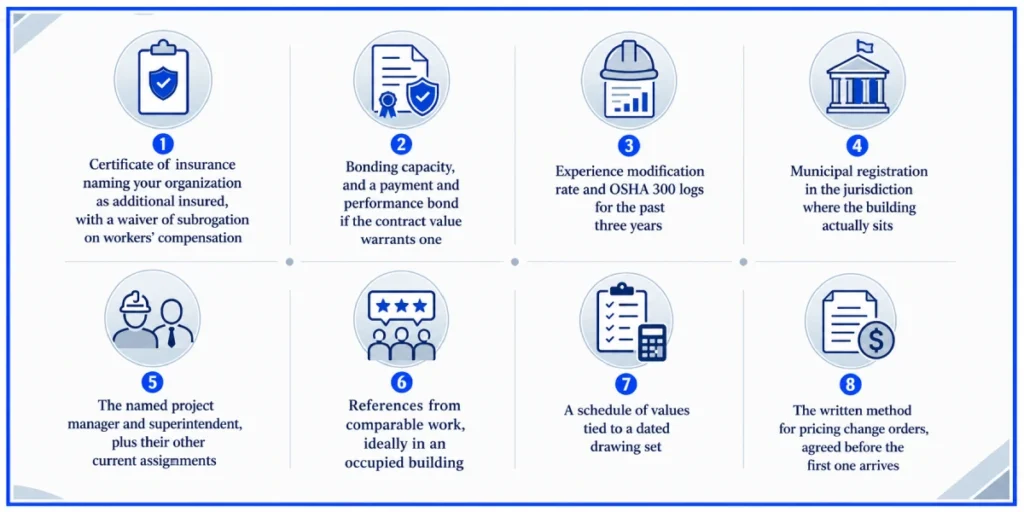
- Certificate of insurance naming your organization as additional insured, with a waiver of subrogation on workers’ compensation
- Bonding capacity, and a payment and performance bond if the contract value warrants one
- Experience modification rate and OSHA 300 logs for the past three years
- Municipal registration in the jurisdiction where the building actually sits
- The named project manager and superintendent, plus their other current assignments
- References from comparable work, ideally in an occupied building
- A schedule of values tied to a dated drawing set
- The written method for pricing change orders, agreed before the first one arrives
Item five deserves a follow-up. General contractor job duties split between an office-based project manager and a superintendent on site every day, and it is the second of the two who determines what your project actually feels like.
Final Thought
Choosing a builder is mostly a decision about where risk sits. A lump sum contract moves cost risk onto the contractor and buys a fixed number, at the cost of no pricing input while the design can still change. Early engagement keeps the design flexible and costs more in fees. Neither is right in the abstract, and the answer depends on how firm your program is and how much schedule you have. Epic Construction Management works with commercial and institutional owners across Chicago’s Northwest suburbs. If you have a project in planning, get in touch.
FAQs
What is a general contractor, in one sentence?
The firm holding the prime contract with the owner, responsible for hiring subcontractors, running the site, and delivering the completed building on the terms written into that contract.
Is a general contractor the same as a construction manager?
No. A general contractor typically begins after the drawings are finished and carries financial responsibility for the build. A construction manager joins earlier, and either advises the owner without holding trade contracts or acts as a constructor with a guaranteed maximum price.
Do we need a general contractor for a small renovation?
Not always. Single-trade work such as replacing flooring or a rooftop unit can go straight to a specialty contractor. Once a job needs two or more trades in sequence, or a permit, somebody has to coordinate them, and that coordination is the thing a general contractor sells.