Every commercial project starts with a number. Whether that number survives contact with reality is a question of construction cost management. The teams that finish on budget are not luckier; they estimate harder, buy out tighter, and watch the money daily instead of monthly.
This guide gives owners and project managers the framework: the seven pillars of project management that construction teams use, the strategies that actually move the cost-at-completion line, the software that powers real-time construction cost tracking, and the risk practices that protect the budget when the unexpected happens.
What Is Construction Cost Management?
Construction cost management is the end-to-end discipline of planning, estimating, budgeting, procuring, controlling, forecasting, and reporting project cost from the first concept estimate to final reconciliation. It is the financial backbone of commercial construction cost management; separate from accounting, separate from estimating, and the single biggest predictor of whether a project lands on budget.
On any meaningful commercial job, cost management runs in parallel with construction itself: scope going into the building, money coming out of the budget, both tracked against the same baseline.
The 7 Pillars of Construction Cost Management
Effective construction estimation & project management services stand on seven pillars. Skip one, and the budget springs a leak.
- Estimating – Quantity-driven baseline at every design milestone.
- Budgeting – Locked baseline by code of accounts.
- Procurement – Tight buyout converts estimates to commitments.
- Change Control – Priced and approved before work proceeds.
- Cash Flow – SOV, retainage, and lien waivers in lockstep.
- Forecasting – Monthly cost-at-completion refresh.
- Reporting – One dashboard, real-time, owner-facing.
1. Construction Cost Estimating Services
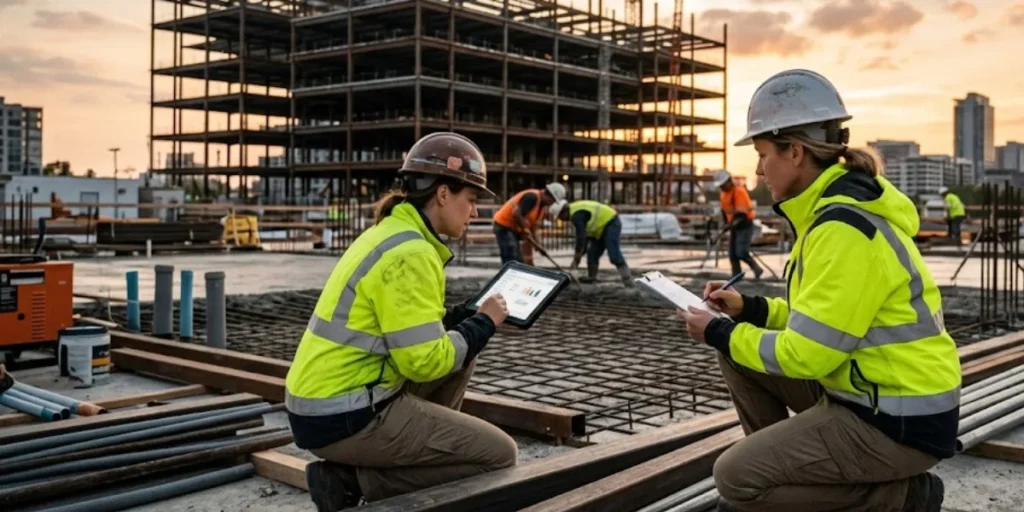
Cost management starts with a credible estimate. Construction cost estimating services produce a quantity-driven, code-of-accounts-aligned number that becomes the project’s baseline budget. The estimate is the contract between hope and reality, and the deeper the estimate, the smaller the gap.
Owners should require at a minimum:
- Conceptual estimate at programming, with ±25% accuracy.
- Design development estimate at 60% drawings, ±10%.
- GMP-level estimate at 90-100% CDs, ±5%.
- Escalation and contingency lines are called out separately, never buried.
2. Budgeting and Construction Budget Management Software
Once estimates are blessed, they harden into a baseline budget structured by the CSI division or company-specific code of accounts. The budget is what every dollar gets measured against for the rest of the job.
Construction management software matters here because budgets only work if they are updated in lockstep with commitments. The best construction cost management software ties the budget to contracts, change orders, invoices, and forecasts in a single ledger, no spreadsheets in personal folders.
3. Procurement and Vendor Buyout
Buyout is where estimated dollars become committed dollars. Locking subcontracts and material orders early, especially during volatile markets, is the single largest lever owners have for commercial construction budget tracking. Every package bought below the estimate releases contingency; every package over the estimate eats it.
4. Change Order Control
On a commercial project, the scope will change. Whether it costs you depends on the change control process:
- Every change is priced before it is approved.
- Time impact is assessed at the same time as cost.
- Owner approval in writing before work proceeds.
- Change log reconciled against the contingency ledger weekly.
Loose change control is the #1 cause of overruns in general contractor commercial construction work.
5. Cash Flow and Pay Application Discipline
Cost management is also liquidity management. A schedule of values that front-loads the contractor will starve the owner’s cash position later. Tie monthly applications to certified percent complete, hold standard retainage, and require lien waivers from every tier, every month.
6. Forecasting Cost-at-Completion
Budgets do not predict the future; forecasts do. Each month, the cost team should refresh the estimate at completion using earned value plus a bottom-up review of unbilled commitments and pending changes. Variance between budget and forecast is the early-warning system every owner needs.
7. Real-Time Construction Cost Tracking and Reporting
The final pillar is visibility. Real-time construction cost tracking means the budget, commitments, invoices, changes, and forecast live on the same dashboard, refreshed continuously instead of monthly. When a superintendent reports a quantity from the field on Monday, the cost-at-completion line on the owner’s report moves the same day.
Types of Construction Costs
You cannot manage what you cannot classify. Every dollar on a commercial job falls into one of these buckets, and the budget structure should make each of them visible.
Hard Costs
Physical construction: labor, materials, equipment, site work, structure, MEP, finishes. Typically, 70–85% of the total project cost.
Soft Costs
Design fees, permits, legal, insurance, financing, FF&E, marketing, commissioning. Off the slab but still on the spreadsheet.
Direct Costs
Tied directly to a scope or work package; concrete in the foundation, steel in the frame, electricians on the floor.
Indirect Costs
General conditions, site management, temporary utilities, safety, and cleanup are required to deliver the scope, but are not attached to one trade.
Fixed Costs
Lump-sum commitments that do not move with quantity: bonds, mobilization, and certain design contracts.
Variable Costs
Quantity- or time-driven: rebar by the ton, formwork by the SF, equipment rental by the week.
Overhead
Home-office burden allocated to the project: accounting, executive oversight, IT, and insurance pools.
Claims & Delay Costs
Extended general conditions, acceleration, disruption, and liquidated damages. The line nobody budgets for and everyone pays for.
A proper Cost Breakdown Structure (CBS) aligns these categories with the CSI divisions (or your company code of accounts) so every commitment, invoice, and change order maps to exactly one line. No CBS, no control.
Construction Cost Control Strategies That Actually Work
Pillars set the structure. Strategies move the number. These six are the construction cost control strategies we apply to every commercial engagement.
Six proven strategies for controlling
cost.
- Value engineering – Optimize function and quality for the lowest life-cycle cost, before drawings freeze.
- Contingency management – Allocate, draw, and report contingency line-by-line, never as a single pool.
- Earned value tracking – Compare planned, earned, and actual costs to forecast the finish, not just measure the past.
- Early vendor buyout – Lock long-lead and large packages first to remove price and supply uncertainty.
- Change order discipline – Price, approve, and log every change against the contingency ledger weekly.
- Active risk register – Identify, quantify, and assign every cost risk; review monthly with the owner.
Best Construction Cost Management Software (2026)
There is no single best construction cost management software for every project; the right tool depends on size, contract type, and how integrated you need cost to be with field operations. Common picks in commercial construction:
| Platform | Best For | Strength |
| Procore | Mid-to-large commercial GCs | Unified field + cost + docs |
| Autodesk Construction Cloud Cost | BIM-heavy projects | Tight design-to-cost link |
| Sage 300 CRE | Enterprise GCs and owners | Deep job cost accounting |
| Kahua | Owners and program managers | Capital program portfolio cost |
| CMiC | Enterprise self-perform GCs | ERP + project cost in one stack |
| Buildertrend / RedTeam | Mid-market builders | Affordable budget + change control |
| Stack / PlanSwift | Estimating teams | Quantity takeoff to budget |
Whatever stack you choose, the rule is the same: one source of truth for budget, commitments, and forecast. Side-channel spreadsheets are how overruns hide.
Risk Management in Building Construction
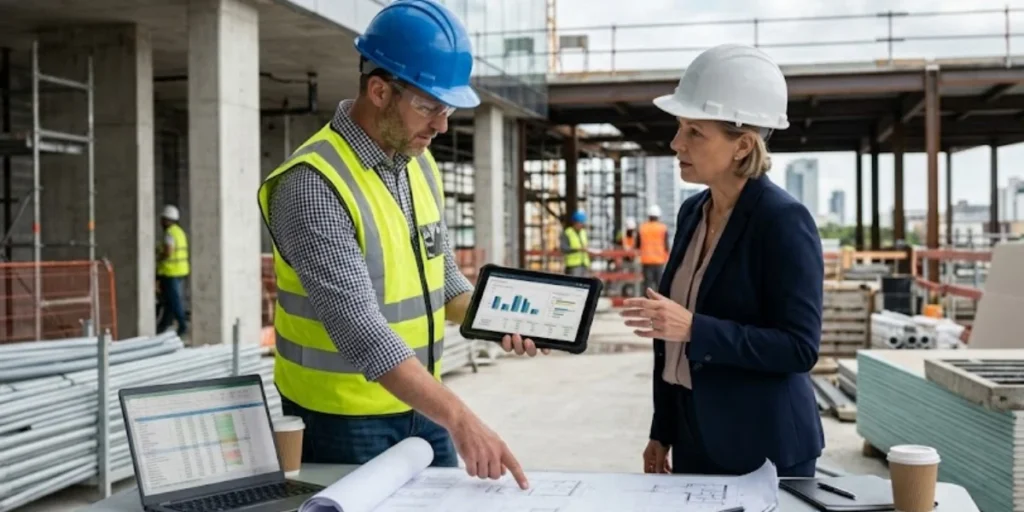
Risk management in building construction is the other half of cost management. You cannot control what you have not named. A working risk register lists each cost risk, its probability, its dollar impact, the owner, and the mitigation. It is updated monthly and tied to a separate cost risk contingency line, not buried inside the GC’s general contingency.
Construction financial risk management goes further: it covers escalation exposure, currency exposure on imported materials, surety and bonding capacity, and the financial health of key subcontractors. On a $50M project, a single key subcontractor failure can cost more than the entire cost management fee for the year. How to Manage Construction Costs: A Monthly Cadence
How to manage construction costs in practice comes down to a repeating monthly rhythm:
- Week 1. Reconcile pay applications, lien waivers, and committed costs.
- Week 2. Update change order log; price pending changes.
- Week 3. Refresh the earned value and cost-at-completion forecast.
- Week 4. Owner cost report: budget vs. commit vs. forecast, with variance commentary and risk register update.
Run this loop every month, and you will know about a $200,000 problem when it is still a $20,000 problem.
Construction Cost Management Services: When to Hire Help
Most owners reach for outside construction cost management services when the project crosses one of three thresholds: contract value above $5M, GMP or CM-at-risk delivery, or a portfolio of more than three concurrent jobs. Below those thresholds, an experienced internal PM can usually run the budget; above them, independent cost management pays for itself.
Frequently Asked Questions
What is construction cost management?
Construction cost management is the discipline of planning, estimating, budgeting, controlling, forecasting, and reporting all project costs from concept through closeout. The goal is to deliver the scope on budget by catching variances early and acting on them before they turn into overruns.
How to manage construction costs?
Build a detailed estimate, lock it into a baseline budget, buy out scope tightly, control changes with a written process, track committed and actual costs against the budget weekly, and forecast cost-at-completion every month. Discipline at each step matters more than any single tool.
What are the best construction cost control strategies?
Value engineering during design, disciplined contingency management, earned value tracking, early vendor buyout, a strict change order process, and an active risk register are the six strategies that consistently keep commercial construction on budget.
What is the best construction cost management software?
The best construction cost management software depends on project size. Procore, Sage 300 CRE, Autodesk Construction Cloud Cost, Kahua, and CMiC lead at the enterprise tier. For mid-market and project cost management construction workflows, Buildertrend, RedTeam, and Stack Estimating are common picks.
What is real-time construction cost tracking?
Real-time construction cost tracking connects committed costs, approved changes, and field-reported quantities to your budget on a live dashboard. Instead of finding overruns at month-end, owners and project managers see variance the same day it happens.
What is risk management in building construction?
Risk management in building construction is the process of identifying, quantifying, and mitigating events that can hurt cost, schedule, safety, or quality. Cost risk is managed through contingency, escalation allowances, fixed-price buyout, and a maintained risk register.
How much does construction cost management cost?
Independent construction cost management services usually run 0.5 to 1.5 percent of construction value for commercial projects, depending on scope and duration. The savings from catching overruns early almost always exceed the fee.
What is the difference between cost estimating and cost management?
Construction cost estimating services produce the number before the job starts. Construction cost management protects that number through buyout, changes, forecasting, and reporting until the job closes out. Estimating sets the target; cost management hits it.
What do construction cost management services include?
Construction cost management services typically include conceptual estimating, GMP review, value engineering, schedule of values negotiation, change order audit, cash flow forecasting, monthly cost reporting, and final reconciliation at closeout.
Final Thoughts
Construction cost management is not a software, a spreadsheet, or a monthly report. It is the daily discipline of pricing every decision against a baseline and forecasting the consequences before they happen. Owners who treat cost management as a live function, not a finance task, land their commercial projects on budget. Everyone else gets to write the variance memo.