Construction risk management is the process of identifying what could go wrong on a project, evaluating the severity of each event, and establishing a plan to address it before it occurs.
Every project carries risk; that is not optional. What separates a well-run project from one that overruns is whether those risks are actively managed or simply hoped away.
For an owner, a developer, or a project manager preparing for a build, the practical question is not whether risk management is needed, but whether enough of it is being done, and whether it is the right kind. This guide is designed to answer that question.
The sections that follow cover the five categories of risk every construction project encounters, the framework professional teams use to score and prioritize them, how a risk register operates day to day, and the contractual and insurance provisions that determine who bears the cost when an event occurs. Construction management plays an important role in managing these risks throughout the project.
What Is Construction Risk Management?
Construction risk management is a structured process, not an instinctive reaction. Its purpose is to ensure that, before a problem occurs, the team has already determined the appropriate response, the responsible party, and the expected cost. Construction cost management helps teams plan, monitor, and control these costs throughout the project.
The process spans the full project life cycle: bidding, design, procurement, construction, and closeout.
In practice, the process follows five repeating steps:
- Identify. Document every event that could realistically occur, from a crane incident to a stalled permit to a subcontractor insolvency mid-project.
- Analyze. Score each risk by its likelihood and by the severity of its impact in dollars, days, or injuries.
- Plan. Determine whether to avoid the risk, reduce it, transfer it through insurance or contracts, or accept it with a defined contingency.
- Act. Implement the controls: safety plans, contract clauses, schedule buffers, and vendor qualification checks.
- Monitor. Review the register on a defined cadence and adjust as project conditions change.
According to a KPMG Global Construction Survey, only about 25% of construction projects finish within 10% of their original deadline. The single largest differentiator between projects that meet their targets and those that do not is a mature, actively used risk management process, rather than project size, location, or complexity.
The 5 Main Categories of Construction Risk
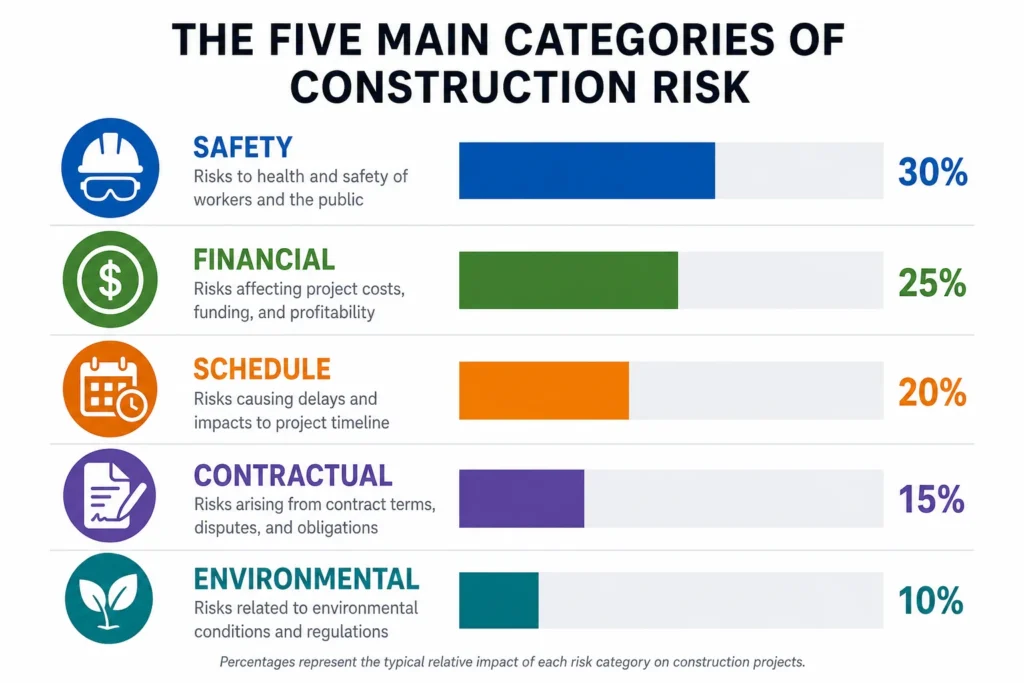
Nearly every project loss falls into one of five categories. Identifying the correct category guides the choice of control: safety risks are not resolved through contract clauses, and contractual risks are not resolved through toolbox talks.
- Safety: Falls, struck-by, electrocution, and caught-in or between events; the OSHA “fatal four” continue to account for most jobsite injuries.
- Financial: Cost overruns, material price swings, funding gaps, and payment disputes that erode margin and cash flow.
- Schedule: Permit delays, weather, long-lead items, and trade sequencing problems that push the completion date.
- Contractual: Scope gaps, indemnity exposure, change-order disputes, and unclear liquidated-damages provisions.
- Environmental: Soil contamination, stormwater runoff, dust and noise complaints, and protected-species or wetland issues.
- External: Permitting policy changes, labor shortages, and supply chain disruptions; risks the project team cannot control but must plan for.
The mix of risk shifts from project to project. A downtown high-rise typically carries heavy safety and environmental exposure. A fixed-price institutional remodel typically carries heavy contractual and schedule exposure.
Identifying the dominant category for the project is the first meaningful step a risk manager takes. Safety management plays a key role in addressing safety risks throughout the project.
How to Identify Risks Before They Hit
Risk identification accounts for half of the work. A team cannot manage what has not been documented. Experienced teams draw from several sources rather than relying on any single individual’s recall.
- Lessons-learned files. Past project closeout reports are valuable; last year’s surprises become this year’s checklist.
- Drawing reviews. A constructability review with the builder, designer, and key trades identifies design risks before they are locked into the documents.
- Site walks. Walking the site with the superintendent reveals ground conditions, access constraints, and adjacent-property issues that do not appear on a plan.
- Subcontractor input. The trades performing the work see hazards that the office cannot. Their input should be solicited early.
- Owner workshops. A two-hour workshop with stakeholders typically identifies 60 to 80 percent of the risks that will materially affect the project.
Scoring Risk: The Likelihood × Impact Matrix
Once the list is complete, the team must prioritize. The standard tool is a likelihood × impact matrix, typically 3×3 on small projects and 5×5 on commercial work. Each risk receives a likelihood score and an impact score, and the product indicates where attention should be focused.
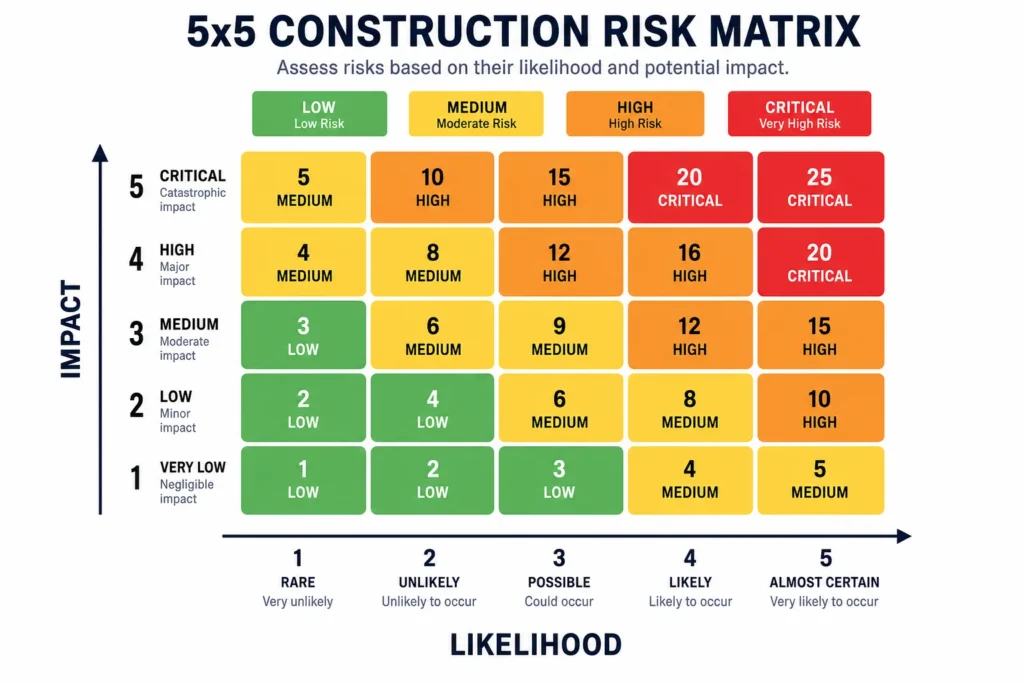
The matrix is not a mathematical exercise; it is an alignment tool. It requires the team to agree explicitly that, for example, a crane strike on an adjacent building is critical even if unlikely, while punch-list slippage is highly likely but low impact.
That alignment is more valuable than the numerical scores themselves.
The Four Responses: Avoid, Reduce, Transfer, Accept
Every scored risk receives one of four responses. Mature risk plans apply all four, not only the most convenient options.
- Avoid. Adjust the plan so the risk no longer applies: select a different site, substitute a material, or remove a scope item.
- Reduce. Reduce the likelihood or the impact through controls, training, redundancy, or schedule float.
- Transfer. Move the financial consequence to another party through insurance, bonds, or subcontract indemnity.
- Accept. Acknowledge the risk and set aside a contingency. Best for low-impact or unavoidable items.
Transferring risk through contracts and insurance is the area in which most owners under-invest. A well-drafted indemnity clause, a properly named additional insured, and a builder’s risk policy with appropriate limits will do more to protect a project than any number of safety toolbox talks, although both are required.
Risk Management vs. Crisis Management
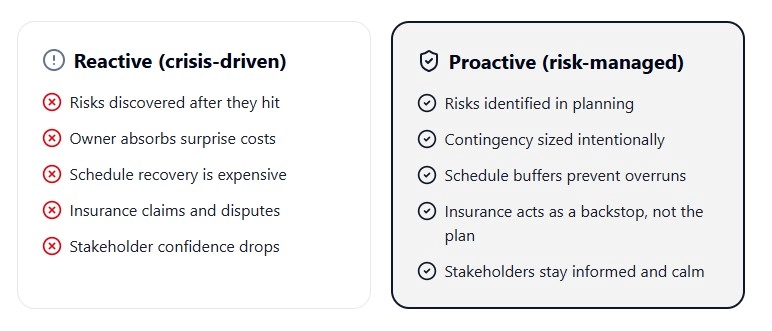
These two disciplines are often confused, and the distinction matters. Risk management occurs before an event. Crisis management occurs after an event. The first is comparatively inexpensive and uneventful; the second is costly and disruptive.
| Factor | Risk Management | Crisis Management |
| Timing | Before an event | After an event |
| Cost | Low: planning and controls | High: claims, delays, legal |
| Owner stress | Routine, manageable | Severe, reactive |
| Outcome | Risk avoided or reduced | Damage limited, not avoided |
| Insurance role | Backstop | Primary recovery |
Every dollar shifted from the crisis side of this table to the risk side is recovered twice: once in avoided loss and again in reduced disruption.
Building a Working Risk Register
The risk register is the single most important document in construction risk management. When constructed well, it is a concise, focused tool that the team actively uses. When constructed poorly, it becomes a 40-tab spreadsheet that no one maintains.
A working register contains at a minimum:
- Risk ID and description. One line, in plain language.
- Category. Safety, financial, schedule, contractual, or environmental.
- Likelihood and impact scores, with the resulting priority.
- Response. Avoid, reduce, transfer, or accept.
- Owner. A named individual, not a department.
- Action and due date. The work being performed and its target completion.
- Status. Open, monitored, or closed.
The register should be reviewed weekly on fast-moving projects and monthly on slower ones. After any incident, change order, or design revision, the team should walk the register and assess whether each entry has shifted.
Contractual and Insurance Risk Transfer
Two instruments shift risk away from the owner without eliminating it: contracts and insurance. Both must be established before the project begins, since negotiating either one after an incident produces poor outcomes.
Professional liability. For the design team. Critical of design-build and any project with engineering complexity.

Indemnity clauses. Define who pays when a third party is injured or initiates a claim. State law limits how far these provisions can extend; they should be reviewed with a construction attorney, not a general practitioner.
Liquidated damages. A fixed daily amount that the general contractor owes for late delivery. Useful, but only enforceable if it reflects a real estimate of harm.
Builder’s risk insurance. Covers the structure under construction against fire, theft, weather, and vandalism. Limits must match the completed value.
General liability (CGL). Covers third-party injury and property damage. The owner should be named as an additional insured on the contractor’s CGL.
Workers’ compensation. Mandatory in nearly every state. Confirm certificates for every sub on every visit.
Common Risks on Real Projects (and What Actually Works)
Theory is one matter; practice is another. The following risks appear consistently on active projects, along with the controls experienced teams apply.
Differing site conditions
The soil does not match the geotechnical report. Control: a robust differing-conditions clause and a geotechnical contingency line in the budget.
Subcontractor default
A trade becomes insolvent mid-project. Control: prequalification, payment bonds on critical subcontractors, and a backup vendor identified in advance.
Permit delays
A reviewer returns drawings for revision. Control: pre-application meetings with the jurisdiction and schedule float for revisions.
Weather
A wet season delays earthwork. Control: a weather-day allowance in the contract and a schedule that does not place critical exterior work in unfavorable months.
Scope creep
The owner adds items without resetting the price. Control: a written change-order process executed by every party at the start of the project.
Material price spikes
Steel or copper increases sharply. Control: early procurement of long-lead items and an escalation clause for volatile materials.
Safety incidents
A fall, a struck-by event, or a near miss. Control: site-specific safety plans, daily pre-task plans, and a reporting culture in which workers can stop work without penalty.
How to Pick a Construction Manager Who Actually Manages Risk
Many firms describe risk management on their websites. Fewer practice it on-site. A short list of questions identifies which type of firm is being considered.
- Request a risk register from a comparable past project. A real document, redacted if necessary. The absence of one is itself the answer.
- Who owns the register on this project? The response should identify one named individual, available on weekends if needed.
- How often will the register be reviewed jointly? Weekly reviews are appropriate during active construction.
- What is the firm’s EMR (experience modification rate)? Below 1.0 is at the industry average; below 0.85 is strong.
- Describe the firm’s most recent safety incident. Transparent firms discuss it openly; evasive firms do not.
- What is included in the standard contingency, and how is it released? A clear response indicates a mature organization.
- Request proof of insurance and bonding capacity. Current certificates should be provided before any contract is signed.
What Is Construction Manager at Risk (CMAR)?
A question that frequently accompanies the phrase what is risk management in construction is the related but distinct phrase construction manager at risk
The two terms are not interchangeable. Risk management is a discipline. Construction manager at risk, often abbreviated to CMAR or CM-at-risk, is a project delivery method in which one party contractually assumes the cost risk.
In a CMAR contract, the construction manager is engaged early, typically during design, to advise on cost, schedule, and constructability. Before construction begins, the manager commits to a Guaranteed Maximum Price (GMP).
If the project comes in under that figure, savings are often shared. If the project exceeds the GMP, the construction manager absorbs the difference. That is the “at risk” component.
By contrast, in agency CM, the construction manager serves purely as a paid advisor; the owner holds every trade contract and absorbs every overrun. At-risk construction management transfers that exposure from the owner to a firm engaged to manage it.
| Factor | CM at Risk | Agency CM |
| Cost commitment | Guaranteed Maximum Price | No price guarantee |
| Trade contracts | Held by CM | Held by owner |
| Cost risk | Sits with CM above GMP | Sits entirely with owner |
| Best fit | Owners who want price certainty | Owners with in-house construction expertise |
CMAR does not replace a risk management plan in construction; it operates on top of one. The construction manager still maintains a risk register, scores risks, and procures insurance. The GMP is the contractual mechanism that determines who pays when those risks translate into actual cost.
Why Risk Management Is Important in Construction
Risk management in building construction matters for a straightforward reason: the industry carries more variables than nearly any other. A factory line manufactures the same product thousands of times each day in a climate-controlled environment.
A construction project is a one-off prototype, built outdoors, by dozens of separate companies, on a site no one has previously built on. Issues arise by default. The purpose of risk management is to ensure those issues are resolved on paper rather than in execution.
The benefits of risk management in the construction industry appear in five areas that matter to every owner:
- Budget protection. Risks priced in advance become contingency line items rather than change orders. Total spend remains closer to the original figure.
- Schedule certainty. Identified risks receive schedule buffers. Unidentified risks compromise the critical path.
- Worker safety. A risk register that treats safety as a priority reduces the experience modification rate, the insurance premium, and the human cost.
- Reputation and financing. Lenders, insurers, and future tenants evaluate how a project was managed. A clean delivery reduces the cost of financing on the next project.
- Owner confidence. Not a line item on a financial statement, but among the outcomes owners value most.
How to Create a Construction Risk Management Plan
The practical question is how to create a construction risk management plan for a specific project, not in theory but in the near term. The following sequence reflects what experienced teams apply. It is consistent across a residential renovation, a commercial fit-out, and commercial construction risk management at scale.
- Define the project’s risk appetite. The owner answers two questions: what is the maximum tolerable budget overrun, and what is the latest acceptable completion date. All subsequent decisions follow from those figures.
- Conduct a kickoff risk workshop. Two hours, with every key party present: owner, designer, builder, and key subcontractors. The output is a working list of 30 to 80 risks.
- Score on a likelihood × impact matrix. Apply the 5×5 matrix introduced earlier in this guide. The team should debate the quadrant rather than the exact number.
- Assign one of the four responses. Avoid, reduce, transfer, or accept. “Accept” is a legitimate response when the cost of mitigation exceeds the exposure.
- Name an owner for every risk. A specific individual, not a department or a placeholder. Risks without owners do not progress.
- Set the contingency. Total the accepted risks and add a buffer for unknown-unknowns. New-build greenfield sites typically require 5 to 8 percent. Renovations of older buildings typically require 10 to 20 percent.
- Integrate the plan into contracts and insurance. The transferred risks should appear in indemnity clauses, builder’s risk limits, and additional-insured endorsements before construction begins.
- Review on a fixed cadence. Weekly during active construction; monthly during design and closeout. Track which risks have closed, which have shifted, and which have been added.
That sequence is the risk management plan in construction; the document is the record of it. A binder without the workshop and the weekly review is not a plan; it is a record without practice.

How to Manage Risk on a Live Construction Project
Project planning is the simpler half of the work. Once construction is underway, the question shifts from what could go wrong to how to manage risk in a construction project that is already in motion, with expenditure occurring daily. A few habits separate teams that retain control from those that do not.
- Daily pre-task plans. The crew about to perform the work documents what they are doing, the hazards involved, and how those hazards will be controlled. Five minutes, every day.
- A weekly risk meeting. Thirty minutes with the project manager, superintendent, and owner’s representative. Open the register, walk the top five items, update statuses, and close out.
- An incident and near-miss log. Captured on the day of the event and reviewed in the following week’s risk meeting.
- Change-order discipline. Every change moves through a written process that reprices, reschedules, and re-evaluates risk before work begins.
- An open escalation path. Anyone on site, including the newest laborer, can raise a risk and receive a same-day response. If that is not possible, the system is not functioning.
Construction Contract Risk Management
Construction contract risk management is the legal component of the discipline. Most owner-side losses on construction projects do not originate from physical failures; they originate from poorly drafted documents.
A small number of clauses carry most of the weight, and they must be negotiated before signing rather than after a dispute.
- Scope and exclusions. The clearer the scope, the smaller the change-order exposure. Vague scope is the single largest source of contractual risk.
- Indemnity and limitation of liability. Defines who pays for third-party claims and whether either party’s exposure is capped.
- Insurance requirements. Spell out limits, additional insured status, waivers of subrogation, and certificate timing.
- Change-order procedure. A written process covering request, pricing, owner approval, and written authorization before any additional work begins.
- Liquidated damages and bonuses. A defined dollar-per-day amount for late completion, and optionally a shared bonus for early.
- Differing site conditions. Defines the response when the soil, existing structure, or utilities do not match the drawings.
- Dispute resolution. Mediation, followed by arbitration or court, and the applicable venue. The venue should be established before any dispute arises.
- Termination rights. Both for cause and for convenience, with clear payment terms for work completed.
In commercial construction risk management, these clauses are typically negotiated by a construction attorney. On residential projects, they are usually pre-printed in an AIA or ConsensusDocs form, but the owner should still read them and raise questions before signing.

Commercial vs. Residential Construction Risk Management
The framework is the same; the settings differ. Commercial construction risk management addresses larger dollar exposures, more stakeholders, a heavier regulatory load, and contracts drafted by counsel on both sides.
Residential risk management involves fewer parties but greater personal stakes; the project is a home, not a line on a financial statement.
In practice, commercial projects lean harder on:
- Subcontractor default insurance (SDI) or payment and performance bonds on major trades.
- Owner-controlled or contractor-controlled insurance programs (OCIP or CCIP) on projects above roughly $25 million.
- Detailed liquidated damages tied to lost rent or operating revenue.
- Formal monthly risk reports to lenders and equity partners.
Residential projects lean harder on:
- Clear allowances for finishes the homeowner hasn’t picked yet.
- A realistic communication cadence; homeowners typically expect more frequent updates than commercial owners.
- A written change-order process the homeowner actually understands.
- Builder’s risk policies sized to the renovation value, not just new construction.
On either side, the core process is the same: identify, score, respond, and monitor. The tools scale up or down to fit the project.
Frequently Asked Questions
What is construction risk management in simple terms?
It is the practice of identifying what could go wrong on a project, evaluating how serious each issue would be, and establishing a plan before it occurs. Safety, financial, schedule, contractual, and environmental risks all fall within this discipline.
Who is responsible for risk management on a construction project?
Responsibility is shared across the project team. The owner sets the risk appetite, the contractor implements day-to-day controls, and the design team identifies risks embedded in the drawings. A dedicated risk manager or project manager maintains the risk register.
What’s the difference between a risk and an issue?
A risk is an event that may occur in the future. An issue is an event that has already occurred. Risk management is the work performed while the event is still a possibility. Once it materializes, the team is engaged in damage control.
How often should a risk register be updated?
At least monthly on most projects, weekly on complex or fast-moving ones, and immediately after any incident, change order, or major design revision. A register that has not been updated in three months no longer reflects the project.
Does insurance replace risk management?
No. Insurance pays out after a loss occurs. Risk management is the discipline that prevents the loss from occurring or limits its severity so the policy responds as intended.
What is construction manager at risk (CMAR)?
Construction manager at risk is a delivery method in which the construction manager commits to deliver the project within a Guaranteed Maximum Price (GMP). The manager is engaged early, during design, to advise on cost and constructability, and then assumes the financial risk of exceeding the GMP during construction.
What is at-risk construction management vs. agency CM?
In at-risk CM, the construction manager holds the trade contracts and is liable for cost overruns above the GMP. In agency CM, the construction manager serves purely as an advisor to the owner, and the owner holds the trade contracts and the cost risk.
Why is risk management important in construction?
Because construction involves more moving parts, and more avenues for financial loss, than nearly any other industry. A functional risk plan protects the budget, the schedule, the workforce on site, and the owner’s liability exposure simultaneously.
How do I create a construction risk management plan?
Start with a risk identification workshop, score each item on a likelihood × impact matrix, assign one of four responses (avoid, reduce, transfer, accept), name a single owner per risk, and review the register weekly or monthly. The plan is the living register plus the response actions, not a one-time document.
Final Thoughts
Construction risk management is not a binder that is written once and shelved. It is a recurring practice, sustained through a weekly conversation among the people accountable for the outcome. The strongest teams are not those without risks; they are the teams that can identify, on any given day, the top five risks, who owns them, and what action is underway.
For an owner, the highest-leverage decision is to engage a builder who already operates this way and then attend the reviews. The cost of doing construction management well is modest. The cost of neglecting it is substantial.