You may have heard this term on a job site, in a work proposal, or maybe your contractor said it, and you just nodded along.
So what is construction management, really?
Here is the short answer. It is the job of keeping a building project from turning into a mess. Someone has to watch the money, chase the plan, work with many different trade teams, and make sure things do not fall apart when one supply truck runs late. That someone is doing construction project management.
This guide explains what construction management is, who does it, why it matters, and how the whole thing works from the first sketch to the last walk-through. If you are an owner, a student, or just curious what a construction manager does all day, this covers it.
What Is Construction Management?
Let us define construction management in simple words.
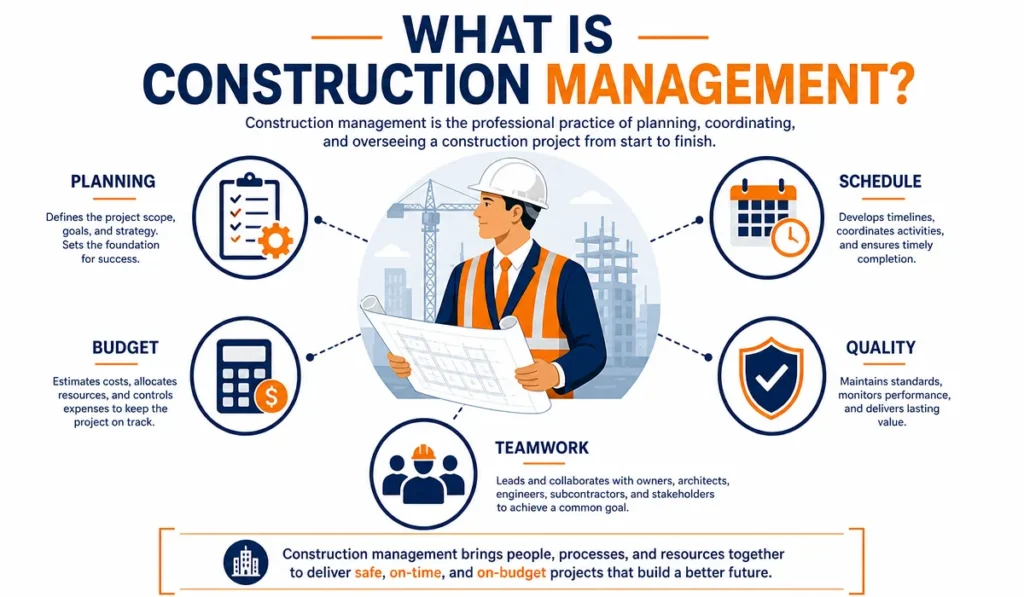
Construction management is the professional care of a building project from start to end. It covers planning, budgets, the schedule, quality checks, and teamwork between everyone, such as owners, architects, engineers, general contractors, and trade crews. The person running things is the construction manager, often called the CM. Their job is to make sure the project is built on time, on budget, and to plan. That is how we define construction management in one line.
That is the book answer. In real life, construction management is more like being the glue of a project. Nothing gets built unless materials show up on time, permits get signed off, and twenty trades work in the right order. The construction manager makes sure all of that lines up. When people ask what construction management does, this is the honest answer.
Goals and Objectives
At its core, construction project mgmt aims to hit five targets:
- Stay on budget by tracking every cost from the first guess to the last bill.
- Stay on schedule by keeping tasks in the right order and moving.
- Keep quality high, so the work meets code and plan.
- Cut down risk by catching problems before they cost a lot.
- Keep everyone in sync so the owner, design team, and crews work from the same page.
Types of Projects That Use Construction Management
This is not just for tall towers. Construction management shows up on:
- Homes and apartment buildings
- Stores, offices, and shopping centers
- Factories and warehouses
- Roads, bridges, and public works
- Hospitals and schools
- Fix-ups and old building repairs
In short, if a project has a budget, a plan, and more than one contractor, it will do better with construction management.
Why Construction Management Is Important
Here is what people miss. Construction management is not extra cost. It is a safety net. A good CM pays for the job by stopping the big money mistakes that happen when no one is at the wheel. That is also why owners often ask what a construction management plan is and want one before work starts.
| Benefit | What It Really Does |
| Better project planning | Maps out the full project before any ground is broken |
| Cost control | Tracks spending and catches over runs early |
| Schedule care | Keeps tasks in order so delays do not pile up |
| Quality checks | Looks at the work to make sure it meets code and plan |
| Less risk | Flags problems before they turn into pricey fixes |
| Better safety | Sets up site safety rules and OSHA rules |
| Better communication | Keeps owner, design team, and crews on the same page |
| Rule follow up | Handles permits, codes, and inspections |
| Strong project handover | Ties it all together into a finished building |
Take away construction management, and you are rolling the dice on all nine of those.
How Construction Management Works
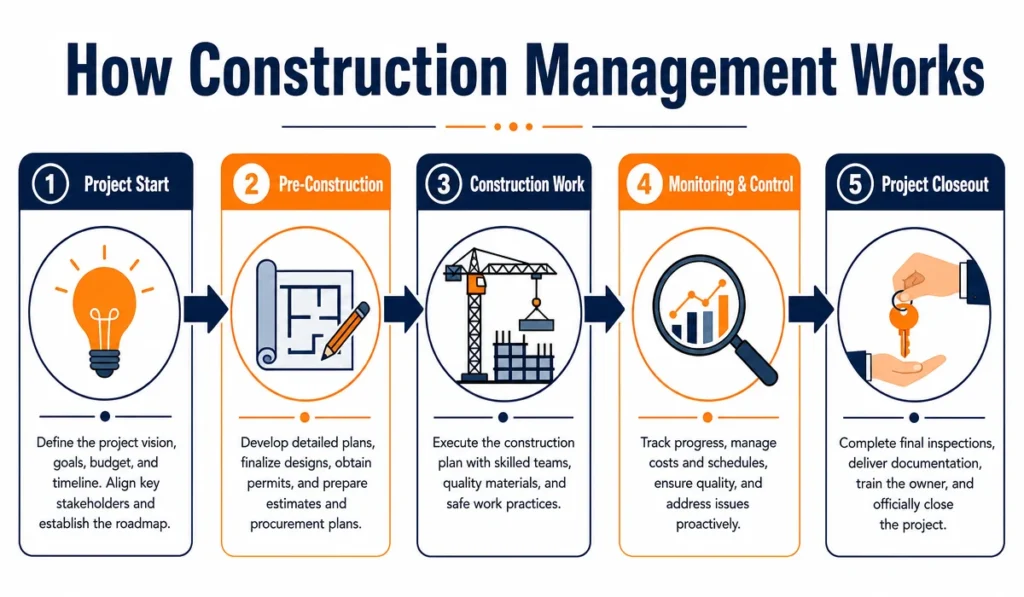
Construction management is not one job. It is a structured process with clear phases that guide a project from the first idea to the final handover. Each stage has its own goals, tasks, and decisions that help keep the project on schedule, within budget, and up to quality standards. Here is how the construction management process usually goes and how to manage construction from day one.
Project Start
This is where the idea turns into a plan. The owner sets the goals, the money range, and the general scope. The construction manager may be brought in here to talk about what is doable before any real money is spent.
Pre Construction
Before a shovel hits the dirt, there is a lot to sort out. This includes site checks, permits, design help, cost guesses, and the schedule. This step is where a real construction management plan takes shape, since most costly mistakes are made, or stopped, at this stage.
Construction Work
This is the step people picture when they think of the construction management process. Crews on site, materials coming in, work happening in the right order. The construction manager is guiding trade teams, tracking work against the plan, and fixing problems as they pop up.
Watching and Control
This runs side by side with the work. It is the ongoing check-in. Is the budget holding? Is the plan holding? Is the quality holding? Site walks and reports happen here.
Project Close Out
The last walkthrough, the punch list, final checks, and the handover to the owner. This also covers wrapping up papers, last payments, and closing contracts.
What Does a Construction Manager Do?
So what does construction management do day to day? A lot, to be honest. Here is what a construction manager really handles. This is a solid list of construction project manager responsibilities.
- Plans the project by mapping timelines, resources, and order before work starts
- Gets architects, engineers, and contractors moving together
- Manages budgets and tracks every dollar from guess to final cost
- Watches schedules and shifts them as issues come up
- Looks after the real work happening on site
- Manages contracts, change orders, and claims
- Talks with owners and partners with regular updates
- Checks quality with tests to catch issues early
- Runs safety by pushing site safety rules
- Spots and manages risks before they cost money.
- Keeps project papers, such as RFIs, submittals, daily logs, and notes
- Handles the final project handover to the owner
A construction manager focuses on the bigger picture. They manage the budget, schedule, resources, and coordination across the project, not only what is happening on the site each day. A project manager has a similar role but may be responsible for a specific part of the project, while the construction manager oversees the project as a whole.
Core Jobs of Construction Management
Construction management breaks down into a few core jobs. Each one focuses on a specific part of delivering a successful project, but they all work together to keep the project on schedule, within budget, and up to quality standards. When these responsibilities are managed as one coordinated system, construction projects run more smoothly from start to finish.
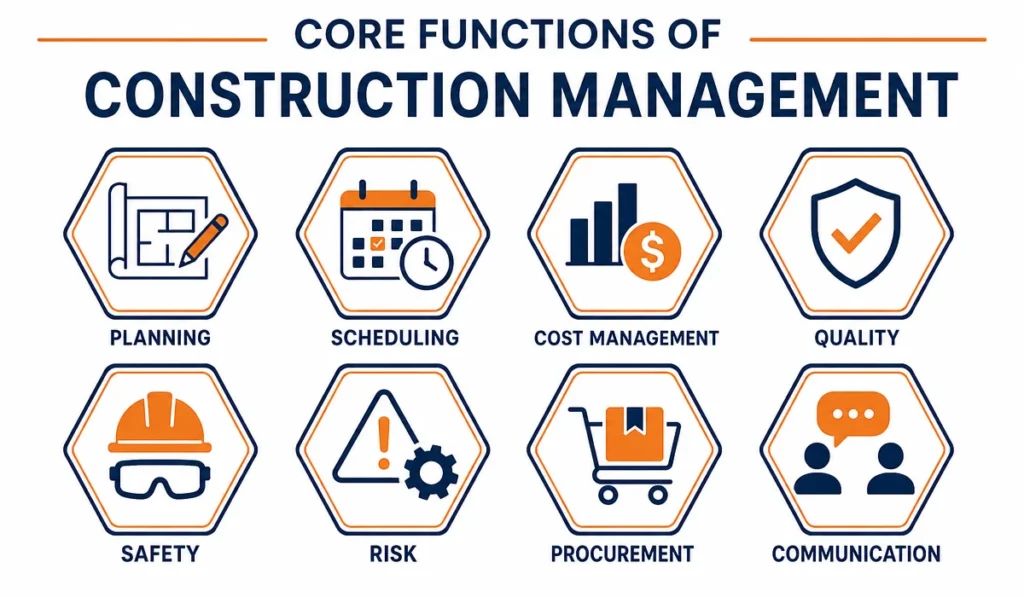
Construction Planning
Planning is where it all starts. It means mapping out what needs to happen, in what order, with what tools, before any work begins.
Why it matters: skip this step or rush it, and you are setting up delays and money surprises later. Good planning finds clashes, like two trades needing the same space, before they turn into site fights.
Key planning tasks include setting the scope, laying out milestones, listing resource needs, and building the first project timeline.
Construction Scheduling
Construction scheduling is the road map that keeps a construction project management process on track. It puts each task in order so trades do not trip over each other and deadlines do not slip.
Common ways include the Critical Path Method, or CPM, Gantt charts, and more and more software tools that update as things change.
Why it hits project success so much: a schedule is not just a calendar. It is what keeps costs down. Every day of delay often means added labor, rented gear sitting still, or fine clauses kicking in.
Construction Cost Management
This is where budgets live or die. Construction cost management covers:
- Cost estimating, which guesses what the project will cost before it starts
- Budgeting, which splits that guess across steps and groups
- Cost control, which manages spending to stay on budget as work happens
- Cost tracking, which checks real costs against the budget in real time
Construction Quality Management
What is quality management in construction? It is the system that makes sure the finished work meets the rules it is meant to. So what is construction quality management? It has four parts. Quality planning sets the rules up front. Quality care builds steps that stop defects. Quality control checks the real work. And formal inspections sign off at key steps.
Construction Safety Management
Construction safety management covers site safety plans, OSHA rules, regular safety checks, and proactive measures to stop incidents before they happen. It is not a nice-to-have. Effective construction safety management keeps workers safe and protects the project and owner from costly incidents, violations, and liability.
Construction Risk Management
What is risk management in construction? It is the ongoing job of spotting trouble before it happens. It runs in four steps:
- Risk spotting, which flags issues in cost, safety, schedule, weather, and supply
- Risk sizing, which figures out how likely and how bad each risk is
- Risk cutting, which builds a plan to lower or avoid the risk
- Risk watching, which keeps an eye on it through the whole project
Construction Procurement Management
Buying covers materials, picking vendors, orders, and delivery time. Get this wrong, and a whole crew can stand around waiting on materials that were due last week.
Construction Contract Administration
This job covers contract care, change orders, claims, and rule follow-up. It is the paper side of construction management, but it is not just red tape. A missed change order can quietly ruin a budget.
Construction Documentation
Documentation includes RFIs, or requests for information, submittals, daily reports, meeting notes, and project records. It sounds dull, but it is what protects everyone if a fight comes up later, and it keeps the whole story of the project in one place.
Construction Communication Management
Construction communication management ties every aspect of a project together. It includes communication with owners, collaboration among project teams, progress reporting, and stakeholder meetings. Many construction projects encounter delays, disputes, or cost overruns because of poor communication at some stage of the project.
You may also hear the term what is facilities management in construction. That is the job of caring for a building after it is built, such as upkeep, systems, and long-term use. Along the same line, what is asset management in construction is the job of caring for the value of buildings and gear over their full life.
Types of Construction Management
Not every project uses the same setup. Here is how the main types of construction management differ.
| Model | How It Works |
| Traditional Construction Management | The CM is hired early for advice and team work but does not build the work |
| Construction Manager as Agent (CMA) | The CM stands for the owner and manages contracts, plans, and trade teams for them |
| Construction Manager at Risk (CMAR) | The CM takes on money risk and gives a set top price for the project |
| Design Build | One group does both design and building for smooth talk |
| Integrated Project Delivery (IPD) | Owner, architect, engineer, and CM share risk and reward as a team |
| Engineering, Procurement, and Construction (EPC) | One contractor does design, buying, and building as one package, common in factories |
What is construction manager at risk in plain words? It is the model where the CM is not just giving advice. They are on the hook for the money and must deliver the project at or under the price they quoted. That is why many owners like it when they want cost peace of mind.
Construction Management vs Other Ways to Deliver
People mix these terms up all the time, so here is the quick version.
Construction Management vs Project Management
Project management is a wider skill used in any field. Construction project management is that same skill used just for buildings, with things like permits, trades, and site safety added on top. So what is construction project management? It is project management shaped for the build world.
Construction Management vs General Contracting
A general contractor runs the build, hires trade crews, and coordinates the work. When choosing a general contractor, consider their experience, communication, and ability to deliver on time and within budget. A construction manager often gets involved earlier
to advise on budget and design and represent the owner.
Construction Management vs Design Build
In design-build, one company does both design and building under one contract. In classic construction management, the CM is a separate party who works between the owner and a separate design team.
Construction Management vs Civil Engineering
Civil engineering is a technical field focused on structural and public works design, while construction management focuses more on building and executing those projects. Construction management is broader, covering budgets, planning, scheduling, and teamwork across every trade on a project, not just the engineering side.
Benefits of Construction Management
Why do owners keep paying for this? Because it works. Every step runs tight, every dollar is easy to track, and problems get caught while they are still cheap to fix. Here is what that looks like in real life.
Better Cost Control
Budgets rarely blow up all at once. They creep, one small overrun at a time. Construction management tracks spending all the time, so those small overruns get flagged and fixed before they add up to a real problem.
Better Quality
Quality does not just happen. It happens through steady checks. A construction manager looks at work at every step, not just at the end, so defects get caught while they are still easy and cheap to fix.
Faster Project Finish
Delays often come from bad task order, not bad luck. A tight schedule keeps trades moving in the right order, so crews are not waiting, and one late task does not stop the whole job.
Better Use of Resources
Labor and materials cost money to waste. Construction management makes sure both go where they are needed, when they are needed, instead of sitting still or being ordered twice by mistake.
Better Communication
Projects fall apart when everyone talks past each other. A construction manager is the one point of contact, taking the place of a dozen broken chats between owner, design team, and field crews.
Lower Project Risks
Fixing a problem always costs more than stopping one. A strong risk plan means issues get spotted early, instead of turning into pricey messes once they have hit the job site.
More Clear View
Owners should not have to guess how their project is going. Regular reports keep them in the loop on budget, plan, and progress, so there are no bad surprises at the end.
Happier Clients
At the end of the day, this is what it all adds up to. Projects that finish on time, on budget, and to plan tend to make people happy, and that is the whole point of construction management.
Common Problems in Construction Management
It is not all easy sailing. Even with a strong construction management plan, projects run into real bumps:
- Budget overruns that eat into the bottom line
- Project delays from weather, permits, or supply issues
- Scope creep, when the project quietly grows past its first plan
- Labor gaps when there are not enough skilled workers
- Material price swings mid-project
- Supply chain issues with items stuck in transit or on back order
- Safety risks, since job sites are risky by nature
- Communication breakdowns between owner, design team, and field crews
- Rule and permit changes that shift over time
Part of what makes a good construction manager worth the pay is how they handle these when they come up. Not if, but when.
Tech in Construction Management
The construction industry has changed a lot over the last decade, and technology has played a major role in that shift. Modern digital tools help teams plan projects more accurately, improve communication, monitor progress in real time, and spot potential problems before they become costly delays. Here are some of the most important technologies shaping construction management today.
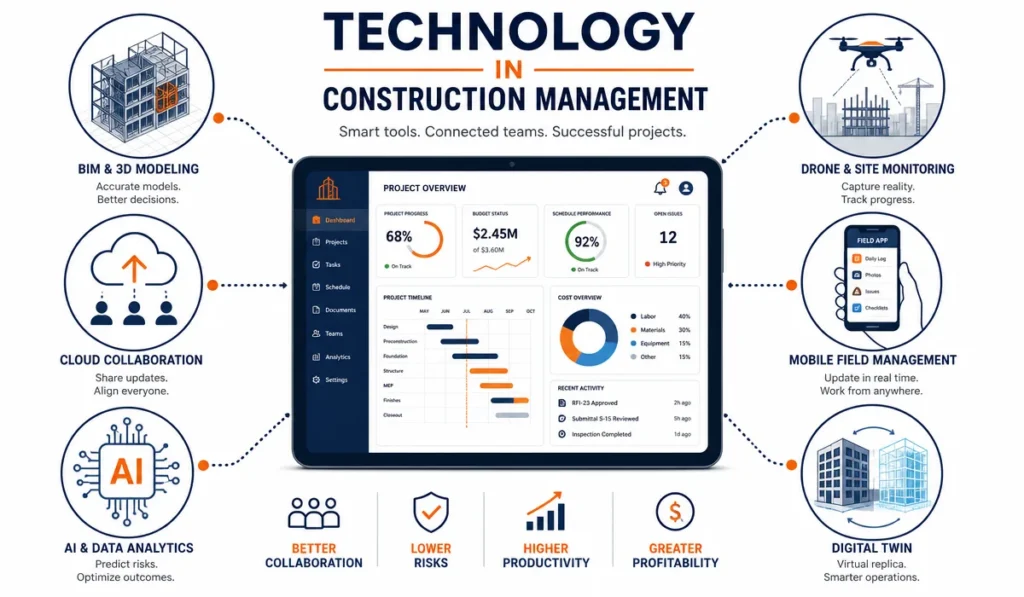
- Building Information Modeling, or BIM, which is 3D modeling that lets teams see and plan the build before it starts
- Construction management software for tracking budgets, plans, and papers in one place
- AI and automation, which are more and more used to guess schedules and costs
- Drones for site checks and progress from the air
- Mobile field apps that let site teams update progress and flag issues in real time
- Cloud sharing that gives access to papers and plans across all people
- Digital twins, which are live digital copies of a building used for tracking, even after the building is done
These tools do not take the place of the construction manager. They just make it easier to catch problems and keep everyone in sync.
Why Hire a Construction Management Company?
If you are an owner and you are not sure you need this service, here is what you are paying for:
- Pro project care from someone who watches every step, not just the parts you check on
- Better cost and budget control with fewer blown budgets and sharper guesses
- Lower project risk because problems get caught before they cost a lot
- Better quality with steady checks instead of hoping things turn out fine
- Better teamwork so you do not have to chase five contractors on your own
- On-time delivery from a dedicated schedule owner
- Rule follow-up from someone who knows permits and codes.
- One point of blame, so one team is on the hook for the outcome instead of finger-pointing between contractors.
That last point is really the biggest one. When something goes wrong on a project without a construction manager, it is often not clear whose job it was to catch it. With one in place, that fog goes away.
Common Questions
What is construction management?
It is the professional care of a construction project, such as planning, budgets, plans, and teamwork with everyone, from the first idea to the final handover.
What does a construction manager do?
They plan the project, manage the budget and plans, work with contractors and trade crews, watch quality and safety, and talk with the owner the whole way through.
Why is construction management important?
Without it, projects are much more likely to run over budget, miss deadlines, or hit quality and safety issues. It is the layer that keeps everything lined up.
What are the steps of construction management?
Project start, pre-construction, construction work, watching and control, and project closeout.
What are the core jobs of construction management?
Planning, scheduling, cost care, quality care, safety care, risk care, buying, contract care, paperwork, and Communication.
What is the difference between construction management and project management?
Project management is a general skill used in many fields. Construction project management uses those same ideas just for building projects.
What is the difference between construction management and general contracting?
A general contractor does the build and runs the trades. A construction manager often starts earlier, stands for the owner, and cares for the whole process, even the contractor’s own work.
What industries use construction management?
Commercial, home, factory, health care, school, hotel, retail, public works, and government projects all use it.
When should you hire a construction management company?
As early as you can, ideally in pre-construction, when planning has the biggest hit on cost and the plan.
How does construction management cut project costs?
By catching budget issues early, holding change orders in check, and keeping the plan tight enough that delays do not roll into more costs.
How does construction management raise project quality?
Through steady checks, clear quality rules set at the start, and blame built into every step.
What software is used in construction management?
Common tools include BIM, cloud-based project management software, scheduling tools, and mobile field apps, all used to keep budgets, plans, and papers in sync.