Construction sends more workers to the hospital than almost any other job in the country. Big machines, work up high, live wires, and site conditions that change hour by hour all add up to real risk. One bad day on a job site can mean a death, a shutdown, a lawsuit, or all three at once.
Construction safety management is how contractors get in front of that risk instead of cleaning up after it. Done right, it is not a binder sitting in a site trailer collecting dust. It is a working system built from policy, people, checks, training, and tools, and it is what keeps crews alive while keeping the job on time.
This guide covers what construction safety management really involves, why it matters past the moral duty, and how to build a program that holds up in the field, not just on paper.
What Is Construction Safety Management?
Construction safety management is the ongoing job of spotting hazards, controlling risk, and enforcing safety rules across a job site to protect workers, equipment, the public, and the schedule. As part of construction management, it combines written policies, daily field practices, and safety software to prevent incidents before they happen.
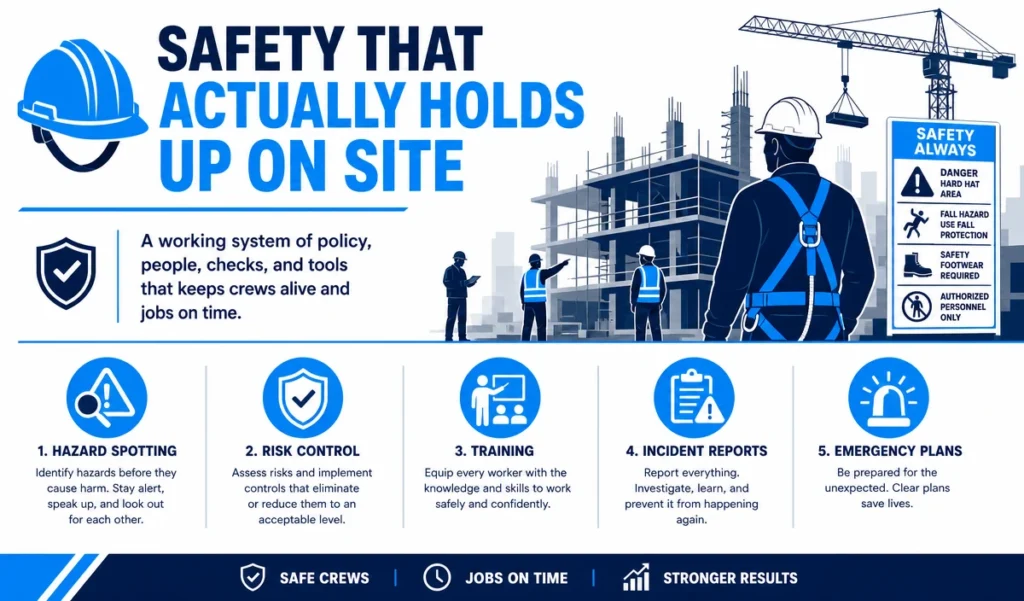
So what is safety management in construction when you break it down to the working parts? It comes down to a short list of jobs working together:
- Hazard spotting. Catching risks before they hurt someone.
- Risk sizing and control. Ranking hazards and putting the right controls in place.
- Rule following. Meeting OSHA and any other rules that apply to the job.
- Training and follow through. Making sure every worker knows the safe way to do their job and actually does it.
- Incident reports and reviews. Writing down what happened and fixing the root cause.
- Emergency planning. Having a plan ready before a crisis, not during one.
- Steady upgrades. Updating the program as rules, crews, and project types shift.
Safety management in construction is never owned by one team or one person with “safety” in their title. It touches owners, project managers, superintendents, subcontractors, and every worker who steps on the site. Good construction site safety management runs on shared duty, not on one lone safety officer.
Why Construction Safety Management Is Important
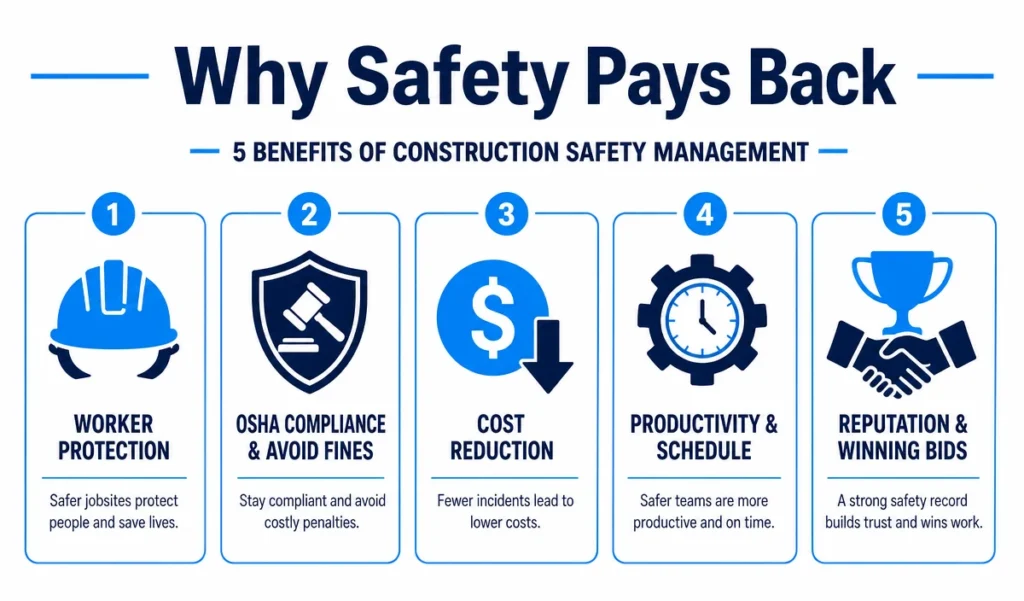
Construction management protects workers, reduces workplace hazards, and promotes a safer, more productive job site. An effective safety management program helps prevent injuries, ensures compliance with OSHA regulations, lowers project costs, and supports the successful completion of construction projects.
Worker protection comes first
Every other win from a safety program flows from this one. Falls, being hit by something, shocks, and getting caught in or between things, what OSHA calls the “Fatal Four,” cause most construction deaths each year. A working safety system cuts the odds of any of them happening on your site.
Rule following and dodging fines
OSHA construction safety requirements and equipment rules are real law, not friendly tips, and fines add up fast. One serious violation can run into tens of thousands of dollars, and repeat or willful ones climb well past that. On top of the fine, an OSHA visit can hold a project up for weeks.
Cost cuts
Workers’ comp claims, insurance rates, equipment damage, and legal risk all spike after an incident. U.S. employers together pay close to $1 billion a week in direct workers’ comp costs for disabling injuries. Effective construction management helps prevent incidents, reduce project risks, and control these costly expenses. Strong construction cost management also helps teams plan expenses and avoid unnecessary project costs. Preventing an incident is almost always cheaper than paying for one.
Productivity and project flow
A site shutdown for an incident review does not just cost money in claims. It costs schedule days that rarely come back easy. Crews who trust the site is run well on safety also tend to work better, since they are not second guessing conditions or covering for missing PPE and broken gear.
Name, bidding, and keeping workers
General contractors and owners now check subcontractors on safety record before handing out work. A strong EMR (Experience Modification Rate) and a clean incident history help win bids. A weak one loses them, and it makes it harder to keep skilled workers in a tight market.
Common Construction Safety Hazards
Not every hazard carries the same weight. Some are steady background risk. Others show up only on a certain trade or phase of the job.
| Hazard Category | Description | Common Examples |
| Falls from height | The top cause of construction deaths | Open edges, roof work, scaffolding, ladders |
| Struck-by hazards | Getting hit by moving gear, trucks, or falling stuff | Mobile equipment, crane loads, falling tools or materials |
| Electrocution | Contact with live power | Overhead lines, damaged cords, open panels |
| Caught-in/between | Being crushed, pinched, or trapped | Trench cave-ins, open machine parts, equipment rollover |
| Ergonomic strain | Slow-build injury from repeat or awkward tasks | Manual lifting, repeat motion, poor posture |
| Environmental exposure | Weather and site linked illness | Heat stress, cold, bad air, loud noise |
| Chemical exposure | Contact with harmful stuff | Silica dust, asbestos, solvents, glues |
These seven groups cover most recordable injuries in construction. A serious safety program tracks contact with each one by project type and phase instead of running the same generic checklist on every job.
Key Components of an Effective Construction Safety Management System
OSHA builds effective safety management around four pillars. Nearly every mature safety program, no matter the company size, is built on some form of this setup.
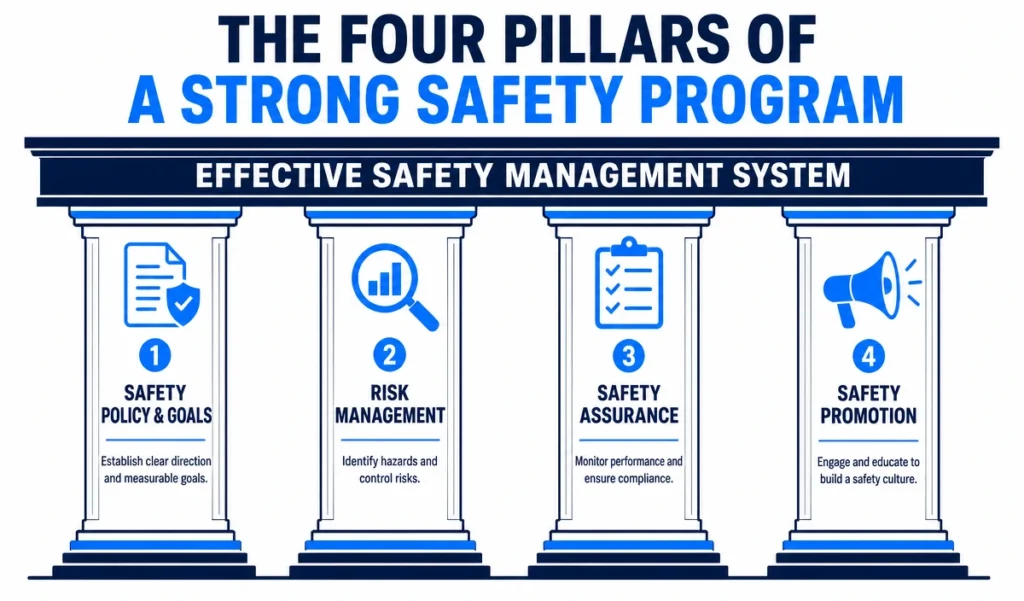
Safety policy and goals
This is the written base. A written note from leadership saying what the company expects, who is on the hook for what, and how safety gets measured. Without this in writing and signed off by workers, the rest of the program loses its bite.
Risk management
This covers construction risk management by spotting, sizing, and ranking the hazards tied to each project. It includes job hazard reviews, pre-task planning, and formal risk checks before work starts, not after an incident forces it.
Safety assurance
Safety assurance is the watch layer. Checks, audits, and data that confirm the risk controls really work in the field. This is where a program either proves itself or shows its holes.
Safety promotion
The last pillar is culture: training, toolbox talks, praise programs, and open talk that keeps safety top of mind for every worker, not just the one with the word in their title.
How to Create a Construction Safety Management Plan
A safety plan should fit the company and, when possible, get shaped further for each project. Building one usually follows this order:
- Check your starting point. Look at past incidents, near misses, and current safety data to spot repeat problem spots.
- Set policy and goals. Put leadership’s safety promise and clear goals in writing.
- Spot project hazards. Walk the site plan, scope of work, and the trades involved to flag likely risks before crews show up.
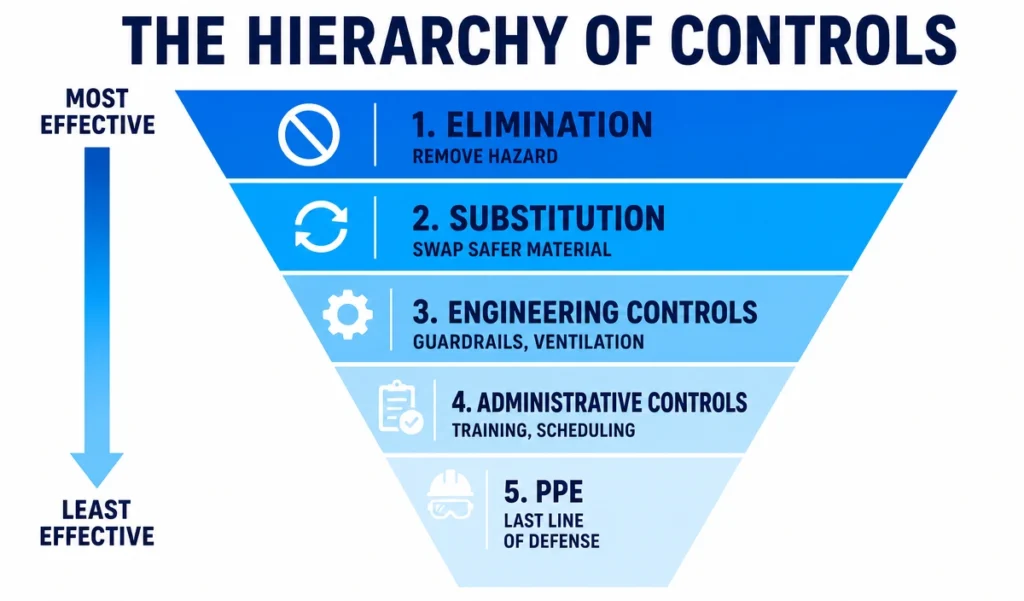
- Set risk controls. Use the hierarchy of controls in this order: remove, swap, engineering controls, admin controls, then PPE.
- Build training and talk plans. Decide how info reaches every worker, including subs and new hires.
- Set inspection and reporting steps. Set how often to inspect, checklist rules, and who signs off.
- Write emergency steps. Write down exit routes, first aid steps, and how people talk during a crisis.
- Give out ownership. Name who owns each part of the plan, from owners down to foremen.
- Review and update often. Treat the plan as a living paper, not a one-time job.
Construction Risk Assessment Process
Construction risk assessment is the process of identifying workplace hazards, evaluating the level of risk they pose, and implementing measures to control or eliminate those risks. Conducting regular risk assessments helps prevent accidents, protect workers, and ensure compliance with OSHA safety standards.
Hazard spotting
Before any task starts, walk through the work plan and flag what could go wrong: the gear used, the weather, and the other crews working close by.
Risk sizing
Once hazards are named, rank them by how likely they are and how bad they could be. A simple risk grid works well:
| Likelihood \ Severity | Minor | Moderate | Severe |
| Unlikely | Low | Low-Medium | Medium |
| Possible | Medium | Medium-High | High |
| Likely | Medium-High | High | Critical |
Risk control
Use the hierarchy of controls, starting with the strongest choice: remove the hazard, swap in a safer way or material, use engineering controls like guardrails and vents, use admin controls like scheduling and training, and lean on PPE as the last line of defense, not the first.
Watching and review
Risk review is not a one-time task. Site conditions change daily, so reviews should happen at key milestones and after any near miss or incident.
Safety Training and Worker Engagement
Training only works if it is clear, repeated, and backed up in the field, not a one-time orientation video.
- Formal certification. OSHA 10-Hour and 30-Hour Construction courses are still the baseline on most U.S. job sites.
- Site-specific onboarding. Every new worker, subs included, should get a briefing on the site’s own hazards before starting work.
- Toolbox talks. Short, steady safety chats that keep hazards front of mind and give workers a place to speak up.
- Mentor programs. Pairing seasoned workers with new hires passes on safety know-how that a manual never fully catches.
- Language access. Training and safety talks need to reach every worker in a language they read well, not just English.
Worker engagement is what boosts results. Programs that actively pull ideas from the field, instead of only pushing rules down from above, see stronger follow through and faster hazard reports, because workers feel ownership over the outcome instead of just being told what to do.
Construction Safety Inspections
Inspections are how a safety plan gets tested against real life. They should happen at more than one level: daily walkthroughs by supervisors, weekly formal checks by the safety manager, and every so often audits by insurance carriers or outside parties.
A solid construction safety inspection checklist usually covers:
- Fall protection setups (guardrails, harnesses, anchor points)
- Scaffolding and ladder condition and setup
- Electrical systems, cords, and panel access
- Trench and dig shoring
- Housekeeping: trash, material storage, blocked walkways
- PPE follow through across all active crews
- Fire extinguisher access and condition
- Equipment inspection tags and service records
- Signs, barricades, and site access control
Digital checklists have mostly taken over from paper on active sites because they timestamp findings, add photos, and send fixes straight to the person on the hook. That closes the loop faster than any clipboard ever could.
Personal Protective Equipment (PPE) in Construction
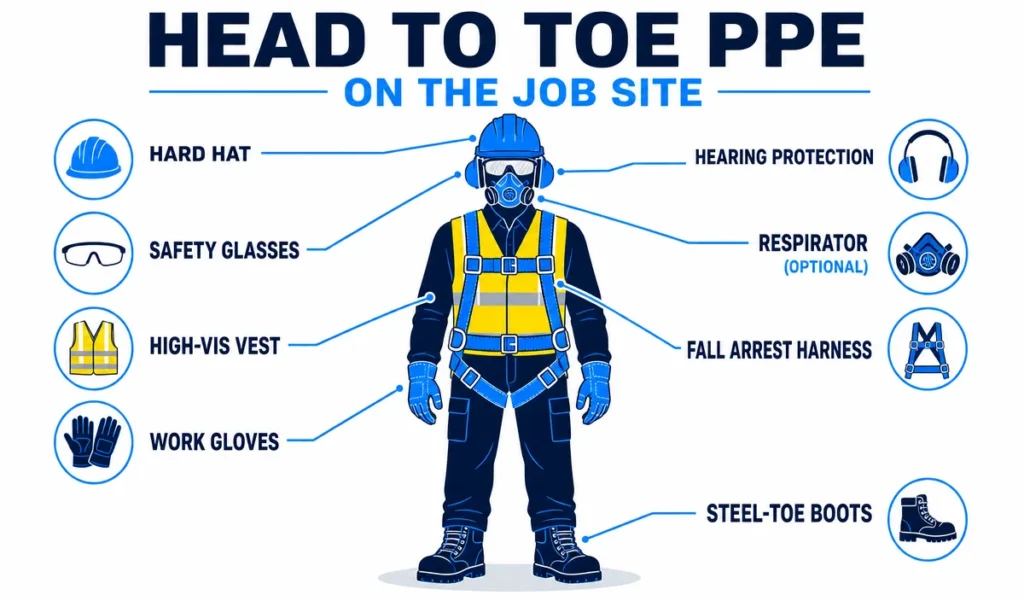
PPE is the last layer of defense, not a stand-in for removing the hazard first, but it is still a must on an active site. OSHA construction safety requirements and equipment rules spell out the minimum PPE by task and contact type.
| Hazard | Required PPE |
| Falling objects, low headroom | Hard hats (Type I/II as the job needs) |
| Flying bits, dust, chemical splash | Safety glasses or goggles |
| Foot injury, punctures | Steel or composite-toe boots |
| Loud noise | Hearing protection |
| Cut hands, chemical contact | Task-fit gloves |
| Falls from height | Fall arrest harness and lanyard |
| Airborne dust (silica, dust) | Respirators, fit-tested where needed |
| High visibility near traffic or gear | High-visibility clothing |
The OSHA equipment safety requirements construction crews follow also go past PPE to the gear itself: guardrails on machines, working backup alarms, right load ratings, and clear inspection tags on ladders, scaffolds, and power tools. A safety program that only checks PPE while ignoring gear condition is only doing half the job.
Incident Reporting and Investigation
Incident reporting and investigation help identify hazards, prevent repeat incidents, and strengthen workplace safety. Every report provides valuable information about workplace risks and helps organizations improve procedures, training, and hazard controls.
Near-miss reporting
A near miss is a free lesson, an incident that almost happened but did not. Sites that push near-miss reports without pinning blame catch bigger problems long before they cause a real injury.
Investigation process
When an incident does happen, the goal is root cause, not blame. A full review usually includes:
- Locking down the scene and gathering right-there evidence
- Talking to witnesses while the details are still fresh
- Checking whether steps were followed or skipped
- Naming what fed into it, like a training gap, gear failure, weak supervision, or worker fatigue
- Writing down the fixes and a timeline for when they get done
Recordkeeping
OSHA tells covered employers to keep injury and illness records (OSHA Form 300, 300A, and 301) and report certain serious incidents: deaths within 8 hours, and hospital stays, amputations, and eye loss within 24 hours. Solid records are not just paperwork for the rules. They are the data your safety program should be learning from.
Emergency Preparedness and Response
Every site needs a written, practiced emergency plan that covers:
- Fire and blast. Exit routes, extinguisher spots, meet-up points.
- Rough weather. Shelter steps for high wind, lightning, or heavy heat.
- Building failure or cave-in. Shutdown and exit steps.
- Medical events. First aid steps, trained people on site, nearest hospital route.
- Utility hits. Steps for hitting gas lines, power conduit, or water mains.
Plans only work if workers really know their part in them. Regular drills, not just a printed sheet in the trailer, are what tell the difference between a plan that holds up under pressure and one that only lives on paper.
Common Challenges in Construction Safety Management
Even well-funded programs run into the same repeat problems:
- High turnover. Always onboarding new or short-term workers stretches training.
- Multi-language crews. Safety talk breaks down when materials are not in every worker’s first language.
- Push for output. Tight deadlines create a pull to cut corners, and “production beats protection” is still one of the top root causes showing up in incident reviews.
- Weak view across sites. Companies running many active projects have a hard time tracking safety without one central data spot.
- Sub coordination. Holding one safety standard across many separate crews on the same site is a steady point of friction.
- Tight budgets. Smaller contractors often skimp on training and gear until an incident forces the spend.
None of these get fixed by policy alone. They need steady follow through, talk systems built for a multi-language, high-turnover crew, and more and more, software that gives safety managers a view they cannot get just by walking the site themselves.
Construction Safety Management Best Practices
Good plans rarely hold up on a busy job site by themselves. These practices come from what sets programs that really cut incidents apart from ones that just make paperwork, no matter the company size or project type.
Make safety a value, not a checklist
Policy matters less than whether workers really think leadership puts safety first. When crews see calls favor protection over shortcuts, follow through comes on its own instead of feeling forced or pushed back on.
Bring workers into planning, not just enforcement
The crews doing the work usually know the hazards better than anyone writing policy from an office. Pulling their input into pre-task planning catches risks that top-down steps often miss.
Standardize pre-task planning
A five minute hazard talk before work starts prevents far more than any post-incident report ever will. Making it routine, not optional, keeps risk fresh in mind every shift.
Put money into real training, not box-checking
Site-specific, hands-on training beats a generic yearly video every time. Workers hold on to lessons tied to their real tools, tasks, and site conditions far longer than lines read off a slide.
Use data to find patterns
Repeat near misses or slips in the same spot usually point to a system issue, not a string of one-off mistakes. Tracking trends helps managers fix causes instead of symptoms.
Bring in digital tools where they add speed
Inspection apps, incident tracking, and central dashboards close the loop between finding a hazard and fixing it. The right tools cut response time without piling more work on field crews.
Audit and revise often
A safety plan written two years ago probably does not match your current crews, gear, or project types. Regular reviews keep the program lined up with how the company really runs today.
Frequently Asked Questions
What is construction safety management?
It is the steady process of spotting hazards, controlling risk, training workers, and holding rules to stop injuries and deaths on construction sites.
What are the four pillars of construction safety management?
Safety policy and goals, risk management, safety assurance, and safety promotion, a frame widely drawn from OSHA’s safety management system guidance.
Who is responsible for safety management on a construction site?
Everyone, in theory, but in real life owners and project managers set policy, safety managers build and run the program, superintendents watch daily field follow through, and every worker owns following steps and reporting hazards.
What should a construction safety inspection checklist include?
Fall protection, scaffold and ladder condition, electrical safety, dig shoring, housekeeping, PPE follow through, fire safety gear, and equipment inspection records at the least.
What OSHA training is required for construction workers?
OSHA does not require the 10-Hour or 30-Hour Outreach courses across the board at the federal level, but many states, cities, and general contractors ask for them as a condition of working on a site.
How often should a construction safety plan be updated?
At least once a year, and any time there is a big change in project scope, crew makeup, or gear, or after an incident or near miss shows a hole.
Final Thoughts
Construction safety management is not a paper you file away after the project kickoff. It is a system that has to hold up under real schedule pressure, real weather, real turnover, and real sub crews who never read the safety plan you wrote.
The companies that get this right treat safety the same way they treat cost or quality: with clear ownership, steady tracking, and a willingness to fix what is not working instead of running the same checklist year after year. That is the gap between a safety program that lives on paper and one that really keeps people alive.