Northern Illinois shows how much new demand utilities are being asked to absorb. By March 2026, more than 75 large-load projects were waiting in ComEd’s queue, data centers among them. Combined, they asked for over 28,000 MW. No peak in ComEd’s history has gone above 24,000 MW.
Demand on that scale has changed the answer to a basic question. Owners still ask it on almost every project: how long does it take to build a data center? The structure itself can go up within a year. Getting enough electricity to the site is slower, sometimes by several years, and in many markets that wait sets the opening date.
How Long to Build a Data Center: The Short Answer
Any figure for the average time to build a data center depends on when the count begins and ends. For a 50 MW facility, JLL’s 2026 outlook gives 18 months. Expect 18 to 24 months for most mid-size projects, counted from the day crews mobilize. That range covers data center construction time alone. Understanding the data center construction process helps clarify how construction fits into the broader project timeline.
Measured from the first site search to servers running live workloads, the full schedule runs three to five years, and sometimes longer, in markets where power is scarce.
Data Center Construction Timeline by Phase
Counting in months makes a data center construction timeline easier to follow because several phases overlap instead of running in a neat sequence. The table shows typical ranges for mid-size U.S. projects and what tends to drive each one:
| Phase | Typical duration (months) | What controls it |
| Site selection and due diligence | 3 to 9 | Power availability and zoning |
| Utility power and interconnection | 12 to 60+ | Load studies and grid upgrades |
| Design and permitting | 6 to 12 | Rack density and local review cycles |
| Long-lead electrical equipment | 18 to 48 for large transformers | Factory production slots |
| Site work and building shell | 6 to 9 | Weather and structural deliveries |
| Electrical and mechanical fit-out | 10 to 15 | Electrician headcount |
| Commissioning and testing | 2 to 4 | Failed tests and retests |
Sources: Electrical Contractor, Bohler Engineering, Wood Mackenzie, Data Center Knowledge, Archdesk
(Adding the rows will overstate the total, since the phases overlap. Use these numbers for early planning only. Your utility and your local permit office decide the real dates.)
What matters most is the order of the work. A shell is usually closed in after six to nine months, but no one can energize the hall until its switchgear and transformers are delivered. Those waits have grown, making construction project planning essential for coordinating procurement, scheduling, and overlapping phases.
JLL’s figure for the average equipment lead time is now 33 weeks, up roughly 50 percent from pre-2020 levels, and large transformers take far longer. Experienced teams therefore place equipment orders while design is still underway.
How Long Do Data Centers Take to Build by Size?
Size changes the schedule because larger sites need more power and more long-lead equipment. An edge deployment built from prefabricated modules moves through the same phases as a gigawatt campus, just in far less time. Construction times compare as follows:
| Facility type | IT load | Typical construction time |
| Prefabricated modular or edge | Under 5 MW | 6 to 12 months |
| Enterprise or colocation building | 5 to 50 MW | 18 to 24 months |
| Hyperscale or AI campus | 100 MW to over 1 GW | 18 to 24 months per building, with campuses phased over several years |
Sources: Vertiv, Connect CRE, Electrical Contractor, Epoch AI
(Here, construction time runs from mobilization to the end of commissioning. It leaves out the utility connection, which can add years in constrained markets.)
Large campuses do not always take longer in proportion to their size. In a November 2025 analysis, Epoch AI put the time from construction start to 1 GW of power at 1 to 3.6 years for the U.S. AI campuses it tracks. Several hyperscalers were planning to reach that mark in under two years.
Why the Power Connection Sets the Finish Date
A completed data hall earns nothing until the utility energizes it. Before committing to a large load, the utility studies how the new demand affects its system and then designs the substation or transmission upgrades needed to serve it. JLL’s 2026 outlook names speed to power as the primary factor in site selection. In other words, the time to build data center capacity now depends more on the grid than on the building.
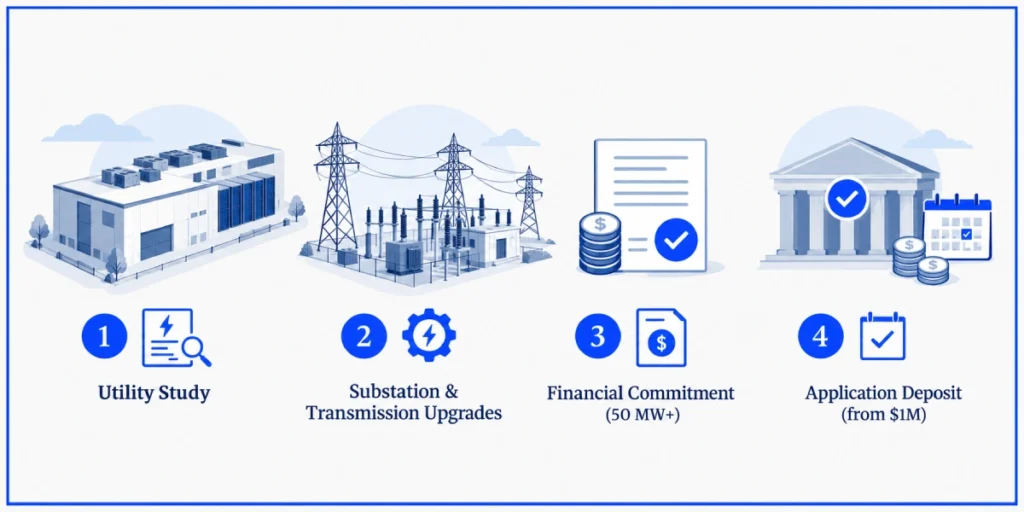
Utilities are also tightening the requirements for new requests. In January 2026, ComEd said it requires a firm financial commitment from projects of 50 MW or more.
Two months later, Illinois regulators approved application deposits that start at $1 million for projects of 50 to 200 MW. Rules like these raise the cost of a speculative request. For owners who do intend to build, a complete, well-documented application has become more important.
How Fast Are Data Centers Being Built Today?
Record builds show how far a schedule can be compressed under the right conditions. NVIDIA reported that xAI’s Colossus supercomputer, set up in a former Electrolux factory in Memphis, was built in 122 days. Training began just 19 days after the first rack reached the floor. That pace depended on reusing an existing building and is not a realistic benchmark for most owners.
Across the market, the volume of construction keeps rising. JLL expects nearly 100 GW of new data center capacity to come online between 2026 and 2030. That volume of work keeps transformer factories and utility engineering teams booked well in advance.
What Causes Data Center Construction Delays?
Delays have become common across the sector. In 2025, about 57 percent of data center projects ran at least three months behind schedule, by JLL’s count. Most data center construction delays come from a short list of causes:
- Utility upgrades that slip past their in-service date, leaving a finished hall without permanent power.
- Transformer shortages. U.S. demand for power transformers has climbed 116 percent since 2019, and Wood Mackenzie expected supply to fall 30 percent short in 2025.
- Late design changes. When a tenant moves to denser AI racks after chillers are already on order, the engineers may have to redesign the cooling layout.
- Electrician shortages. In busy markets, several large jobs may be competing for the same licensed crews at once.
- Public opposition. Neighbors who object to generator noise or water consumption can push a zoning decision through extra hearings or an appeal.
How to Shorten a Data Center Construction Schedule
Months can be won back, although years are harder to recover unless power is arranged early. Each method below has a price in money or in risk, and owners choose based on what their budget and schedule can absorb. Four approaches have the largest effect on a data center construction schedule.
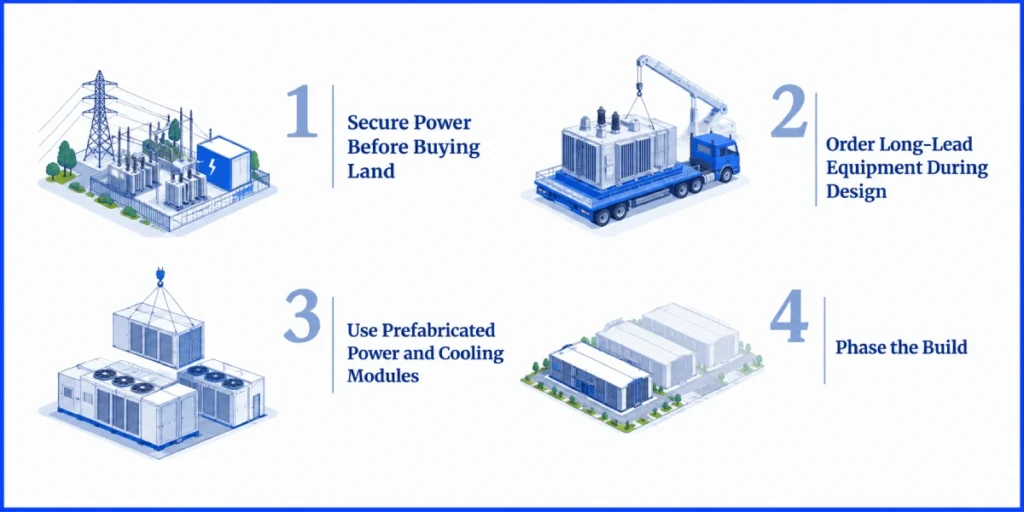
Secure Power Before Buying Land
Filing the utility request before closing on land, or buying a site with committed capacity, addresses the longest wait directly. Neither path is cheap.
Land with committed power costs more to buy. Temporary on-site generation, used as a bridge, may need its own air permit, and it burns fuel every day it runs. Even with those costs, putting power first usually saves more time than any construction shortcut can.
Order Long-Lead Equipment During Design
Releasing purchase orders for transformers and switchgear on early design packages can recover a year or more because the largest units can take over three years to deliver. The downside is design risk.
A layout change after the purchase order can mean paying for a modified unit or redesigning the electrical room around the one already in production.
Use Prefabricated Power and Cooling Modules
Prefabrication moves much of the electrical and cooling work into a factory. Power rooms and cooling skids arrive already tested, and site crews spend those months on foundations instead.
Digital Realty completed HER1, its facility in Crete, within 12 months, using prefabricated systems from Schneider Electric.
The approach has limits. Once modules are in production, design changes become expensive, and the factory’s backlog starts to control the schedule.
Phase the Build
Phasing lets the first data hall go live while later halls are still under construction. Crusoe’s 1.2 GW campus in Abilene, Texas, shows how this works. Its first two buildings, with more than 200 MW, were scheduled to be energized in the first half of 2025, about a year before the other six were due.
The cost is a longer construction period on an active site. A utility that can energize the site in matching blocks makes phasing far more valuable.
Frequently Asked Questions
Owners tend to raise schedule questions before they have even picked a site. The answers here are based on typical U.S. projects in 2026, and they are meant as starting points. Local utility capacity or a slow permit office can move any of these numbers.
How long does a data center take to build once permits are approved?
Plan on 18 to 24 months for a mid-size facility, with commissioning taking up the final two to four. Even then, the building cannot open until the utility energizes the site, and that date may come later.
How long does it take to build a data center capacity for AI?
Construction runs about as long as for any large hall. Liquid cooling for dense AI racks adds some design and testing time. Power is the bigger variable, since a single AI campus can require a gigawatt or more.
How long does it take to construct a data center with prefabricated modules?
Six to 12 months is a typical range because the modules come off a factory line already tested while the site is being prepared. Factory backlogs and the utility connection still set the outer limit.
Final Thoughts
A data center’s schedule is largely fixed before construction starts. Two dates do most of the deciding. One is the date the utility can energize the site. The other is the ship date for the largest transformers, and it can fall a year or more after the building is finished. Get both dates confirmed in writing as early as possible. Once they are, the question of how long to build data center capacity mostly answers itself.
A sequencing problem caught on paper costs a few meetings to fix. Caught in the field, it can cost months. Epic Construction Management reviews budgets and schedules while a capital plan or RFQ is still in draft, and its construction management work continues through site oversight once crews arrive.