By the count in JLL’s 2026 Global Data Center Outlook, a 50 MW data center goes up in about 18 months. Getting power to the site is another matter. In primary markets, the average wait for a grid connection now runs past four years, so a finished building can sit idle while the utility catches up.
Power comes first in the data center construction process, and everything else is planned around it. That changes how to build a data center, because the order of decisions now matters more than the speed of the crews. Effective data center construction management helps coordinate project planning, scheduling, and execution around critical dependencies like power availability.
What Is Data Center Construction?
Data center construction is the design and building of a facility that houses IT equipment, along with the power, cooling, and security systems that keep it running without interruption.
In practice, it is building for uptime. The walls and roof are the easy part. In Cushman & Wakefield’s 2026 cost guide, power infrastructure alone makes up about 21 percent of a greenfield budget, more than any other category.
Scope depends on the occupant. A bank’s enterprise facility might need a few secure halls, while a colocation or hyperscale campus can draw more than 100 MW.
The Data Center Construction Process, Step by Step
The data center development process starts well before groundbreaking, with a power study and a land search. Nothing gets built until the utility and the major suppliers have committed. Then the phases start to overlap. A good schedule plans for overlaps from day one instead of discovering them mid-job.
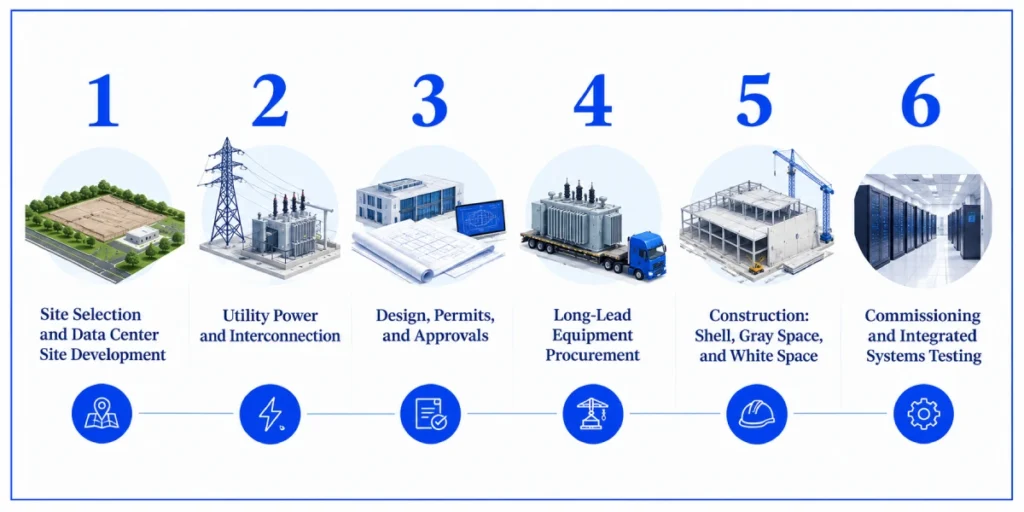
1. Site Selection and Data Center Site Development
Site selection starts with power, not land. Cheap acreage with no utility capacity behind it is no bargain at all. Fiber follows, preferably arriving by two diverse routes. A flood map or a zoning hearing can still undo a promising parcel, so both get checked before the purchase closes.
Then data center site development gets underway, starting with grading and the first utility runs. The site will also need a substation pad and access roads strong enough to carry a transformer delivery.
2. Utility Power and Interconnection
The power request goes in early, sometimes before the land is even bought. From there, the project waits for the utility’s load study, which decides what upgrades the grid needs. The energization date comes last, and it can land years out.
Owners in a hurry tend to choose between two bridges: generating power on site for a while, or starting with a smaller IT load that grows as grid capacity arrives. Designing the electrical system before the utility’s requirements are known is how projects end up redrawing their substations.
3. Design, Permits, and Approvals
Every design conversation opens with the same two numbers: megawatts of IT load and kilowatts per rack. Conventional halls can still be cooled with air. Dense AI racks cannot, at least not efficiently, so more designs now run liquid directly to the chip.
Redundancy is set next, usually at N+1 or 2N. Permits move in parallel. Diesel backup generators can trigger an air permit, and noise and water use tend to come up at the first public hearing. Applications that answer those questions in writing move faster.
4. Long-Lead Equipment Procurement
A data center’s opening date depends mostly on its electrical equipment. The concrete work is quick by comparison.
In 2021, according to Wood Mackenzie, a power transformer took about 50 weeks to arrive. By 2024, the average wait had reached 120 weeks, and large units could take up to 210.
Seasoned owners release purchase orders on early design packages, sometimes before a building permit exists. They accept a little design risk to lock in a delivery slot.
5. Construction: Shell, Gray Space, and White Space
The shell goes up fast. Precast and tilt-up concrete panels are popular for one reason: a building that is closed in early lets the interior trades start sooner.
The harder work happens inside. Gray space is the support side, home to the switchgear and chillers. White space is the data hall itself, the room the rest of the building exists to serve.
Electrical work dominates the labor hours on most of these jobs. When electricians are hard to hire, their crew size becomes the schedule.
6. Commissioning and Integrated Systems Testing
Commissioning climbs through five levels, ending with the integrated systems test. That last level is where the building finally has to prove itself. Load banks stand in for the servers. Then utility power is cut on purpose.
For a few tense seconds, the UPS carries everything until the generators start and pick up the load. Each failure the design claims to survive is proven before a tenant moves in. Trimming two weeks from this phase is a poor trade for a building that is never supposed to go dark.
Data Center Construction Requirements
Most data center construction requirements come from a short list of published standards. The owner and tenants set the targets. The contractor has to prove them in the field, and commissioning is where that proof happens. Effective construction quality management helps ensure that project work is verified against applicable standards, specifications, and owner requirements. Here is where each requirement comes from:
| Requirement | What it covers | Reference |
| Power and redundancy | Backup power and N+1 or 2N paths | Uptime Institute Tier Standard |
| Cooling | Inlet air between 18 and 27°C (64.4 and 80.6°F) | ASHRAE TC 9.9 |
| Fire protection | Detection and suppression in IT rooms | NFPA 75 |
| Connectivity | Diverse fiber entrances and cabling | ANSI/TIA-942 |
| Structure | Floor and roof loads | Local building code |
| Security | Fencing and access control | Owner and tenant standards |
(This is a starting point, not a checklist. Your local building department has the final say, and a tenant lease can add more.)
How Long Does It Take to Build a Data Center?
Once crews mobilize, a mid-size facility usually takes 18 to 24 months to finish. The full schedule runs longer. From site search to live load, three to five years is realistic in power-constrained markets, because the grid moves on its own timeline.
A typical breakdown by phase looks like this:
| Phase | Typical duration |
| Feasibility and site selection | 3 to 9 months |
| Utility power and interconnection | 1 to 5+ years, depending on the market |
| Design and permitting | 6 to 12 months |
| Long-lead equipment delivery | 1.5 to 4 years for large transformers |
| Construction | 18 to 24 months |
| Commissioning | 2 to 4 months |
(The phases overlap, so do not add the rows together. Power availability in your market will move the finish line more than anything that happens on site.)
What Slows Down Building Data Centers?
In 2025, more than half of data center projects hit construction delays of three months or more; JLL puts the share at 57 percent. The causes of delay in building data centers are familiar by now.
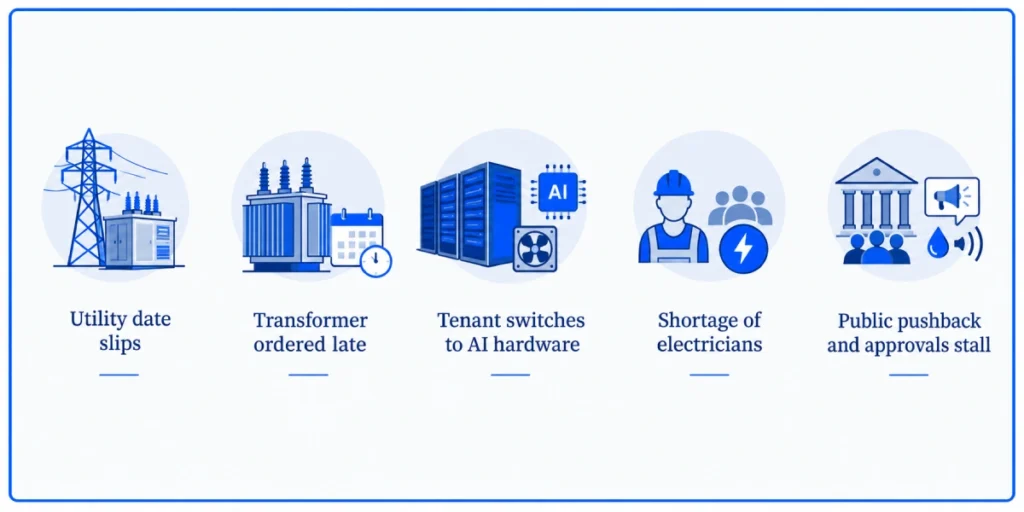
Anyone building data center capacity on a deadline watches for these:
- The utility date slips, and a finished building waits for power.
- The transformer is ordered after design wraps up, and the hall sits finished while the unit is still in production.
- A tenant moves to AI hardware halfway through design, sending the cooling engineers back to the drawing board.
- Busy markets run short of electricians, and nobody else can do their work.
- Residents push back on noise or water use at a public hearing, and approvals stall.
Frequently Asked Questions
Owners planning their first data center tend to ask the same questions. And most of them come up long before anyone buys land. Cost usually leads, with power a close second.
How much does it cost to build a data center?
Modern greenfield builds in the U.S. and Canada average $17.6 million per megawatt, according to Cushman & Wakefield’s 2026 cost guide. That excludes chips and GPUs. Across markets, costs run from $8.9 million to $23.3 million.
How much power does a data center need?
It ranges from a few megawatts to more than a gigawatt. The International Energy Agency says a typical AI-focused data center uses as much electricity as 100,000 households. The largest sites under construction will use 20 times that.
Can an existing building be converted into a data center?
It can, but the building has to cooperate. Warehouses with tall ceilings and thick slabs work best, provided power is nearby. At Colossus 2, xAI reused industrial shells to help reach gigawatt scale in 12 months, Epoch AI reported.
What is PUE, and what is a good number?
PUE, or power usage effectiveness, compares a facility’s total power with what its IT equipment uses. The closer to 1.0, the better. Uptime Institute’s 2024 survey put the industry average at 1.56, and newer facilities usually score lower.
Final Thoughts
A data center’s schedule is mostly decided before the first wall goes up. If your organization is weighing how to build data center capacity, the first six months deserve the most attention. That is when the site is chosen and when the power request goes in. Equipment orders follow close behind.
Epic Construction Management provides construction management services for complex commercial and industrial projects, from the first budget through site oversight. A conversation about sequencing at the start is cheap. Fixing the sequence later is not.