
Choosing a commercial general contractor is one of the highest-leverage decisions an owner makes. The cheapest bid is rarely the cheapest project. The biggest name is not always the best fit. The contractor who finishes ahead of you in the lobby is usually the one who was evaluated, not just selected.
This guide gives you a seven-step framework for how to choose a commercial general contractor, the questions to ask, the documents to demand, and a weighted scorecard you can copy into your next RFP. It works whether you are hiring a national builder for a 30-story tower or a regional firm for a 40,000 SF tenant build-out.
What Is a Commercial General Contractor?
A commercial general contractor is a licensed firm hired under a single construction contract to deliver a commercial building. They are the legal counterparty on the construction agreement, the holder of every trade subcontract, and the entity responsible for delivering the project on schedule, on budget, and to code.
Commercial construction general contractor work differs from residential in three ways: larger contracts, stricter code and inspection regimes, and a heavier reliance on bonded subcontractors. A general contractor for commercial projects is expected to carry higher insurance limits, hold bonding capacity, and produce certified payrolls and lien waivers monthly.
What Does a Commercial General Contractor Do?
The scope of commercial general contractor services usually covers:
- Preconstruction. Estimating, constructability review, value engineering, and scheduling.
- Buyout. Bidding and awarding trade subcontracts within the GMP or lump-sum.
- Field supervision. A superintendent runs the site; safety and quality management are enforced daily.
- Project management. RFIs, submittals, change orders, pay applications, and reporting.
- Permits and inspections. Pulling trade permits and coordinating jurisdictional inspections.
- Closeout. Commissioning, punch list, as-builts, O&M manuals, and warranty service.
On a traditional design-bid-build job, the GC takes ownership of the work after drawings are complete. On a CM-at-risk or design-build job, commercial building general contractors are pulled in early to advise during design.

The 7-Step Framework for How to Choose a Commercial General Contractor
Every credible selection process, whether public or private, comes back to the same seven checks. Run all seven, in order, on every finalist.
- License & Insurance – Active license, COI, EMR, OSHA history.
- Relevant Experience – Same building type, size, and market.
- Portfolio Walk – Tour finished work and an active jobsite.
- Reference Calls – Independent references, on-type, recent.
- Bonding & Insurance – Bonding capacity 2x project value.
- Financial Strength – Working capital, backlog, D&B report.
- Team & Communication – Meet the PM and superintendent.
Step 1: Verify License, Insurance, and Bonding
Start with the paperwork. A licensed commercial construction general contractor should produce, on request and without delay:
- Active state contractor license with the right classification and limit.
- Certificate of insurance with general liability, auto, workers’ comp, and umbrella limits that match your contract.
- Bonding letter from a Treasury-listed surety with single-project and aggregate capacity above your contract value.
- OSHA 300 logs and Experience Modification Rate (EMR) for the last three years, under 1.0 is the benchmark, under 0.85 is excellent.
Any hesitation on these documents is the answer. Move on.
Step 2: Confirm Relevant Commercial Experience
“Twenty years in business” is not the same as “twenty years building your building type.” A general contractor’s commercial construction resume needs to match your project on three axes:
- Building type. Office, healthcare, retail, industrial, hospitality, and education; each has its own learning curve.
- Size and complexity. A firm that builds $5M projects well does not automatically build $50M ones well.
- Market and jurisdiction. Local permit knowledge, inspector relationships, and trade base matter more than national rankings.
Ask for five projects completed in the last three years that match all three axes. If they cannot produce five, narrow your shortlist.
Step 3: Review the Portfolio in Person
Photos lie. Drone shots lie even more. Tour two finished projects with the GC. Walk a current jobsite without them. Look at:
- Site cleanliness and material storage.
- Safety signage, fall protection, and PPE compliance.
- Quality of finishes in the completed building one year on.
- Whether the superintendent on site knows the drawings cold.
Step 4: Call References (Not the Ones They Picked)
Every GC has three references they love. Call those, then ask each one for two more references that the GC did not put on the list. That is where the truth lives.
Ask each reference five questions:
- Did they finish on schedule? If not, why?
- Did they finish on budget? What was the change-order percentage?
- How did they handle problems you did not see coming?
- Would you hire them again, with no hesitation?
- Who was the superintendent, and would you ask for them by name?
Step 5: Test Financial Strength and Bonding Capacity
A contractor failure mid-project is the most expensive thing that can happen to a commercial owner. Request audited financial statements for the last three years and look for:
- Positive working capital ratio above 1.5.
- Backlog under 3x annual revenue (overextended firms fail first).
- Bonding capacity of at least 2x your project value.
- Clean Dun & Bradstreet report and no pending litigation that affects delivery.
Step 6: Meet the Project Team, Not Just the Sales Team
The principals who win the work are rarely the team that builds it. Before signing, name names in the contract. Insist on meeting:
- The project executive who owns the contract.
- The project manager who runs the office side.
- The superintendent who runs the field.
- The preconstruction lead if you are on a GMP or CM-at-risk.
Add a key-personnel clause: those individuals cannot be swapped without written owner approval.
Step 7: Score, Don’t Just Pick
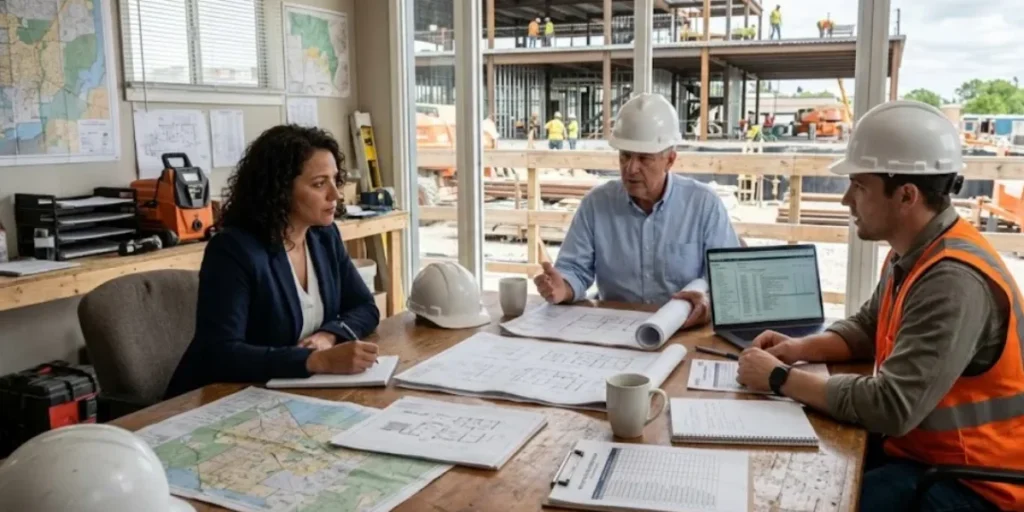
The final step is a written rubric. Score every finalist against the same weighted criteria. Lowest price never wins on its own. Best total value wins.
A weighted scorecard removes emotion from a high-stakes decision.
| Criterion | Weight | What You’re Measuring |
| Relevant experience | 20 | Comparable building type, size, market |
| Safety record / EMR | 20 | EMR under 1.0, clean OSHA history |
| Financial strength | 20 | Working capital, backlog, bonding |
| References | 15 | Independent, recent, on-type |
| Schedule confidence | 15 | Logic, milestones, manpower |
| Price | 10 | Total cost of risk, not lowest bid |
How to Hire a Commercial General Contractor (Process)
Once you have a winner on paper, the path to a signed contract is mechanical:
- Letter of intent. Lock in the team and key terms while you negotiate the contract.
- Contract form. AIA A102 (GMP) or A101 (lump-sum), or ConsensusDocs equivalents.
- Schedule of values. Match line items to the budget you approved.
- Insurance certificates. Named additional insured, waivers of subrogation, primary, and non-contributory.
- Performance and payment bonds. 100% of contract value on any project above $500K.
- Preconstruction meeting. Schedule, submittals, RFI process, change-order protocol, and payment cycle.
Construction Manager vs General Contractor
Owners often ask about a construction manager vs. a general contractor in the same breath as choosing a GC. Both roles exist for a reason. A construction manager works for the owner, advising on cost, schedule, and risk. A general contractor works under a construction contract to build the project.
On most commercial projects above $5M, the strongest outcome is a construction manager in the owner’s corner and a qualified commercial general contractor under contract, two independent sets of eyes on the same building.
How to Evaluate Design-Build Contractors
Evaluating design-build contractors overlaps with this framework, but adds two checks: their in-house design capability and their integrated delivery history. A design-build firm is signing for both the drawings and the building; verify that they actually employ architects and engineers, not just subcontract them. The seven-step framework above still applies; just weigh experience and references higher than price.
Red Flags to Watch For
Green Flags:
- Name the superintendent in writing.
- Open-book preconstruction estimating
- EMR under 1.0, clean safety record
- References answered on the first call.
- Provides a bonding letter without delay
Red Flags:
- Bid significantly below the others.
- Vague or boilerplate references
- Will not name field leadership
- Heavy current backlog vs. capacity
- Pushes to skip a written contract scope
Frequently Asked Questions
What is a commercial general contractor?
A commercial general contractor is a licensed construction firm hired by an owner to build a commercial project, office, retail, industrial, healthcare, or institutional project under a single construction contract. They hold trade contracts, manage the jobsite, and deliver the finished building against drawings and specifications.
What does a commercial general contractor do?
Commercial general contractors handle buyout, scheduling, site supervision, safety, permits, inspections, change orders, billing, and closeout. They put the building in place using their own crews and subcontracted trades, and carry construction risk once the contract is signed.
How to choose a commercial general contractor?
Verify license and insurance, check relevant commercial experience, review their portfolio, call recent references, confirm bonding capacity and financial strength, evaluate their team and communication, and score finalists against a written rubric before signing.
How to hire a commercial general contractor?
Prequalify three to five firms, issue an RFP with complete scope and drawings, hold a pre-bid walkthrough, review proposals on value, not just price, check references and EMR, negotiate the contract and schedule of values, then execute an AIA or Consensus Docs agreement.
How to evaluate design-build contractors versus general contractors?
Design-build firms hold both design and construction under one contract, so they evaluate their in-house architects, engineers, and integrated delivery track record. General contractors are evaluated against finished drawings, so focus on buyout discipline, schedule control, and field execution.
What is the difference between a construction manager and a general contractor?
A construction manager is hired by the owner to plan and oversee the project; a general contractor is hired to build it. CMs advise; GCs hold the trade contracts and carry construction risk. Many commercial owners hire both.
What are the top commercial general contractors in the US?
By ENR revenue, the largest commercial general contractors include Turner, Whiting-Turner, AECOM, Clark, Skanska USA, Suffolk, Gilbane, Hensel Phelps, Mortenson, and DPR. The best commercial general contractors for your project are firms with directly comparable work in your building type and market.
What commercial general contractor services should I expect?
Preconstruction estimating, value engineering, scheduling, buyout, site management, safety, quality control, change order management, BIM coordination, commissioning support, punch list, and warranty service.
How much does a commercial general contractor cost?
Commercial general contractor fees typically run 5 to 15 percent of construction cost, depending on project size, complexity, and contract type. Lump-sum bids include the fee inside the price; CM-at-risk and GMP contracts break it out as a fee plus general conditions.
Final Thoughts
Choosing a commercial general contractor is mostly about discipline. Verify the paperwork. Test the experience. Walk the jobsites. Call the references nobody put on the list. Score the finalists against the same rubric. The contractor you pick that way will rarely be the cheapest, and almost always be the best total value.
If you want a second set of eyes on the selection, that is exactly the work an owner’s construction manager does every day.