Ever seen businesses building their shops, offices, or hospitals in your area? That’s Commercial construction. It is the process of planning, renovating, and building structures for business use. Offices, retail spaces, and industrial facilities are examples of commercial construction. Unlike residential projects, commercial building construction creates spaces for public and business operations. It maintains strict safety regulations. This guide covers everything you must know about commercial construction.
What Is Commercial Construction?
Commercial construction provides the physical place for a business. It ensures that businesses have the environments to serve customers and house employees. Commercial construction is the process of building, renovating, expanding, or improving properties. The properties are for business and public use, not for private use. It involves constructing spaces where people work, shop, receive services, stay, or gather.
Take a quick look at the types of commercial construction. We’ll discuss them later on.
| Commercial Construction Type | Purpose | Common Examples |
| Office Buildings | Provide workspace for businesses and organizations | Corporate offices, coworking spaces |
| Retail Construction | Create spaces for selling products and services | Shopping malls, retail stores, supermarkets |
| Hospitality Construction | Serve guests and travelers | Hotels, resorts, restaurants, cafés |
| Healthcare Facilities | Deliver medical and healthcare services | Hospitals, clinics, medical offices |
| Educational Buildings | Support learning and training | Schools, colleges, universities |
| Warehouses & Distribution Centers | Store and distribute goods | Warehouses, fulfillment centers, logistics hubs |
| Entertainment & Recreation | Host leisure and public events | Theaters, gyms, sports arenas, cinemas |
| Government & Civic Buildings | Provide public and administrative services | Courthouses, municipal offices, libraries |
| Mixed-Use Developments | Combine multiple commercial functions in one property | Retail with offices, hotels with shopping spaces |
| Commercial Renovations & Fit-Outs | Upgrade or customize existing commercial spaces | Office remodels, tenant improvements, store renovations |
What Is a Commercial Building?
A commercial building is a structure where at least 50% of its floor space is for business activities. To qualify as a commercial property, the building must be zoned for business use. The intention is to generate income by renting or selling products or services. Examples of commercial buildings include office buildings, retail stores, restaurants, hotels, hospitals, schools, warehouses, and entertainment venues.
What Is Commercial Building Construction?
The planning, design, and construction of buildings used for commercial activities. Companies build these to support businesses, provide public services, or generate income.
Building a new structure from the ground up. Renovating an existing property. Adding new spaces to accommodate business growth. All fall under commercial building construction.
Commercial construction projects need special engineering requirements. For example, heavy-duty heating and cooling systems, advanced fire safety, and a strong structure.
What Is a Commercial Project?
A project run by a business or developer to build, expand, or renovate a property for commercial use. That’s a commercial project. The goal is to create, improve, or upgrade a building. So it better serves a business, organization, or public institution.
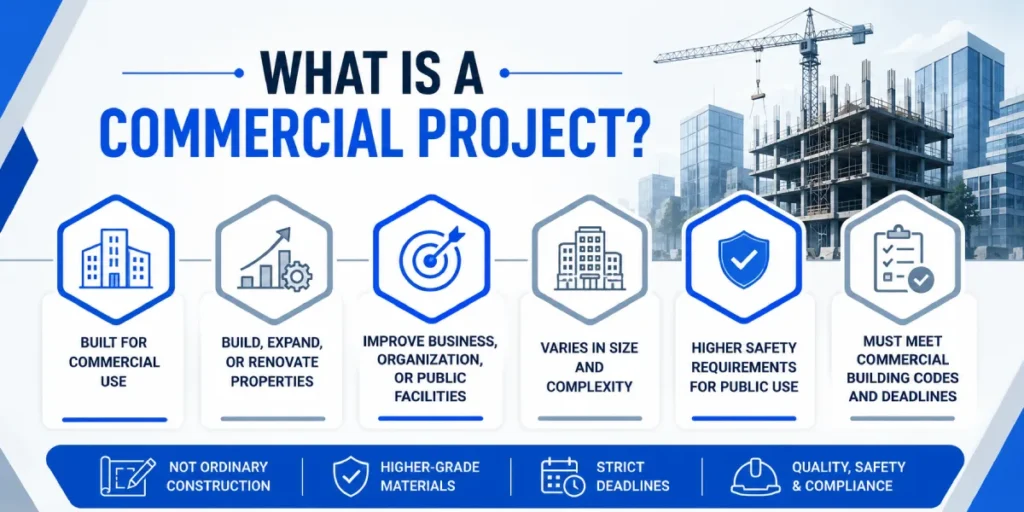
Commercial projects can vary in size and complexity. Renovating a retail store is a small project. A large project is constructing a multi-story office building or a hospital.
Commercial projects are different from ordinary construction work. They need commercial building codes, higher-grade materials, and must meet strict deadlines. The public uses these. So the safety requirements are much higher than those for a private home.
Types of Commercial Construction Projects
The scope of work in the commercial sector is diverse. It depends on the goals of the business owner. It may start from an empty lot or updating the interior of an existing office.
New Commercial Construction
New commercial construction is building a structure from the very beginning. These projects offer the highest level of customization. The owner can design every part of this construction project.
Commercial Renovation Projects
Renovations mean updating an existing commercial building to improve its look. It can be to make the project energy efficient. Or improve security and safety. Businesses often choose renovation to modernize their brand image. Commercial renovation is more cost-efficient than building a new one.
Tenant Improvement (Fit-Out) Projects
Tenant improvements (fit-outs) are when a landlord provides a “shell” space, and the tenant customizes the interior. Customization includes adding walls, flooring, lighting, and other equipment for the tenant’s business.
Commercial Building Additions and Expansions
Business grows. But it can outgrow its current space. An expansion project adds new square footage to the existing one. This is common for growing medical facilities or warehouses needing more storage capacity.
Adaptive Reuse Projects
Adaptive reuse means taking an old building, adapting it for a new commercial purpose. Like taking an old 19th-century building, turning it into a modern office loft or a brewery. These projects are best for preserving historic architecture.
Interior Build-Out Projects
Interior build-out is similar to a fit-out project. Interior build-out projects focus only on the internal environment. These projects maximize the layout for productivity. Also, it matches the company’s corporate identity.
Shell Core Construction
In shell core construction, the developer completes two things. The basic structure and the main systems. ( Shell and core). The systems, or core, mean the lobby, lift system, etc. Future tenants customize the interior.
Historic Restoration Projects
Historic restoration projects focus on old, historic commercial buildings. It brings them back to their original state. At the same time integrates modern safety and accessibility features. These projects need specialized knowledge of old-fashioned materials and techniques.
Common Types of Commercial Buildings
Commercial buildings are generally categorized by how they are used. Each type has specific requirements for layout, parking, and utility access. This variety of rules ensures the business can run smoothly.
Office Buildings
Office buildings range from small professional suites to high-rise skyscrapers for global corporations. Designed for administrative tasks and professional collaboration.
Retail Stores and Shopping Centers
Retail stores help the sale of consumer goods. They prioritize foot traffic flow, storefront visibility, and inventory management spaces.
Restaurants and Hospitality Buildings
This category includes cafes, full-service restaurants, hotels, and resorts. These buildings require specialized plumbing, commercial-grade kitchens, and specific health and safety layouts.
Healthcare Facilities
Healthcare construction includes hospitals, emergency clinics, and dental offices. Hygiene, patient privacy, and medical equipment housing are a must-have for these buildings.
Warehouses and Distribution Centers
Warehouses and distribution centers focus on logistics. These need large open floor plans, high ceilings, and loading docks. They are essential for the e-commerce and manufacturing sectors.
Educational and Institutional Buildings
Private schools, universities, and vocational training centers fall under commercial construction. Only when privately funded and operated as business entities.
Commercial Construction vs. Residential vs. Industrial Construction
The differences between commercial, residential, and industrial sectors are wide. Knowing them helps owners prepare for their unique challenges. Each sector operates under different sets of rules and expectations.
| Feature | Commercial Construction | Residential Construction | Industrial Construction |
| Purpose | Business & Commerce | Private Living | Manufacturing & Processing |
| Building Use | Offices, Retail, Hotels | Houses, Apartments | Factories, Power Plants |
| Size | Medium to Large | Small to Medium | Very Large / Specialized |
| Budget | High (Investor funded) | Lower (Personal/Bank) | Very High (Corporate) |
| Timeline | Strict / Fast-paced | Flexible | Long-term / Complex |
| Materials | Steel, Concrete, Glass | Wood, Brick, Drywall | Heavy Steel, Specialized Alloys |
| Complexity | High (Public Safety) | Moderate | Very High (Technical) |
The main difference lies in the scale and the rules. Residential construction is usually smaller. It uses wood framing to make homes cost-effective. Commercial construction uses steel and concrete to support larger crowds and taller structures. Industrial construction is the most complex, as it involves building massive facilities. Like heavy machinery and specialized power needs.
Levels of Commercial Construction Projects
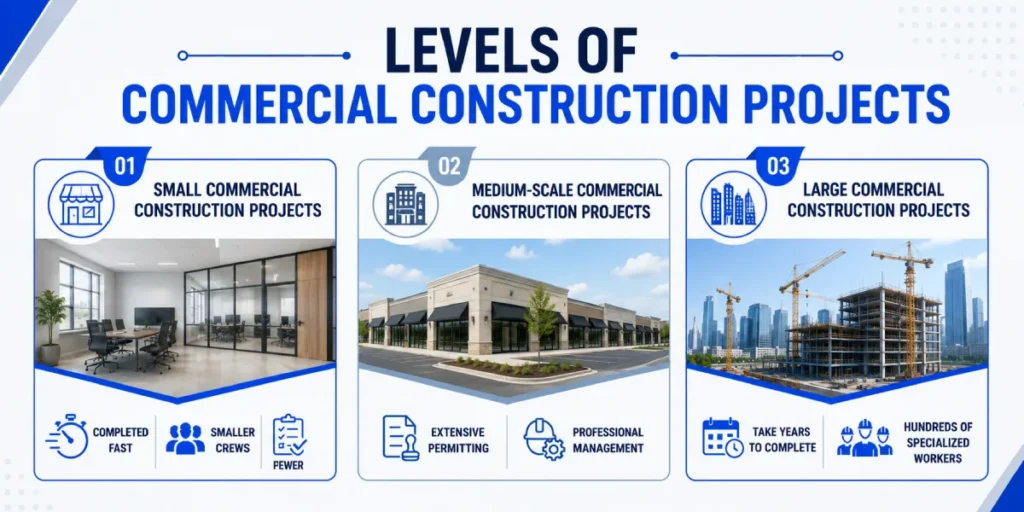
Not all commercial projects require the same amount of resources. The industry breaks projects down into three levels based on the size of the building and the cost of the work.
Small Commercial Construction Projects
Small-scale projects involve minor repairs, office refreshes, or small retail build-outs. These are often completed fast. Need smaller crews and fewer permits.
Medium-Scale Commercial Construction Projects
Medium projects include building mid-sized restaurants, shopping plazas, or multi-story office renovations. You’ll need extensive permitting and professional management.
Large Commercial Construction Projects
Large-scale construction involves massive undertakings like airports, skyscrapers, or hospital campuses. These projects take years to complete and involve hundreds of specialized workers.
How a Commercial Construction Project Works
A successful project follows a specific sequence of events. Skipping a step can lead to legal issues, safety problems, or a jump in budget.
Step 1: Planning and Feasibility
The owner and consultants determine if the project is a good idea. This includes checking the land, looking at local rules, and making a rough guess on the total cost.
Step 2: Design and Engineering
Architects and engineers create detailed drawings. They ensure the building looks good and stays strong. Also, it must follow all local safety laws.
Step 3: Permits and Approvals
Before practical work begins, the project must get a “thumbs up” from the city. This means getting approval from the city council. This ensures the building is safe and won’t damage the neighborhood.
Step 4: Procurement and Budgeting
The main contractor buys the materials and hires the specialized teams. A final budget is set to keep records of the finances.
Step 5: Construction Phase
This is the actual building part. It starts with clearing the land and pouring the foundation. Followed by putting up the walls, the roof, and the interior details.
Step 6: Final Inspection and Project Handover
Once the work is done, an official inspector checks everything. If it passes, the owner gets a certificate that says people are allowed to enter and work in the building.
Commercial Construction Delivery Methods
The “delivery method” is the type of contract used to get the job done. It determines who is in charge of what and how the money flows between the owner and the builders.
Design-Bid-Build
The owner hires a designer first, then asks builders to compete for the job based on that design. This is common because it usually results in the lowest price.
Design-Build
Same company handles the design and the building. This makes things simpler for the owner because they only have to talk to one person for the whole project.
Construction Management at Risk (CMAR)
Owner hires a manager to help with the design. They manage the construction. CMAR promises the owner that the project won’t go over a certain price.
Integrated Project Delivery (IPD)
Everyone, including the owner, the designer, and the builder, works as one single team. They share the profits if the job goes well and share the losses if it doesn’t.
Who Is Involved in a Commercial Construction Project?
Commercial construction projects are big. And so they need a diverse group of experts working together. Each person has a specific role in making sure the building is safe and functional.
Property owners provide the funding and the vision. Architects handle the visual design. Engineers make sure the electricity, water, and structure work properly. The general contractor runs the site, and the project manager keeps track of the schedule. Subcontractors are the specialists, like painters or plumbers, who do the specific tasks. Finally, inspectors make sure the project follows the law.
Common Materials Used in Commercial Building Construction
Commercial buildings need to last for decades and withstand heavy use. Because of this, the materials used are much stronger than what you would find in a typical house.
Structural steel for the “bones” of the building. Reinforced concrete for floors and foundations to prevent fires from spreading. Masonry, like brick or stone, is used for the exterior walls. Large glass systems are common for modern storefronts( Retail stores). For the roof, contractors usually use durable rubber or plastic membranes. These cover large, flat areas without leaking.
What Affects the Cost and Timeline of a Commercial Construction Project?
No two projects are the same, and several factors can change how much you pay and how long you wait. Being aware of these can help a business owner plan more effectively.
Building size and project scope are the biggest factors. A massive warehouse costs more than a small shop. The cost of wood or steel, how many workers are available, and the weather can also change things. If the land is rocky or muddy, it takes longer to build. Finally, the location matters. Building in a busy city is usually more expensive than building in a rural area.
Cost per Square Foot by Project Type (Chicago)
[Source: Bdcnetwork, TMgroup]
| Project Type | Approximate Cost ($/SF) | Notes / Details | Primary Source(s) |
| Office (2–4 story, mid-rise) | $294–$306 (Q2 2026 ~$306) | Green building considerations included in model; higher for Class A high-rise | Gordian RSMeans via BD+C (2026) |
| Hospital (3-story) | ~$540.50 (2025) | Specialized systems drive higher costs; national avg. ~$451 | Gordian RSMeans via BD+C (2025) |
| Hotel (15-story model) | ~$308 (2025) | Varies widely by class (limited-service lower; luxury much higher) | Gordian RSMeans via BD+C (2025) |
| Industrial / Warehouse (Distribution Center) | Small (~109k SF): ~$124–$128 Medium (~476k SF): ~$75 Large (~901k SF): ~$57–$63 | Core & shell; site work, structure/enclosure largest shares; includes contingency | Cushman & Wakefield 2025 Industrial Construction Cost Guide |
| Retail Build-Out / TI (from vanilla box) | Full: $90–$130 High-end/flagship: $130–$200+ Cosmetic refresh: $30–$55 | Tenant improvement focus; new construction shells lower (~$75–$150 national adjusted) | Chicago Construction Crew (2026 local guide) |
| General Commercial (broad range) | $185–$340 | Mid-range market figure; union labor & permits noted as cost drivers | TM International Group (2026 Chicago guide) |
Common Challenges in Commercial Construction
Even the best-planned projects face hurdles.
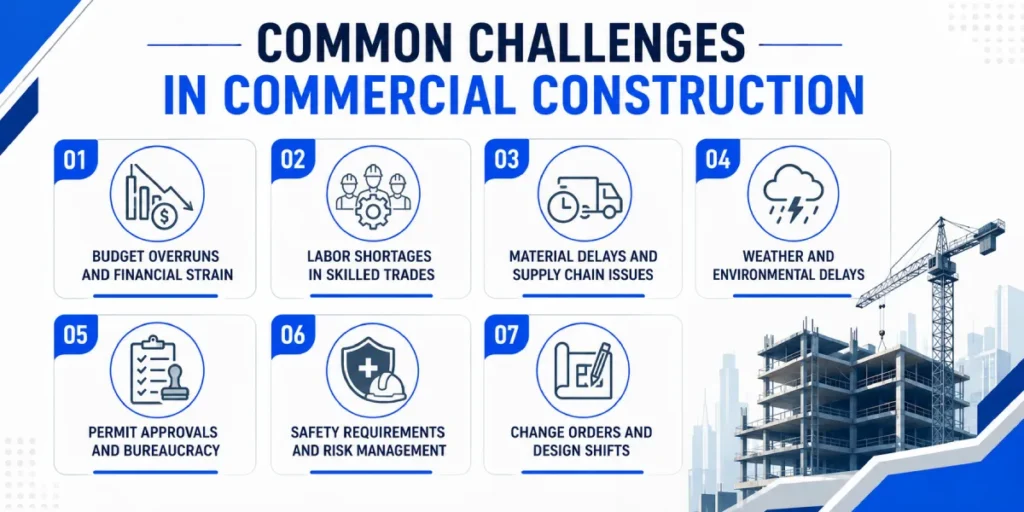
The key to a successful build is how the team handles these unexpected problems when they pop up.
Budget Overruns and Financial Strain
Unexpected costs are one of the most frequent issues. The price of steel can suddenly go up. A mistake in the initial estimate is also a common challenge. These financial gaps can delay a project.
Labor Shortages in Skilled Trades
Finding qualified workers, certified electricians, or specialized masons is difficult. When there’s a labor shortage, the construction schedule falls behind.
Material Delays and Supply Chain Issues
Large projects need massive amounts of specific materials. If a shipment of custom windows or specialized HVAC units is delayed, the entire project can halt.
Weather and Environmental Delays
Interior work can continue in the rain. However, heavy storms or extreme cold can prevent foundation pouring or roof installation. This leads to significant setbacks.
Permit Approvals and Bureaucracy
Getting the right paperwork from the city can be a slow and frustrating process. If a building inspector finds an issue or if the permit is denied, you can’t work legally.
Safety Requirements and Risk Management
Construction sites are dangerous places. Maintaining a safe environment requires constant training and monitoring. A single major accident can result in heavy fines and project shutdowns.
Change Orders and Design Shifts
The owner decides to change the layout or materials after the building has already started. These changes require new plans, new materials, and extra time.
How to Choose the Right Commercial Construction Contractor
The contractor you choose will determine the success of your project. You need someone who is not only good at building but also good at managing people and money.
Always check for experience in your specific industry. A company that builds schools might not be the best choice for a high-tech hospital. Look at their past work and call their previous clients. Make sure they have the right insurance so you aren’t liable for accidents. A good contractor will be honest about the schedule and will have a clear plan for how to handle problems.
Frequently Asked Questions
How long does a commercial construction project take?
The timeline depends on the project’s size and complexity. Small renovations may take a few months. Whereas large commercial developments can take one to three years or longer.
What is commercial work in construction?
Commercial work in construction refers to any construction activity performed on business buildings. Retail, healthcare, education, hospitality, or other commercial purposes rather than residential homes.
How do commercial construction loans work?
Commercial construction loans provide short-term funding to cover construction costs. The lender releases funds in stages as the project progresses. The loan is repaid or refinanced once construction is complete.
What is commercial management in construction?
Commercial management oversees the project’s budget, contracts, procurement, and financial performance. It ensures the project stays on schedule and within budget.
Why is commercial construction so expensive?
Commercial construction is expensive because of large project sizes and strict building codes. It needs specialized materials, skilled labor, complex designs, permits, and advanced safety requirements.
What is a commercial construction company?
A commercial construction company specializes in planning, building, renovating, and managing commercial properties. Such as offices, retail centers, healthcare facilities, hotels, and industrial business spaces.
What is a commercial construction site?
A commercial construction site is the location where commercial building work takes place. It includes the work area, equipment, materials, and workers involved in the project.
Why are commercial construction inspections important?
Commercial construction inspections verify that the project meets building codes and safety regulations. As the public will use these buildings, it’s necessary to meet quality standards.
What is the difference between commercial and industrial construction?
Commercial construction focuses on buildings used for business and public services. But industrial construction needs scope for manufacturing, production, processing, or heavy industrial operations.
What permits are required for commercial construction?
Building permits, zoning approvals, electrical, plumbing, mechanical, and fire safety permits. The exact requirements vary by location and project type.
What is the difference between a contractor and a subcontractor?
A contractor manages the entire construction project. He/she works directly with the client. Whereas subcontractors are hired by the contractor. They complete specialized tasks such as electrical, plumbing, or HVAC work.
Final Thoughts
Commercial construction creates buildings where businesses operate, and communities get essential services. You might be planning a new build, renovating an existing space, or expanding a property. Understanding the whole process can help you make the best decisions. An experienced contractor can complete a commercial construction project that meets your goals.