Ask an owner when the budget got locked in, and you will usually get the wrong answer. They point at the groundbreaking. By then it had been fixed for months.
The real moment comes when the construction documents are finished. Structure, mechanical layout, finishes: all settled. A bid comes back high at that stage and your options narrow to going back to the architect, paying for a redraw, and waiting out plan review a second time. Weeks go by. Leverage goes with them.
So what is preconstruction? It is the phase ahead of that lock, and it is where an owner still has room to move.
What Is Preconstruction?
Owners searching ‘what is preconstruction’ are usually after a list, so here is one. Site and existing-conditions review. Cost estimating. Constructability review. Scheduling. Permit strategy. Subcontractor prequalification and buyout. All of it happens before a shovel moves.
Search the term, and you will find it written three ways: preconstruction, pre construction, and pre-construction. Same phase. The spelling varies more than the meaning does.
The point of doing this work early is narrow. A builder knows what things cost and how long they take, and that knowledge is worth a great deal while the design is still moving and much less once it stops. Give a contractor a schematic set, and they can still argue you out of a structural system. Give them a finished construction document set, and all they can do is add it up.
Most owners come looking for the definition after that window has already shut.
Where Preconstruction Sits Among the Construction Phases
The stages of construction divide into three. Preconstruction covers everything before mobilization. Construction is the physical work on site. Post-construction is closeout: punch lists, O&M manuals, systems training, and the warranty period.
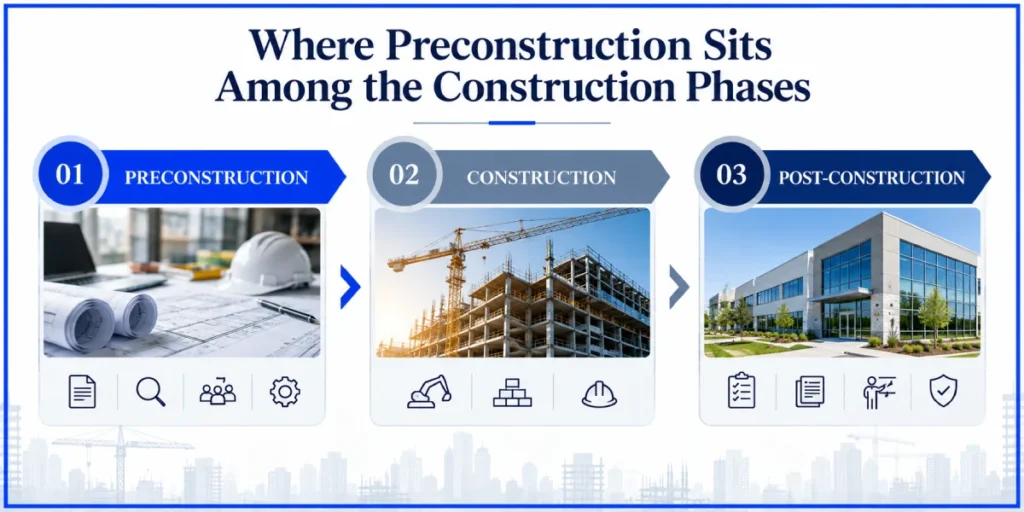
These construction phases are not equal in influence. Decisions made in the first determine much of what the second costs, which is why the preconstruction fee is generally the least expensive dollar spent across the whole construction process.
What Preconstruction Services Include
Preconstruction is not a single meeting. It runs alongside design development and produces updated deliverables as the project becomes more defined, which is why the outputs arrive in versions rather than all at once. A full preconstruction services list covers eight items.
Site and existing-conditions review
Survey, topography, utility locations, and soil borings. On a renovation, it also means opening walls and ceilings to find where the as-builts are wrong, as they usually are in buildings more than thirty years old.
Cost estimating
Cost estimating is not a one-time task but a continuous construction estimating process that includes schematic estimates, design-development estimates, and construction-document estimates, each based on a dated set of drawings. If a line item changes between estimates, identify what changed and why.
Constructability review
The contractor reads the drawings as a builder rather than a designer and flags what cannot be built as drawn, or what can only be built at a premium.
Value engineering
Alternatives that hold the program and cut cost. Every one carries a tradeoff, and a contractor showing only the savings is showing half the picture.
Polished concrete instead of luxury vinyl tile lowers thirty-year maintenance cost, but a school hallway sounds different. Standard rooftop units instead of a dedicated outdoor air system can save six figures where the energy code allows the swap, at a permanent cost in energy performance.
Preliminary schedule and long-lead identification
Switchgear, transformers, and rooftop units are the items that most often set the critical path. Verify current lead times with the supplier at the time of estimate rather than working from a prior job, because those durations have moved substantially since 2022. Identifying them early is what makes advance ordering possible.
Permit and code strategy
A matrix naming every approval required, the authority that issues it, and a realistic turnaround for each. A village building department, a fire district, and a health department run on separate clocks, and the longest one governs.
Subcontractor prequalification and buyout
Vetting bidders on bonding capacity, safety record, and relevant past work before they are invited, rather than discovering a problem after award. On Illinois public school work, Section 10-20.21 of the School Code governs competitive bidding, so how the packages are divided has to be settled before anything goes out.
Bid alternates
Priced options an owner can accept or decline when bids arrive. On the $32 million Union Ridge School District 86 expansion in Harwood Heights, construction manager F.H. Paschen and architect ARCON Associates structured close to twenty alternates ahead of bid day, which gave the district a way to protect scope without a rebid.
Pre-Construction Responsibilities: Who Does What
The architect owns design intent. The contractor owns what that intent costs and how long it takes to build. The productive part of preconstruction management is the disagreement between those two positions, settled on paper rather than in the field. ‘Pre construction responsibilities then shift with the delivery method.
| Delivery method | When the contractor arrives | What the owner gets |
|---|---|---|
| Design-bid-build | After the construction documents are finished | A bid, and no influence on what produced it |
| CM as adviser (AIA C132) | Before design begins, procured separately from the architect | Independent cost advice; the owner holds the trade contracts |
| CM as constructor (AIA A133–2019) | Before design begins | Preconstruction phase services defined in Article 2, then a guaranteed maximum price |
| Design-build | Design and construction under one contract from the first week | A single point of responsibility, with planning running alongside design |
Engaging a CM before design begins means running a second selection process, which is real administrative work. Districts and congregations accept it because a CM sitting in schematic design can tell a board what a scope costs while the referendum language or the campaign target is still being written.
Pre-construction management under either CM route also gives an owner a named individual accountable for the estimate, instead of a bid number with no author.
How Long the Pre-Construction Phase Takes, and What It Costs
Duration tracks complexity rather than square footage. Two to three months is normal for a tenant improvement. Institutional work carrying a public approval process, a referendum, or an environmental review routinely runs six months to more than a year.
Contractors charge either a flat fee or a percentage of the estimated project cost, and many credit part or all of it back against the construction contract if they are awarded the work. AIA Document A133–2019 divides the construction manager’s services into a preconstruction phase and a construction phase, so the agreement defines the scope you’re buying rather than leaving it to a proposal letter. Ask which estimates you receive and at which design milestones.
Carry contingency, and be clear whose it is. For renovations inside an occupied building, 10 to 15 percent held by the owner is common. On ground-up commercial work, lenders more often set five to ten. The contractor’s own contingency line inside a guaranteed maximum price is separate money covering different risk. During preconstruction, you decide what each one covers.
Preconstruction Planning for a Building That Stays Open
For a school, a church, or a bank branch, the hardest constraint is rarely the design. It is keeping the building in use while the work happens, and every decision that makes that possible is made during preconstruction planning, not on site.
For a district, the question is which scopes must land inside the summer window and which can run during the academic year behind temporary partitions. You have to settle that split at design development. Decide it in June, and you are already committed to whatever the calendar allows.
For a congregation, the sanctuary is the constraint. A nave renovation means either a temporary worship space or a phasing plan that returns the room to usable condition every Saturday afternoon.
For a branch, the lobby has to keep serving customers while the teller line is rebuilt, which usually means temporary counters and a security review of every interim condition.
The planning is the same in all three buildings, and it comes down to a short list of physical decisions made before mobilization. Each one costs something, and the cost is easier to accept on paper than on site. Five items carry most of it.
- Temporary partitions separating construction from occupied space
- Negative air and dust control, with filtration sized to the work
- Noise scheduling around class periods, services, or teller hours
- Separated construction access and material staging away from public entrances
- A decision about how much work moves to nights and weekends
Phasing around occupancy typically adds ten to fifteen percent to the schedule, because trades work in smaller zones and cannot stack. Premium-time labor carries its own multiplier on top of that. Price it while the phasing plan is still a drawing.
A Preconstruction Checklist Before Mobilization
A preconstruction checklist is not a formality; it is the evidence that the phase actually happened. Before the first crew arrives, an owner should hold eight documents. If any is missing, the work ahead is being priced on assumptions rather than on findings, and someone pays for the difference later.
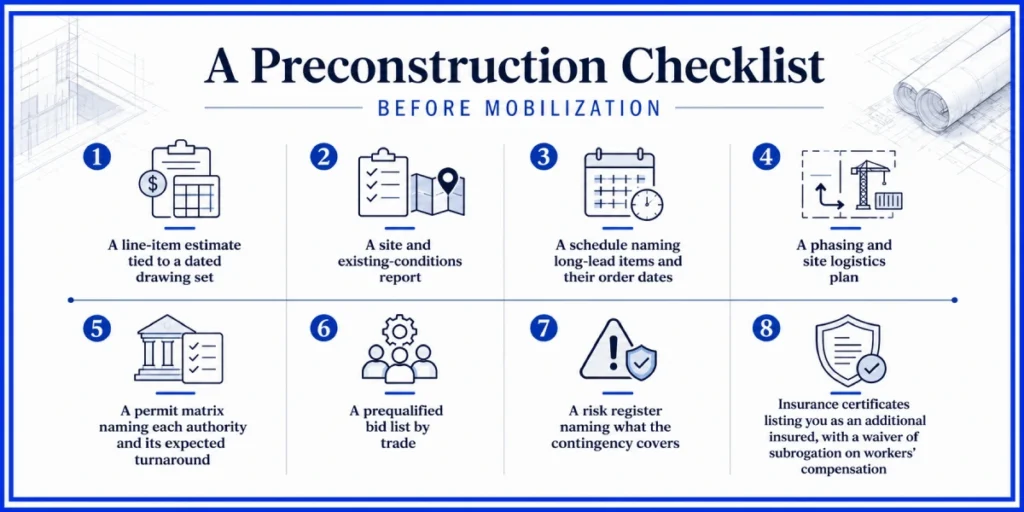
- A line-item estimate tied to a dated drawing set
- A site and existing-conditions report
- A schedule naming long-lead items and their order dates
- A phasing and site logistics plan
- A permit matrix naming each authority and its expected turnaround
- A prequalified bid list by trade
- A risk register naming what the contingency covers
- Insurance certificates listing you as an additional insured, with a waiver of subrogation on workers’ compensation
FAQ
We already have an architect. Why bring a contractor in early?
Because an architect prices intent and a contractor prices labor, material, and time. Those two numbers disagree. You want the disagreement at design development, when a wall assembly can still change, rather than at bid opening, when changing it means a redraw and another trip through plan review.
Is the fee wasted if we don’t hire that contractor to build the job?
Usually not. You keep the estimates, the schedule, the permit matrix, and whatever the existing-conditions work turned up, and all of it transfers to whoever builds the project. Many contractors also credit some or all of the fee back if awarded the work, so ask how that credit is written before signing.
Our building has to stay open. Does that change anything?
It changes almost everything about sequencing. Occupied work gets planned in zones around the hours the building is actually used, which means partitions, dust control, and some night and weekend labor. Expect the schedule to stretch. The alternative, finding the constraint after mobilization, costs considerably more.
Final Thought
Good planning gives an owner the one thing that gets expensive later: room to change your mind. Costs can be tested against the design, site problems can be raised and addressed, and schedule conflicts can be settled while they are still lines on paper. No process removes every risk from a construction project. What this one does is surface risks early, when a decision still costs a meeting instead of a change order. Epic Construction Management works with commercial and institutional owners across Chicago’s Northwest suburbs. If you have a project in planning, get in touch. And we’ll talk through where it stands.