
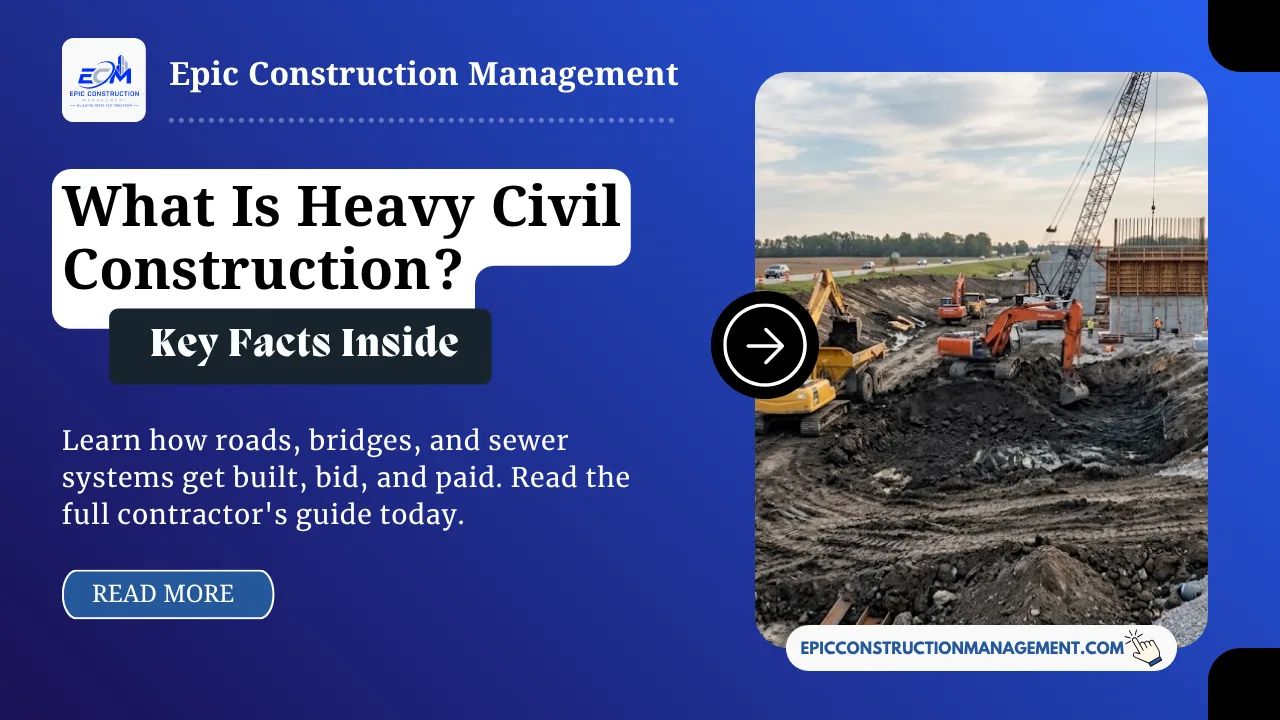
Heavy civil construction covers the horizontal side of the industry: roads, bridges, tunnels, water and sewer systems, rail corridors, airports, and levees. This type of civil construction focuses on large-scale infrastructure rather than vertical building projects.
What sets it apart from building work is not size alone. The earth gets moved in volume, the funding usually traces back to a public agency, and the engineering is finished before anyone puts a price on it. Owners tend to run into the term when a building project turns out to need a site package. Contractors run into it the first time a public agency asks to see their prequalification.
What Is Heavy Civil Construction? A Working Definition
The term describes large-scale infrastructure work rather than a specific trade. A firm may pave a county road one year and install storm sewer for a distribution center the next. What stays constant is the scale of earthmoving, the engineering that comes first, and the amount of public oversight attached.
How Heavy Civil Differs From Building Construction
Building construction is vertical and ends at a property line. Heavy civil work is linear and often crosses several of them. A commercial building sits on one parcel, reviewed by one building department. A three-mile roadway reconstruction can touch a state agency, two municipalities, a county highway department, and several utility owners, each with separate approval authority.
Measurement changes too. Building work is priced by square foot of enclosed space. Civil work is priced by cubic yard, ton, and linear foot. That difference decides how the contract is written.
Why the Scale Is Different
The Illinois Department of Transportation’s Fiscal Year 2026 to 2031 Proposed Highway and Multimodal Improvement Program commits $50.6 billion over six years, of which $32.5 billion goes to state and local roads and bridges. That program covers 7,107 lane miles of roadway and 8.4 million square feet of bridge deck. The FY 2026 annual program accounts for $6.36 billion of it.
Those figures explain why the heavy civil construction industry runs differently from commercial building construction. Contracts stretch across fiscal years, funding arrives in appropriations rather than draws, and a shift in program priorities can move a project before a shovel touches the ground.
Types of Heavy Civil Construction
Most lists of project types run flat: roads, bridges, dams, tunnels, ports. Grouping the work by what it does to the ground is more useful to an owner deciding which contractor to call.
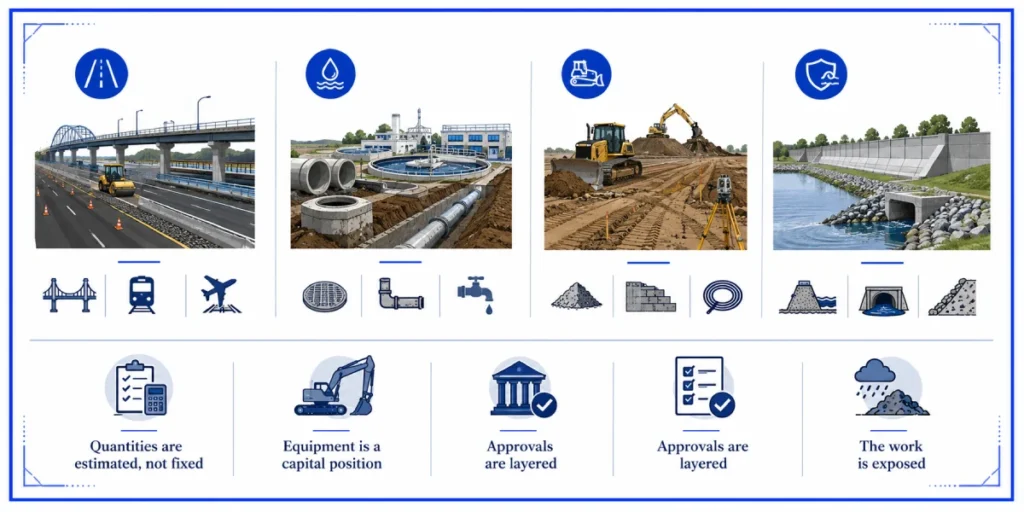
Transportation Infrastructure
This covers roadway, highway, bridge, rail, and airfield work. Structural concrete, deep foundations, and paving dominate the scope. Traffic staging is usually the controlling constraint, because the road has to keep carrying vehicles while it is rebuilt.
Water, Sewer, and Drainage
This group covers storm sewer, sanitary sewer, water main, detention basins, and treatment facilities. Most of it sits below grade, so the schedule is governed by trench conditions, dewatering, and utility conflicts rather than by weather alone.
Site Development and Earthwork
Mass grading, cut and fill, soil stabilization, retaining structures, and underground utilities make up this group. It is the category most commercial and institutional owners meet, because every building project sits on top of a site package.
Water-Control and Protective Structures
Levees, floodwalls, culverts, and shoreline stabilization belong here. They are engineered against a design storm event rather than occupancy loads, which puts the geotechnical report at the center of the design.
Across all four groups, heavy civil construction projects share characteristics that commercial work does not:
- Quantities are estimated, not fixed. The engineer publishes a takeoff, and field quantities are measured and paid as installed.
- Equipment is a capital position. Excavators, pavers, and cranes are owned or on long-term rental rather than subcontracted per job.
- Approvals are layered. Several agencies hold sign-off, and none answers to the others.
- The work is exposed. Almost all of it happens outdoors, in soil whose condition is only partly known at bid time.
Who Can Bid Heavy Civil Work in Illinois
Illinois issues no statewide general contractor license. Publicly let transportation work carries a different gate: prequalification with the Illinois Department of Transportation.
IDOT Prequalification
A firm that wants to bid as a prime contractor on IDOT projects, local agency projects, or Department of Natural Resources projects must be prequalified first. The process runs under Title 44, Part 650 of the Illinois Administrative Code. IDOT reviews a firm’s experience, equipment, and financial condition, then issues a Certificate of Eligibility. According to IDOT’s prequalification page, roughly 750 firms currently hold it, and the list is republished every Monday.
Three details matter to anyone planning around it:
- Ratings expire. Prequalification is valid for 16 months from the date of the financial statement filed with the application.
- Ratings are category-specific. Approval for one type of work does not carry over to another.
- The financial statement sets capacity. The rating establishes how much work a firm may carry at one time.
Private Site Civil Work
Prequalification applies to publicly let transportation contracts, not private work. A developer’s site package, a school district’s parking and detention work, or a bank’s site improvements are awarded by negotiation or invited bid. The scopes overlap heavily with public work. The procurement path does not.
Where Heavy Civil Work Comes From in Illinois
Not all of this work reaches the market the same way. The owner sets the procurement path, and that path decides who is eligible to bid. The table below sorts the four routes most common in Illinois.
| Work type | Typical owner | How it is awarded | IDOT prequalification required |
|---|---|---|---|
| State highway and bridge | IDOT | Low responsible bid at scheduled letting | Yes |
| County and municipal roadway | County, township, or village | Locally advertised bid | Yes, for the prime contractor |
| Site development, grading, utilities | Developer or private owner | Negotiated or invited bid | No |
| Institutional site work | School district, church, bank | RFQ or invited bid | No |
(This table is a general guide, not legal or procurement advice. Requirements vary by owner, funding source, and jurisdiction, and IDOT work categories change. Verify current requirements with the awarding agency before bidding.)
How Heavy Civil Construction Estimating Works
Estimating this work does not follow the rules of commercial estimating, and owners coming from the building side are often caught out by the difference.
Unit Price Instead of Lump Sum
Most commercial building work is bid as a stipulated sum: the contractor prices a defined scope and carries the risk of getting quantities wrong. Public heavy civil work is usually bid on unit prices. The engineer publishes estimated quantities, bidders price each line item, and payment follows what is measured in the field.
Where the Risk Actually Sits
The tradeoff runs in both directions. Unit pricing moves quantity risk to the owner: if excavation runs 15 percent over the engineer’s estimate, the owner pays for the extra cubic yards. It moves a different risk to the contractor, because unit prices are locked at bid time no matter what happens to fuel, asphalt, or hauling rates across a two-season contract.
Two line items deserve attention on any unit price schedule. Mobilization is a discrete item rather than a percentage spread across the job, which affects early cash flow. Unclassified excavation carries the geotechnical unknowns, and it is the item most likely to produce a dispute when the boring log and the field disagree.
Heavy Civil Construction Safety
Safety on these sites is dominated by two hazards that barely register on a commercial building project: open excavation and buried utilities. Both are governed by published standards rather than site preference, and both carry consequences that arrive fast. A trench wall does not fail gradually, and a struck gas main does not wait for a supervisor to decide what to do.
Trench and Excavation Protection
Depth drives the rule here. OSHA’s excavation standard, 29 CFR 1926 Subpart P, treats five feet as the threshold where a trench needs sloping, shoring, or shielding, and the only ground exempt from that is solid, stable rock. Past 20 feet, the crew no longer chooses the method. The system has to be designed by a registered professional engineer. Inspections run on their own schedule: a competent person walks the excavation before work starts each shift, and again after rain.
Underground Utility Strikes
Every dig in Illinois begins with a locate request. JULIE covers the state outside Chicago, and DIGGER handles the city itself. Per the Illinois Commerce Commission’s Safe Digging Month notice from April 2026, the call to 811 goes in three business days ahead of excavation; work then has to start within 10 working days, and the ticket stays valid for 25 days. Two business days was the number in circulation for years, which is reason enough to check the current rule instead of working from memory.
When an Owner Needs a Heavy Civil Contractor
Heavy civil infrastructure construction and building construction are sometimes bid by the same firm, and sometimes should not be. Three questions usually settle it.
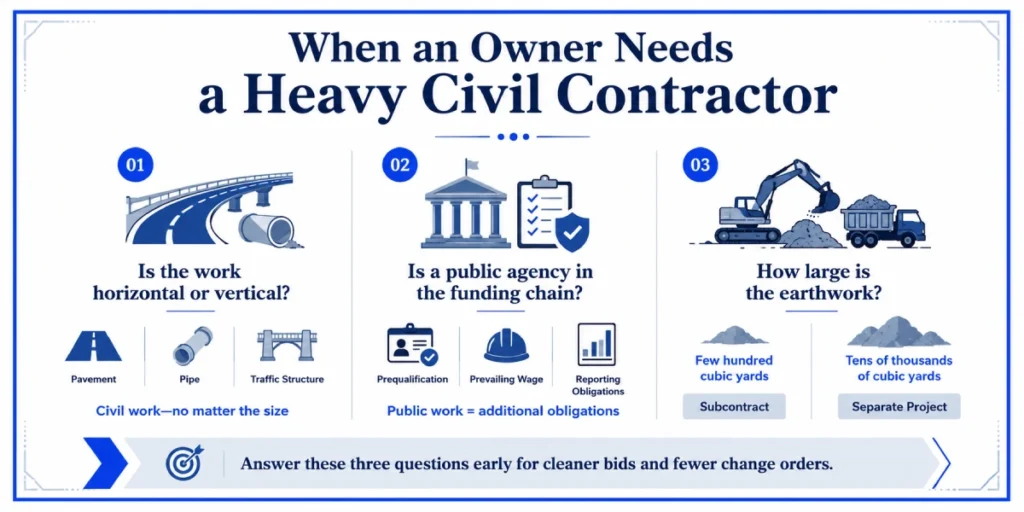
Is the work horizontal or vertical? If the deliverable is pavement, pipe, or a structure carrying traffic rather than occupancy, it is civil work no matter how small the contract is.
Is a public agency in the funding chain? State or federal dollars bring prequalification, prevailing wage, and reporting obligations that a private site package does not carry.
How large is the earthwork? A site moving a few hundred cubic yards is a subcontract. A site moving tens of thousands is its own project with its own schedule risk, and it usually needs to be bid separately from the building above it.
An owner who settles those three questions before drawings go out gets cleaner bids and fewer change orders than one who bundles everything and hopes.
FAQs
What is the difference between civil construction and heavy civil construction?
Civil construction is the broader field, including small site work and utility installation. Heavy civil is the larger end, involving significant earthmoving, engineered structures, and usually a public owner.
Do you need a license for heavy civil construction in Illinois?
Illinois issues no statewide general contractor license. Municipalities set their own registration requirements. For publicly let transportation work, IDOT prequalification under 44 Ill. Admin. Code 650 is required before a bid is accepted.
Is heavy civil work always publicly funded?
No. Private site development, industrial site packages, and institutional site work involve the same scopes with no public funding and no prequalification requirement.
Final Thoughts on Heavy Civil Construction
This work is defined less by equipment size than by how civil construction is procured and measured. Quantities are estimated rather than fixed. Owners are often public agencies with layered approval authority. Bids are priced by the cubic yard and the linear foot, not the square foot.
On the public side, the right to bid at all is a separate qualification a firm holds before the letting is advertised. Understanding these four points early is what keeps a civil construction scope from becoming the part of the project nobody planned for.
If you are working through a site package or an infrastructure scope attached to a building program, Epic Construction Management is glad to look at your drawings and talk through the sequence.