
Construction scheduling is the way we lay out every task on a job, put them in the right order, and figure out how long each one will take. As an essential part of construction management, effective scheduling helps teams keep a building project moving instead of getting stuck. When teams schedule well, projects stay on track; when they skip it or do it poorly, delays add up fast and the budget goes up right with them.
This guide walks through what construction scheduling really means, the methods and software teams use, and the habits that make a construction schedule work instead of just sitting in a folder.
What Is Construction Scheduling?
A construction schedule is a clear timeline that lists every task in a project, the order it needs to happen, how long it should take, and who is in charge. It is the shared plan that keeps owners, contractors, and subcontractors working from the same page. If you are asking what construction scheduling is, this is the short answer: a timeline that turns a project plan into daily action.
Construction Planning vs. Construction Scheduling
People often use these two words like they mean the same thing, but they do not. Construction planning is the big picture: picking the approach, the resources, and the overall game plan. Construction planning and scheduling work together, since scheduling takes that plan and turns it into a timeline with real dates. Think of planning as deciding what needs to happen, and scheduling as deciding when. This is the heart of planning and scheduling in construction.
How Construction Scheduling Fits into Project Management
Scheduling for construction projects is one part of the bigger construction project management puzzle, along with budgets, quality checks, and safety. But it is the part that ties the others together. A budget only holds if the construction works schedule holds, and quality checks only happen on time if the building schedule tells the team when to expect them. That is why a strong construction project management schedule matters so much.
Why Construction Scheduling Matters
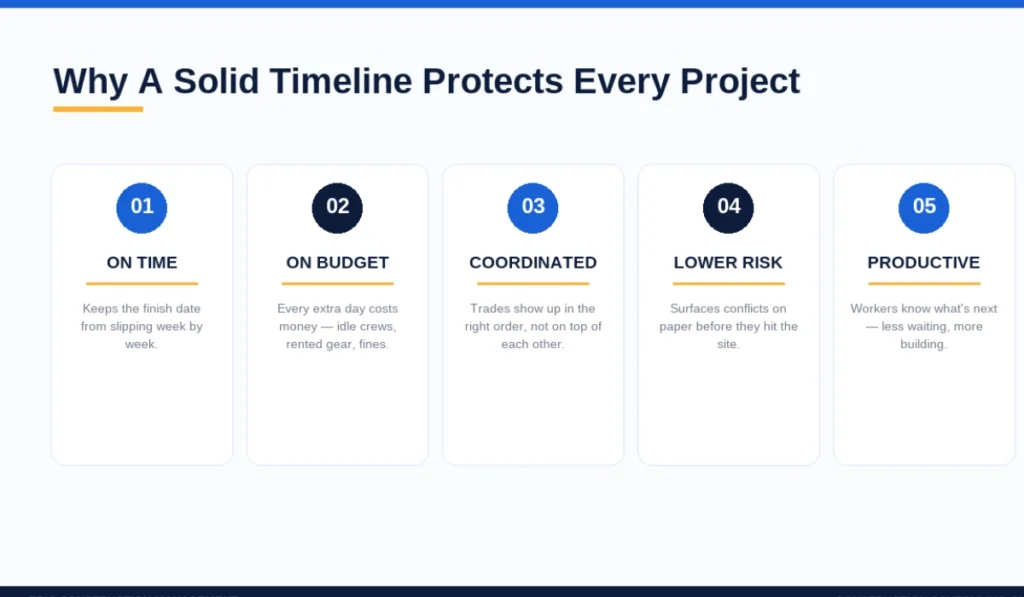
A good schedule of work construction does more than tell people when to show up. It protects the whole project in ways that are easy to miss until something goes wrong.
Keeps Projects on Schedule
This sounds simple, but it is worth saying: a construction schedule is the one thing standing between a job that finishes on time and a job that slips week by week until the deadline feels far away.
Controls Project Costs
Every day a project runs past its planned finish date costs money. That could be extra pay for workers, rented gear sitting idle, or a fine kicking in. A tight construction works schedule keeps spending close to what was planned.
Improves Team Coordination
With many trades moving through a site at different times, a shared construction project management schedule keeps the electrician from showing up before the framing is done. It gives everyone one common point of reference.
Reduces Construction Risks
A well built project schedule construction brings problems to the surface early, like two trades needing the same space at the same time, so the team can fix it on paper instead of on site.
Increases Productivity
When workers know what to do and when, less time is wasted waiting or trying to figure out what comes next. A clear plan keeps things moving.
Key Components of a Construction Schedule
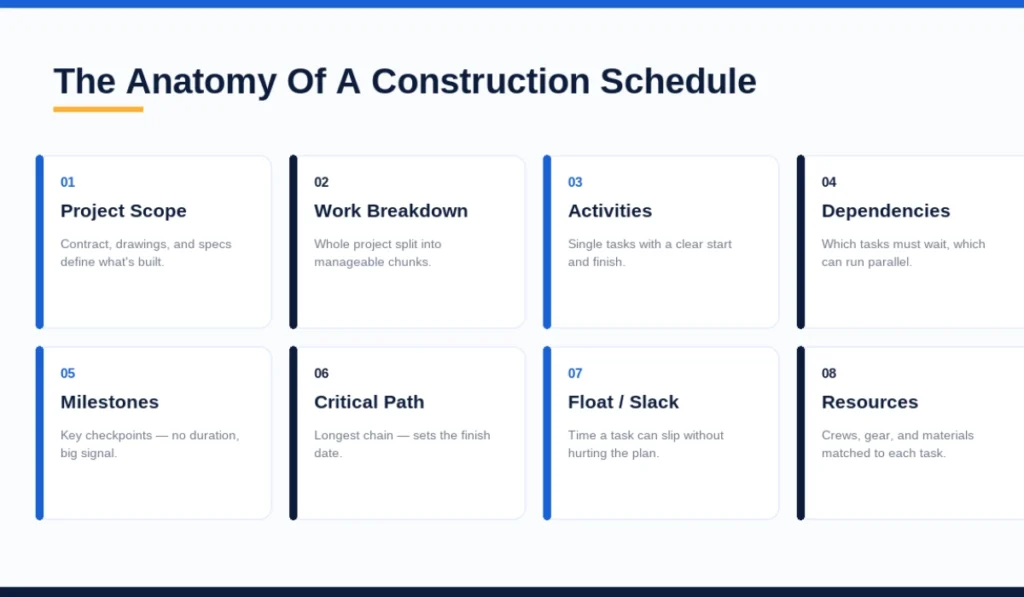
Every construction schedule, no matter how simple or complex, is built from the same core parts. Knowing these parts helps answer what are schedules in construction really made of.
Project Scope
The full picture of what the project includes, based on the contract, drawings, and specs. Everything else in the building construction schedule flows from this.
Work Breakdown Structure (WBS)
A way of breaking the whole project into smaller, easy to manage chunks of work, usually sorted by phase or system.
Construction Activities
The single tasks that make up the work, like pouring a foundation or hanging drywall. Each one has a clear start and finish.
Task Dependencies
The links between activities. Framing must happen before drywall goes up, for example. Dependencies turn a task list into a real sequence.
Project Milestones
Key checkpoints in the timeline, like finishing the foundation or starting inside finishes. Milestones have no length of their own, but they mark big progress.
Critical Path
The longest chain of linked tasks in the project. Any delay to a task on the critical path pushes back the whole finish date.
Float and Slack Time
The amount of time a task can slip without hurting the overall schedule. Tasks on the critical path have zero float.
Resource Allocation
Giving each task the workers, gear, and materials it needs, and making sure nothing is booked in two places at once.
How to Create a Construction Schedule
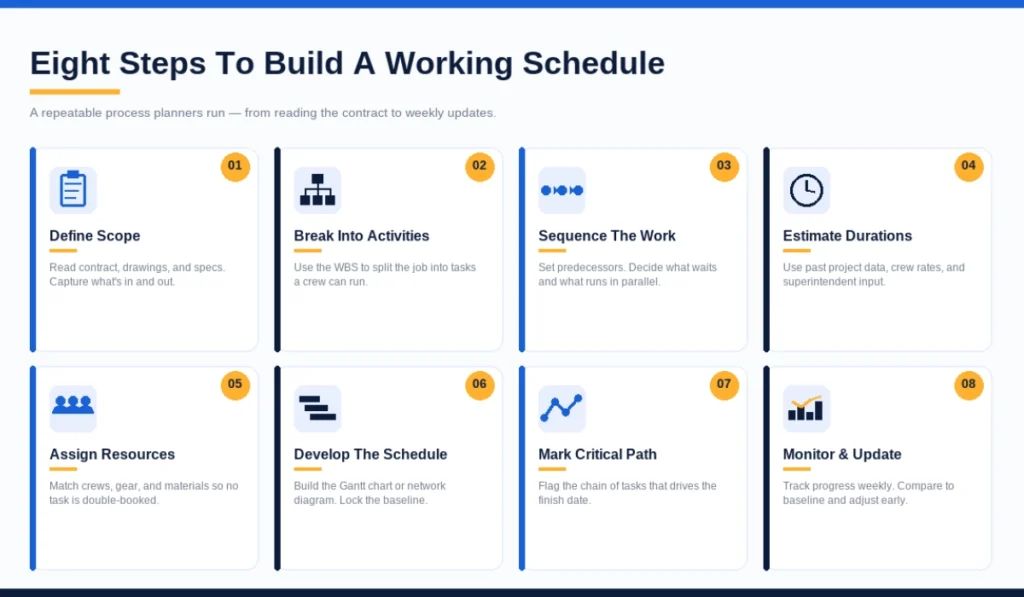
Building a basic construction schedule follows the same steady steps, whether the project is a single family home or a mid rise office. Building construction planning and scheduling on a bigger job uses the same steps, just with more layers.
Define the Project Scope
Start by reading the contract, drawings, and specs closely. You cannot build a real construction project scheduling plan without a clear picture of what is being built.
Break the Project into Activities
Use the work breakdown structure to list every task the project needs, from site prep to the final walk through.
Sequence the Work
Decide which tasks depend on others and which can happen at the same time. This step turns your task list into a logical flow.
Estimate Activity Durations
Give each task a real time estimate, based on past project data, crew work rates, and input from the people who will actually do the work.
Assign Resources
Match workers, gear, and materials to each activity, and look for clashes, like one crane being needed in two places at once.
Develop the Schedule
Pull everything together into a visual format, usually a Gantt chart or a network diagram, so the whole team can see the plan at a glance.
Identify the Critical Path
Once the schedule is drafted, mark the critical path so the team knows which tasks cannot slip without changing the finish date.
Monitor and Update Progress
Track real progress against the plan often, and update the schedule as things change. A schedule that is never updated stops being useful fast.
Types of Construction Schedules
Not every schedule does the same job. Different types of construction schedules come into play at different points in a project, each built for a different level of detail.
| Schedule Type | What It Is Used For |
| Master Schedule | The full road map of the project from start to finish, showing big phases and milestones. Used for high level planning and owner updates. |
| Baseline Schedule | The first approved schedule, locked in as the point of comparison for tracking real progress against the plan. |
| Look Ahead Schedule | A short term view, usually two to six weeks out, that helps site teams plan the work right in front of them. |
| Procurement Schedule | Tracks the ordering, approval, and delivery timing for materials and gear, so nothing holds up the work. |
| Resource Schedule | Focuses on workers, gear, and material readiness across the project. |
| As Built Schedule | A record of what really happened on the project, built after the fact, often used for close out paperwork or settling arguments. |
Construction Scheduling Methods Explained
A handful of methods have become the backbone of planning and scheduling in construction. Which one fits best depends on the project type and how much is going on.
Critical Path Method (CPM)
CPM is the most widely used method for construction project scheduling. It maps every task and its links to find the critical path, the sequence that sets the shortest possible project length. It works well for complex jobs with many linked tasks, though it needs solid input to be useful.
Program Evaluation and Review Technique (PERT)
PERT works like CPM but plans for the unknown by using three time guesses per task: best case, worst case, and most likely. It is less common in day to day construction work today, but its way of handling uncertainty still shows up in modern risk aware scheduling.
Line of Balance (LOB)
LOB is built for repeat work, like highways, pipelines, or multi story buildings where the same tasks repeat floor after floor. It plots work against both place and time, making it easy to spot where one crew is about to catch up to another.
Last Planner System
The Last Planner System is a team based way of planning that comes from lean construction. Instead of one person setting the schedule from an office, the people doing the work help build it, through pull planning and weekly promises. It takes buy-in to work well, but it tends to give a more reliable plan.
Lean Construction Scheduling
Lean scheduling borrows ideas from lean factory work, aiming to cut waste, whether that is wasted time, wasted materials, or wasted motion. It often works right beside the Last Planner System to keep work flow steady and easy to guess.
Common Construction Scheduling Challenges
Even a well-built schedule runs into real-world friction. General contractors deal with these challenges regularly, especially when coordinating crews, materials, subcontractors, and changing site conditions. Here is what shows up most often on live projects.
Weather Delays
Rain, snow, or extreme heat can push back outside work with little warning, mostly during site prep and the frame stage.
Labor Shortages
A shortage of skilled trades can stretch out task times or force a project to wait for the right crew to be free.
Material Procurement Delays
Long lead times or supply chain hiccups can stall a task even when the crew is ready to go.
Scope Changes
Added or changed work resets the schedule in ways that ripple through every task that comes after.
Equipment Availability
Shared gear, like one crane serving many tasks, can cause traffic jams if it is not planned for.
Poor Communication
When schedule updates do not reach every trade in time, work gets doubled up, delayed, or done out of order.
How to Improve Construction Scheduling
Getting better at your construction schedule is less about finding a perfect tool and more about building better habits around it.
Start Planning Early
Construction work planning that starts during pre-construction, not once work is under way, gives the team much more room to catch problems before they cost anything.
Build Realistic Timelines
A schedule that hopes for the best sets a project up to fail from day one. Build in real buffers for weather, checks, and the surprise that always seems to come.
Monitor Progress Regularly
A schedule is only useful if it shows what is really going on. Regular check ins against real progress catch drift before it becomes a real delay.
Improve Team Communication
Every trade needs to know about schedule changes as soon as they happen, not a week later when the work has already gone sideways.
Use Construction Scheduling Software
Digital tools make it much easier to update a schedule, share it across the team, and see the effect of a delay in real time, instead of drawing a chart by hand.
Track Key Performance Indicators (KPIs)
Numbers like schedule variance and on-time task finish give a team a clear read on whether their construction management scheduling process is really working.
Construction Schedule Analysis
Building the schedule is only half the job. Reading it right, and knowing where the real risk sits, is what keeps a project from drifting off track.
What Is Construction Schedule Analysis?
Construction schedule analysis is the practice of looking over a schedule, both before and during a project, to see where the risk sits and where things have gone off plan. It turns a schedule from a still file into a live tool for running the job.
Critical Path Analysis
This looks at the tasks with zero float to confirm the project’s true finish date and flag which tasks need the closest eye.
Float Analysis
Float analysis looks at how much cushion sits across tasks that are not on the critical path, helping teams see where they have room to flex and where they do not.
Delay Analysis
When a project falls behind, delay analysis is used to figure out what caused it and whether the delay was fair, paid, or the contractor’s own fault. It often plays a role in settling arguments.
Resource Analysis
This checks whether workers, gear, and materials are really ready when the schedule calls for them, catching clashes before they stop the work.
Best Practices for Construction Scheduling
None of these habits are hard on their own, but together they are what sets apart teams that hit their deadlines from teams that are always saying why they missed one.
Create a Baseline Schedule
Lock in an approved version of the schedule early, so you have a clear point of comparison as the project moves forward.
Review the Schedule Frequently
Weekly reviews during active construction catch small slips before they turn into real delays.
Keep Stakeholders Informed
Owners, designers, and subcontractors should never be caught off guard by a schedule change.
Plan for Risks
Build in extra time for the delays that are common on every project, like weather or checks.
Document Schedule Changes
Every change should be written down, along with the reason behind it, both for fairness and for later reference.
Frequently Asked Questions About Construction Scheduling
What is construction scheduling?
It is the process of laying out every task in a construction project, in the right order, with real time frames, so the whole team knows what to do and when.
Why is construction scheduling important?
Because it keeps a project on time and on budget. Without it, tasks get done out of order, resources get booked twice, and delays pile up fast.
What is the difference between planning and scheduling?
Planning sets the overall approach and scope of a project. Scheduling takes that plan and gives real dates and lengths to each task.
Who creates a construction schedule?
Usually the general contractor or a dedicated project scheduler builds it, with input from subcontractors, site leads, and the owner.
What are the different types of construction schedules?
Common types of construction schedules include the master schedule, baseline schedule, look ahead schedule, procurement schedule, resource schedule, and as built schedule.
What is the critical path in construction?
It is the longest chain of linked tasks in a schedule. Any delay to a task on the critical path delays the whole project.
What is a baseline schedule?
It is the first approved version of the schedule, used as the fixed point of comparison to track real progress against the plan.
How often should a construction schedule be updated?
Weekly is the standard during active construction, and after any big change, delay, or event.
What are the biggest causes of schedule delays?
Weather, labor shortages, material delays, scope changes, and poor communication between trades are among the most common causes.
Final Thoughts
A construction schedule is never really done until the project is. It is a living document that needs regular care, honest updates, and buy-in from everyone working on the job. As a key part of construction management, the schedule is not a chart that gets built once and forgotten.
Teams that treat construction scheduling as an ongoing habit, not a one time task, are the ones that steadily hit their deadlines. Whether you are running a small remodel or a large business build, the basics stay the same: know your tasks, know your order, know your critical path, and keep the schedule current.