A hospital takes more planning than most buildings. After all, patient rooms and operating suites, along with all the systems behind them, really do have to work from the very first day the doors open. So, naturally, owners planning new hospital construction projects tend to start with one question: How long does it take to build a hospital?
The honest answer? It depends, and on a lot more than the building itself. In fact, construction is just one part of the timeline. Planning, approvals, design reviews, and final inspections all take their share as well, and several of them actually happen before a single crew even reaches the site. With so many stages to coordinate, experienced construction management services can help project owners organize the process, manage schedules, and keep each phase moving toward completion. With that in mind, the sections below walk through each stage, along with the factors that can stretch or shorten it.
How Long to Build a Hospital: The Short Answer
A permanent hospital takes years to deliver. Stephen Meuschke, a vice president of operations at McCarthy Building Companies, put the average for a traditional hospital at three to six years in comments published by Bluebeam. His count starts at initial programming and ends when patients are in beds. For a licensed, permanent facility, that range is the most useful answer to how long to build a hospital.
Northwestern Medicine’s planned 24-story tower in Chicago shows how those years add up. The health system planned to file for a certificate of need in fall 2026.
If the state approves the project, construction is expected to start in spring 2027 and finish in 2031, as Healthcare Design reported. From filing to completion, that is roughly five years.
Hospital Construction Timeline by Phase
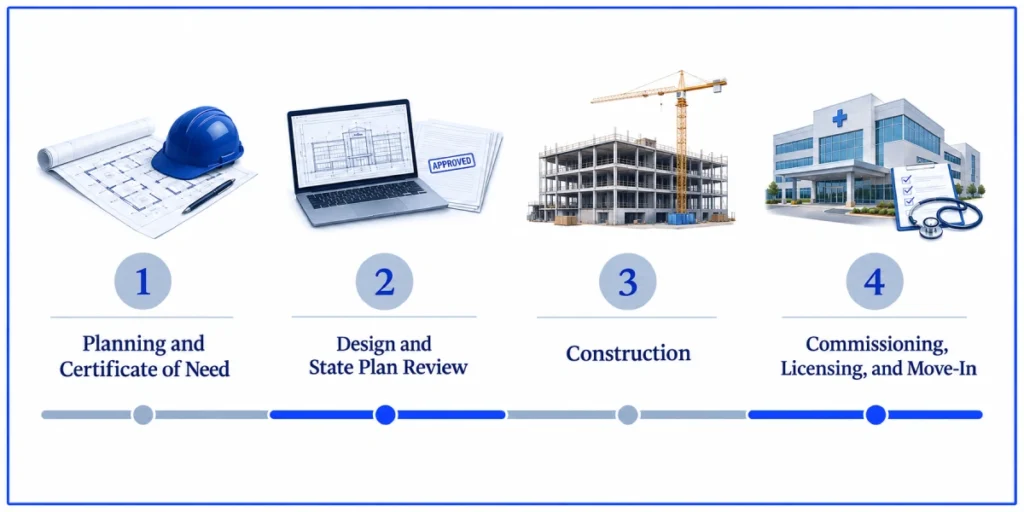
A hospital construction timeline has four main phases. Two of them can run alongside other work. Designers keep drawing while the state reviews the application, and commissioning crews start testing before the last trades leave. The approvals cannot be rushed or reordered. Each one has to clear before the next phase opens up.
Planning and Certificate of Need
Every hospital starts on paper, of course. Before anyone talks about steel or concrete, the owner puts together a functional program, which is really just a list of the services the hospital will offer and the space each one needs. That list then shapes the budget, and the budget goes into the application for a certificate of need (CON).
Design and State Plan Review
Hospital design follows its own set of health care standards, so the drawings simply get a closer look than most. In Illinois, the Department of Public Health (IDPH) actually reviews them twice under its hospital licensing rules, and construction cannot begin until the final set is approved. That means the design team should expect some back and forth with the state before anyone breaks ground.
Construction
Once the approvals are in place, crews can finally get to work, and from there the size of the building sets much of the pace. Even a fairly small hospital takes a while, though. Advocate’s 40-bed replacement for Trinity Hospital in Chicago is expected to open about three years after construction started, according to Healthcare Design. Bigger towers, naturally, take longer still.
Commissioning, Licensing, and Move-In
Near the end, the focus shifts from building to testing. The major systems get checked against the design, and then the state comes back for a final inspection. Effective construction quality management helps keep quality requirements and project specifications in focus throughout the process. Under Illinois rules, no one can occupy the new space until IDPH signs off in writing. And if the project replaces an older hospital, there is still the move itself to plan.
How Long It Takes to Build a Hospital by Project Type
How long it takes to build a hospital depends heavily on the type of facility. An emergency hospital built during a crisis and a permanent tower designed to serve for decades run on schedules that differ by years. Published examples show the range:
| Project type | Example | Reported timeline |
| Emergency hospital | Huoshenshan Hospital, Wuhan, China (1,000 beds) | 10 days |
| Tent hospital | Joplin, Missouri (60 beds) | About one week |
| Modular hospital | Joplin, Missouri (140 beds) | Six months to design and build |
| Replacement acute care hospital | Advocate Trinity, Chicago (40 beds) | About three years of construction, from June 2026 to a planned summer 2029 opening |
| Hospital tower | Northwestern Medicine, Chicago (24 stories) | About four years of construction, planned from spring 2027 to 2031 |
Sources: NBC News, Bluebeam, Healthcare Design on Advocate Trinity, Healthcare Design on Northwestern Medicine
(Each report measures time a little differently, so the rows are not a strict comparison. The emergency and tent hospitals went up during disasters, and their timelines say little about a permanent hospital that must pass state review.)
Why Hospitals Take Longer Than Other Buildings
Simply put, a hospital has to do a lot more than an office building. It needs medical gas lines and backup power, along with special air systems for operating rooms, and each of these has to be installed and tested with patient safety in mind. That alone adds time.
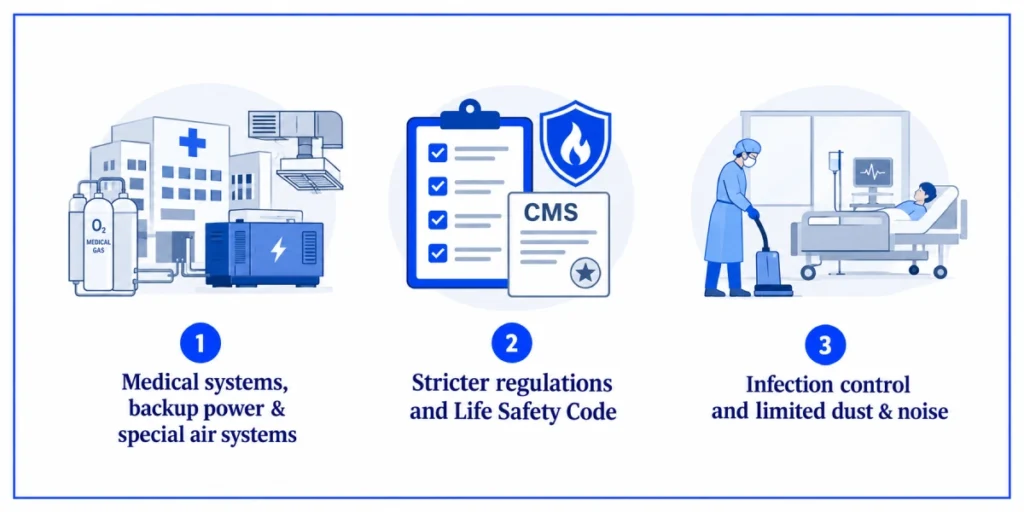
The rules are stricter, too. On top of the state reviews covered above, hospitals that take part in Medicare and Medicaid also have to meet a national fire safety standard, the Life Safety Code, under CMS rules.
Then there is infection control. On an expansion, crews can end up working right next to patients, so dust and noise have to stay under tight control. Naturally, that slows things down a little.
What Slows Down Hospital Construction Projects?
Some delays on hospital construction projects begin in the review process. Others come from building on an active campus, which is common. Revista found that roughly half of the hospital construction pipeline consists of expansions on existing hospitals. The usual causes are these:
- Incomplete submissions. The HFSRB review period counts from the date an application is complete, under 77 Ill. Adm. Code 1130.610. The IDPH comment period for final drawings also starts only once a submission is deemed complete, under Section 250.2420.
- Changes after approval. If a contract change alters what a space does or how it is designed, IDPH must approve it before crews go ahead. The department then has up to 30 days to reply under IDPH rules.
- Lapsed approvals. IDPH plan approval becomes void if construction contracts are not executed and construction has not started within one year of the approval date, under the same section. A stalled project can lose its approval this way.
- Work beside patients. During an expansion, the existing hospital keeps treating patients next door. Crews plan utility shutdowns and loud work around that care.
How to Shorten a Hospital Construction Schedule
Every Illinois hospital construction schedule has to include the state reviews. The time around those reviews can still be reduced. None of the steps below is free, though. Each one trades some cost or risk for time:
- Parallel Planning: Prepare the CON application alongside the functional program, since the review period starts only once the application is complete. The risk is paying for design before approval.
- Early State Feedback: Resolve code questions during the design development review, when IDPH comments arrive before final drawings, and changes cost less. The design gets fixed sooner, though.
- Design Freeze: Settle room layouts and major equipment choices before final drawings reach IDPH. Fewer late changes mean fewer mid-construction approvals, but clinical teams lose some flexibility.
- Off-Site Fabrication: Prefabricate where the design repeats. In Joplin, Missouri, a 140-bed hospital built with 60 to 80 percent prefabricated materials took six months to design and build, Bluebeam reported. Late changes get harder once factory work starts.
Frequently Asked Questions
A few schedule questions come up on almost every hospital project, usually in the first planning meetings. The short answers here are based on Illinois rules and on projects covered by news and trade outlets. Your own scope and site will set the real dates, so use these as a starting point.
Can a hospital really be built in 10 days?
Only in an emergency, and only as a temporary facility. Field hospitals can go up in days during a crisis, but a permanent hospital is really a different story. Between planning, approvals, construction, and inspections, it usually takes several years.
How long does a certificate of need approval take in Illinois?
It depends on the project. Simpler projects tend to move faster, and major ones get a longer review. Either way, plan for a few months between filing a complete application and the state’s final vote.
How long does it take to build a small hospital?
Even a small hospital usually takes a few years. The building itself goes up faster than a large tower, of course, but the approvals and inspections still apply, and those steps do not shrink much with size.
How much does it cost to build a hospital per bed?
There is no single number. Cost per bed depends on location and on the services and equipment the hospital needs. For that reason, early budgets should be based on local construction costs and a clear list of services.
How Long Does It Take to Build a Hospital?
A permanent hospital typically takes three to six years from initial planning to opening. The timeline depends on project size, design approvals, construction, inspections, and licensing.
Final Thoughts
Back to the original question, then: How long does it take to build a hospital? Plan on several years for a permanent facility. A good part of that time passes before construction starts. That said, Illinois does offer one real advantage: predictability. The deadlines sit right there in the state rules, after all. So you can tell, more or less, how long each review will take before the schedule is even drafted.
If a health care project is on your list, it is worth looking at the schedule early. A short review is usually enough to spot the dates the state has already fixed. Everything else is still yours to shape. And when you are ready to move forward, Epic Construction Management offers construction management that covers planning, budgeting, scheduling, and site oversight.