
The quality of the job and the cost depend on the general contractor. That’s why “how to choose a general contractor?” remains the first question when starting projects. It can also impact the amount of time required for the project. Many believe that the route to take is to hire the professional who offers the least expensive quote. Not all the lowest bids are best. This could cause sudden costs down the road, or a poor job.
Step 1: Define Your Project Scope & Priorities
Defining the project goal and priorities is the first thing before hiring the contractor. Otherwise, you’ll waste your time and money.
Establish Your Project Size, Budget, and Timeline
Before talking to anyone, write down exactly what you want to build. Determine your maximum budget and your ideal move-in date.
Identify Your Must-Haves and Priorities
Decide what matters most to you. Are you focused on sustainability and green energy? Do you want local materials? Is speed the most important factor, or are you willing to wait for high-end custom finishes? Knowing your priorities prevents the project from getting bigger and more expensive than planned.
Document Site Conditions and Project Constraints
Note any challenges the contractor will face. This includes limited parking for work trucks and strict Homeowners Association (HOA) rules. Or the fact that you will be living in the house during construction.
Step 2: Research & Build a Shortlist of General Contractors
The vast number of general contractors can confuse you. Research first. Go through local recommendations, google/website reviews, and recent projects.
Find Contractors Through Local Recommendations
Begin by asking friends, neighbors, or local architects who they trust. Local trade associations have membership lists of people in good standing within the community. You can find them in the directories.
Check Online Reviews and Contractor Reputation
Look at Google, the Better Business Bureau (BBB), and Yelp. Only star ratings don’t mean anything. Read the comments to see how the contractor handled complaints or delays. Check records of disciplinary actions with the state licensing board.
Review Portfolios and Similar Completed Projects
Look for a contractor who has done work like yours in the last 3 to 5 years. If you are building a modern restaurant, a contractor who only does traditional home kitchens may not be the right fit.
Visit Active or Recently Completed Job Sites
Ask to see a project currently under construction. A clean, organized job site where workers are wearing safety gear is a sign of a professional operation.
Narrow Your List to 3–5 Qualified Contractors
After initial research, pick the top five companies. This is a manageable number for the interview and bidding phase.
Step 3: Verify Licensing, Insurance & Financial Stability
Now that you’ve narrowed down your desired contractors to a handful of companies. The next step is to verify their authenticity. Look for license, insurance, and financial stability.
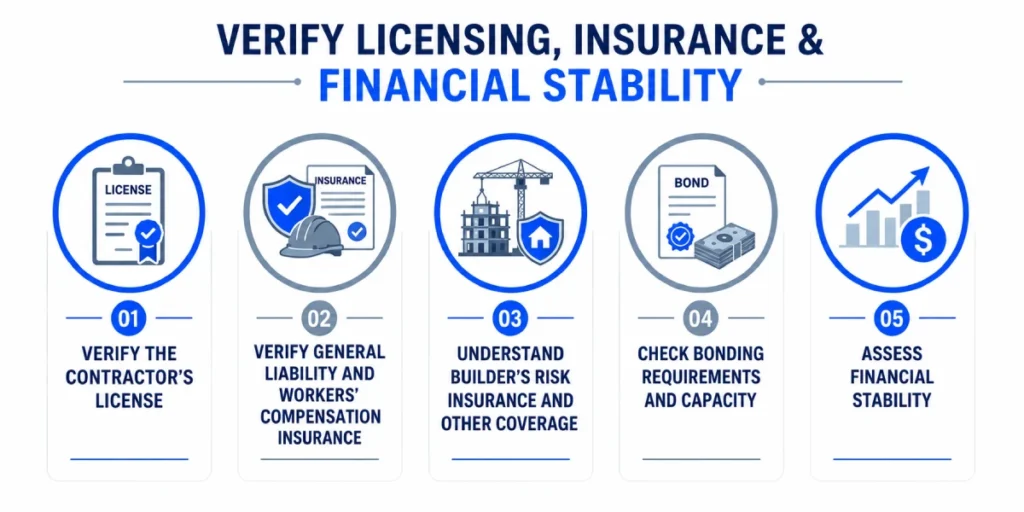
Verify the Contractor’s License
Ask for the contractor’s license number and check it against the state’s official database. Ensure the license is “active”. They must be authorized to do the specific type of work your project requires.
Verify General Liability and Workers’ Compensation Insurance
Never take a contractor’s word for it. Request a Certificate of Insurance (COI). Call the insurance agent listed on the paper to make sure the policy is still paid for and active. Liability insurance covers damage to your property. Workers’ compensation protects you if a worker gets hurt on your land.
Understand Builder’s Risk Insurance and Other Coverage
Builder’s risk insurance covers damage to a building under construction, such as from fire or storms. Clarify who will be paying for this specific policy.
Check Bonding Requirements and Capacity
For larger projects, a bond is a form of financial protection. It ensures the work gets finished even if the contractor goes out of business. A high “bonding capacity” is a trustworthy sign from a bank.
Assess Financial Stability
A stable contractor pays their bills on time. Ask for references from their material suppliers.
Step 4: Interview Contractors and Ask Strategic Questions
Interviewing the contractor needs strategy. Instead of asking basic ones, ask them these strategic questions to show their quality-
Ask How They Manage Construction Projects
Professional contractors often use project management software to track schedules and costs. You want to hear a clear plan, not a vague promise that they “know how to do it.”
Ask About Communication and Your Main Point of Contact
Who will you talk to every day? Sometimes the person who sells you the job is not the person present on the job site. Make sure you know who your daily contact is and how often you will receive updates.
Ask How They Select and Manage Subcontractors
A general contractor is only as good as the people they hire. Ask if they use the same subcontractors regularly. Long-term relationships usually mean better quality and more reliable construction scheduling.
Ask About Their Current Workload
If a contractor has 20 active projects and only two crews, your project will likely face delays. Ensure they have the manpower to commit to your specific timeline.
Ask How They Handle Problems and Change Orders
An example of a past problem and how they fixed it is helpful. A “change order” is the paperwork used when the plan changes. Ask about the cost and documentation so you aren’t surprised by the final bill.
Ask About Permits, Codes, and Compliance
The contractor should handle the permit process and schedule all inspections. Be wary of any contractor who asks you to pull the permits. This makes you legally responsible for any mistakes.
Ask About Warranties and Post-Construction Service
What happens if a pipe leaks six months after the project is done? Ask for a written labor warranty and copies of material warranties for things like roofing or appliances.
Step 5: Check Contractor References
Cross-check the contractor reference for full verification. Their recent client have more information and reviews than anyone else.
Speak With Recent Clients
Talk to people who had work done in the last two years. This gives you the most accurate picture of how the contractor’s current crew and office staff operate.
Visit a Recent Project When Possible
Seeing the finished product in person allows you to check the “fit and finish.” Look at the corners, the paint lines, and the tile spacing to see if they meet your quality standards.
Step 6: Request, Decode & Compare Contractor Bids
Now you have a solid contractor list with you. Check the bids, compare them, and avoid choosing the cheapest one.
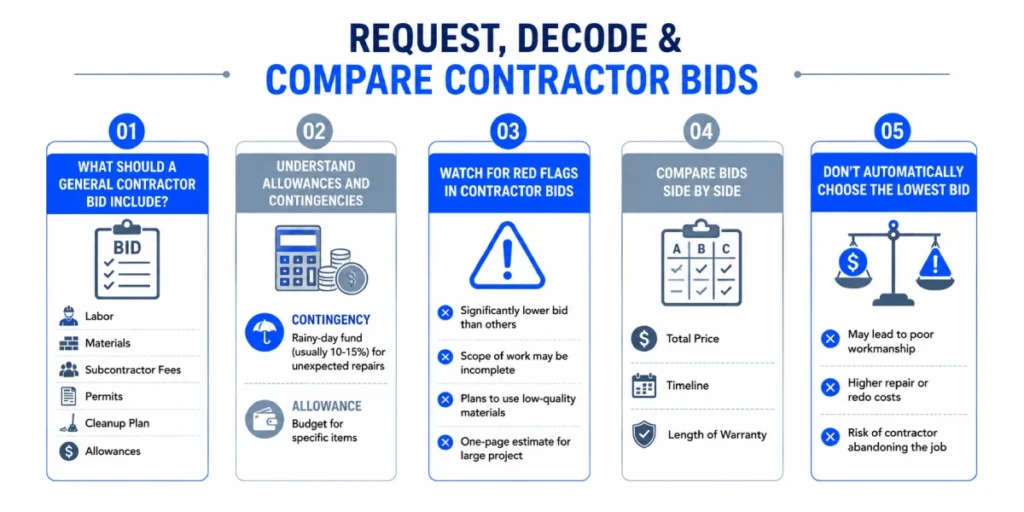
What Should a General Contractor Bid Include?
A professional bid should be itemized. It must list labor, materials, subcontractor fees, permits, and a cleanup plan. It should also include “allowances”. Set amounts of money for things you haven’t picked out yet, like faucets or flooring.
Understand Allowances and Contingencies
A “contingency” is a rainy-day fund (usually 10-15%) for unexpected repairs. An “allowance” is a budget for specific items.
Watch for Red Flags in Contractor Bids
Be careful if a bid is significantly lower than others. This often means the contractor missed something in the scope of work or plans to use low-quality materials. A one-page estimate for a large project is also a sign of potential trouble.
Compare Bids Side by Side
Use a simple chart to compare the 3-5 bids. Look at the total price, but also look at the timeline and the length of the warranty.
Don’t Automatically Choose the Lowest Bid
The cheapest contractor might be the most expensive in the long run. There is a chance they do poor work that needs fixing, or they abandon the job halfway through.
Step 7: Assess Contractor Fit, Communication & Professionalism
Another step to selecting the perfect general contractor is their professionalism and behavior.
Take Note of How They Communicate
Taking a week to return a phone call before you hire them. They will likely be even slower once they have your money. Look for someone who explains things without using confusing jargon.
Look for Behavioral Red Flags
Walk away if a contractor pressures you to sign a contract immediately. Or tells you that a permit isn’t necessary. If they are dismissive of your questions now, they will not listen to your concerns during construction.
Step 8: Review, Negotiate & Sign the Construction Contract
You’ve got your general contractor. Now it’s time to sign the contract. But first, review and negotiate for your benefit.
Detailed Scope of Work
The contract should describe exactly what is being built. If it isn’t in writing, don’t expect it to happen.
Review the Project Cost and Payment Schedule
Never pay for the whole project upfront. Project cost management is important when setting a payment schedule. A typical schedule includes a small deposit, followed by “progress payments” after reaching specific milestones, such as finishing the foundation or framing.
Define the Change-Order Process
The contract must state that no extra work will be paid for unless it is approved by you in writing first. This prevents the price from ballooning without your permission.
What to Do After Hiring a General Contractor
Once you sign the contract, hold a kickoff meeting to introduce everyone involved. Document the current state of your property with photos. In this way, you have proof if damage occurs during construction. Establish a regular day and time for a weekly progress meeting so you stay informed.
General Contractor Red Flags: When You Should Walk Away
- No current license or insurance.
- Asking for more than 10-25% as a down payment.
- Refusing to provide a written contract.
- Telling you to get your own building permits.
- Bidding way lower than everyone else.
Choosing a General Contractor for Commercial vs. Residential Projects
Hiring a general contractor for commercial and residential projects is not the same.
Take a look at how these differ-
Residential Focus
For a home project, you need someone who understands how to work around families and pets. They must be experts in residential building codes and HOA rules.
Commercial Focus
Commercial contractors must handle much larger crews and more complex systems. Like industrial heating and cooling. They also deal with strict fire safety codes and accessibility laws (like the ADA).
Pick the Right Contractor: Selection Checklist
- Relevant experience
- Current license
- Liability insurance
- Workers’ compensation
- Bonding
- Strong references
- Recent portfolio
- Site visit
- Detailed estimate
- Clear timeline
- Communication plan
- Qualified subcontractors
- Detailed contract
- Change-order process
- Warranty
- Overall project fit
Frequently Asked Questions
Are general contractors cheaper than doing it myself?
While you save on the management fee, DIY often costs more. Rookie mistakes, lack of professional tools, and the work fails inspection most of the time.
How to Choose a General Contractor in My Area?
Search local directories, ask for referrals from local hardware stores, or check the member list of your local Home Builders Association.
How do I find a licensed contractor?
Visit your state’s Department of Professional Regulation website. You can search by the company name or the individual’s name to see their license status.
When should I hire a general contractor?
Hire a general contractor as soon as you have a basic plan or blueprints. Bringing them in early can help you avoid designs that are too expensive to actually build.
What should I know when hiring a general contractor?
Know that communication is just as important as building skill. You will be working closely with this person for months, so trust and transparency are vital for a successful project.