
That new building down the road has probably been under scaffolding for months. There is a reason for that. Construction labour productivity has grown about 1% a year over two decades, against 2.8% for the wider world economy. So construction delays are not a run of bad luck. Most of them trace back to decisions made long before the first crew showed up, in the planning, construction management, and the ordering. This piece lays out what a project delay actually is. What sets one off. And what to do once the schedule starts slipping.
What Is a Delay in Construction?
Put simply, a delay in construction is any stretch where the work wraps up later than the contract date. Simple enough. The real question is who caused it. That is what settles who pays and who gets extra time. A construction project delay usually falls into one of four types, and most contracts lean on those same labels.
Contract administrators and courts sort delays before anyone argues about money. The categories below come from the Society of Construction Law’s Delay and Disruption Protocol, the reference most delay clauses echo.
| Type of delay | What it means | Typical outcome |
| Excusable | Beyond the contractor’s control, such as owner changes | More time granted |
| Non-excusable | The contractor’s own fault, such as thin manpower | No extra time; damages may apply |
| Compensable | An excusable delay the owner caused | More time and money |
| Concurrent | An owner delay and a contractor delay overlap | Time usually yes, money often disputed |
(Treat these as general buckets, not legal advice. Your own contract spells out its terms, and that wording is what really decides the outcome.)
The Common Causes of Construction Delays
No two late projects fail the same way. One review of 17 delay studies across 15 countries sorted the causes of construction delays by who triggers them: the owner, the contractor, or something outside both. Start there, with the source, because the fix shifts depending on it. These are the reasons for construction delays that show up most.
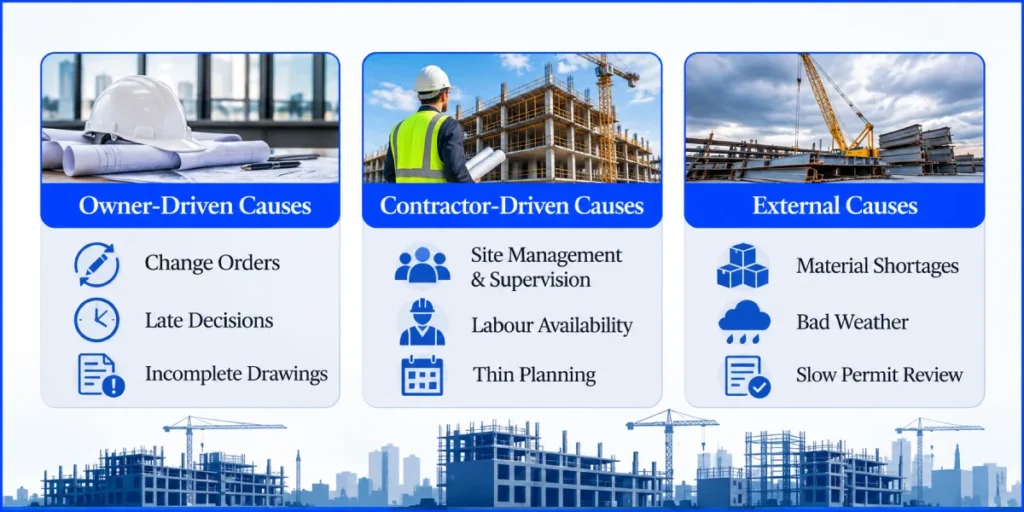
Owner-Driven Causes
Change orders top the list. That same review found change orders towered above every other owner-side cause. Once a design is signed, every change to it resets the buying and the sequencing underneath. Late owner decisions and half-finished drawings do the same, and fast-track jobs feel it worst. The cheapest moment to catch all this is back in preconstruction, before the scope and budget harden.
Contractor-Driven Causes
On the contractor’s side, site management and supervision rank first, then labour availability. Underneath both sits thin planning. You can have every worker on site and still lose a week when the sequence is off, or when the next trade shows up to an area that is not ready for them. Loose cost control adds to it. A shaky construction estimate forces rework the moment real prices come in.
External Causes
Some causes of delay sit outside anyone’s direct control. Material shortages are the big one, called by far the most significant external cause in the same study. Long-lead gear makes that sting more. Switchgear and rooftop units can take months to show up, so they need a spot on the schedule from the first week. Add bad weather and ground nobody expected, and the list grows. A slow permit review can even hold up a start before the first day on site.
How to Handle a Construction Project Delay
Once a job slips, what you do next counts as much as what went wrong. How to handle a construction project delay really comes down to a few habits. Write it down. Measure it against the critical path. Then act before it reaches the next trade. That same routine answers how to deal with construction site delays the moment they land in the field.
A delay you have recorded and measured is one you can either claw back or defend later. The steps below keep how to deal with construction delays from hardening into a dispute:
- Send written notice as soon as the delay appears, the way the contract asks.
- Update the schedule so the slip lands against the critical path, not in a note somewhere.
- Log it daily: crew counts, weather, what got delivered, and photos.
- Put a number on the impact, and split owner-caused time from your own.
- Settle on a recovery plan before the next trade feels it.
How to Avoid Project Delays
Most blown schedules trace back to calls made before anyone broke ground. So how to avoid project delays is mostly about front-loading the work that owners like to rush past. A job that ends up late almost never falls apart in the field first. They fail in planning, and a capable general contractor builds that planning in.
This is where the schedule actually gets protected, well before any crew mobilises:
- Base the schedule on how long jobs like yours really run, not bid-day hope.
- Order the long-lead gear during preconstruction, not once permits are in hand.
- Keep a three to six week look-ahead going, so field problems show up early.
- Check crew and subcontractor availability against every other job you have running.
Delay and Disruption Analysis and Delay Assessments
When a delay becomes a claim, opinion stops mattering, and method takes over. Delay and disruption analysis is the forensic look at what truly pushed the finish date out, and construction delay assessments turn that into a number you can defend. Two standards steer the work: AACE International’s Recommended Practice 29R-03 and the SCL Protocol.

Which method fits depends on the records you have. Impacted as-planned inserts the delay event into the baseline to model its effect. Time impact analysis does the same against the schedule update closest to the event. Windows analysis compares planned against as-built over set periods. There is no single right pick here, and AACE 29R-03 itself backs no one method over the rest.
FAQs
Most of these come up before a contract is even signed, and a few again once a job starts to slip. Here are straight answers to the ones owners raise most.
Why is construction so slow?
Partly because the industry has barely sped up. Its output per worker has inched up about 1% a year for two decades, while the rest of the economy managed 2.8%. And every job runs on one critical path. Dozens of trades, a design drawn from scratch, weather, parts that take months to arrive (all of it feeds that single line). When one thing slips, whatever sits behind it slips too.
What are the most common construction delays?
The common construction delays are a short, familiar list. Change orders. Shortages of materials and equipment. Shaky site supervision. Crews stretched too thin. New home construction hits most of the same walls, just on a smaller scale. What sets commercial and institutional work apart is the heavier procurement and permitting load riding on top.
Who pays for a construction delay?
That comes down to the type. If the owner caused it and it counts as excusable and compensable, the contractor can recover both more time and more money; if the contractor caused it, usually neither. Concurrent delays, where both sides contribute, are where most disputes land.
How is a delay measured in a claim?
Through a construction delay assessment that follows a recognised method, usually time impact analysis or a windows analysis. But the method matters less than the paperwork behind it. Clean daily records, current schedule updates, notices sent on time (those usually decide how it lands).
Final Thoughts
A construction project delay is seldom one big event. More likely, it stacks up quietly. A change order. A switchgear lead time nobody checked. A rainy week that never made it into the log. Effective construction management helps owners stay on schedule by treating planning as the real work, not just the fieldwork.
Catch the small things early, and they stay small. For institutional work around Schaumburg and the Northwest suburbs, Epic Construction Management builds that habit in from the first budget review.